
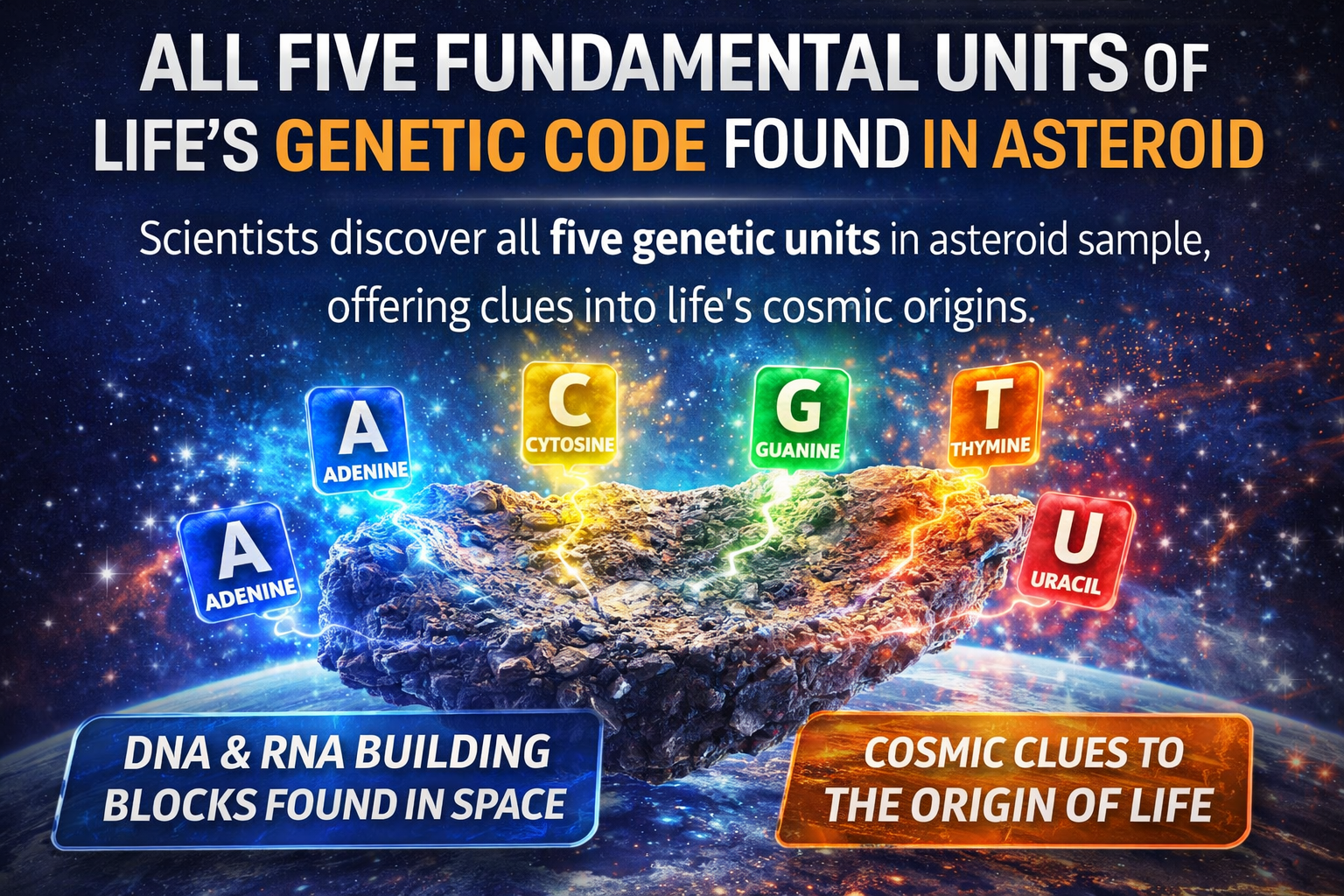
In a stunning breakthrough that could redefine our understanding of life’s origins, scientists have discovered all five fundamental nucleobases of DNA and RNA in a sample from the asteroid Ryugu. The finding, recently reported by an international team of researchers, provides the first evidence that the complete set of building blocks for life can form naturally in space, offering strong support to the theory that life on Earth may have been seeded by extraterrestrial materials.
The Significance of Nucleobases
Nucleobases are the chemical compounds that make up the letters of life’s genetic code. In DNA and RNA, these molecules—adenine, guanine, cytosine, thymine, and uracil—pair in specific ways to store and transmit genetic information. While previous studies had detected individual nucleobases in meteorites and space dust, the presence of all five canonical nucleobases in a single asteroid is unprecedented. This discovery provides a direct link between extraterrestrial chemistry and the molecules essential for life.
Dr. Hiroshi Tanaka, lead author of the study from the University of Tokyo, emphasized the importance of the finding: “Detecting all five nucleobases in Ryugu demonstrates that the fundamental ingredients of life are not unique to Earth. This suggests that the building blocks of life may be widespread throughout the cosmos, potentially delivered to Earth via asteroids or comets.”
Methodology: Ensuring Extraterrestrial Origin
The Hayabusa2 mission, led by the Japan Aerospace Exploration Agency (JAXA), retrieved samples from Ryugu in 2020, returning them to Earth under rigorously controlled conditions. Researchers analyzed the samples using ultra-high-performance liquid chromatography coupled with mass spectrometry (UHPLC-MS), a technique capable of detecting trace concentrations of organic molecules with exceptional precision.
To confirm that the nucleobases were genuinely extraterrestrial and not introduced during sample handling, the team conducted isotopic analysis. The nucleobases were enriched in heavy nitrogen isotopes, a clear signature of space formation. Additionally, stringent laboratory protocols and contamination controls were applied to rule out terrestrial origins. This rigorous approach confirms that the detected molecules were native to the asteroid and formed naturally in space.
Implications for the Origins of Life
The discovery lends strong support to the panspermia hypothesis, which suggests that life—or at least its molecular precursors—can be transported across space via asteroids, comets, or meteorites. The idea that the molecular ingredients for life are not exclusive to Earth has profound implications for understanding how life emerged. It suggests that the chemical foundation for life could exist throughout the solar system and potentially across the galaxy.
Astrobiologists have long debated whether the complex molecules needed for life formed independently on Earth or arrived from space. The Ryugu sample provides compelling evidence that at least some of these molecules originated extraterrestrially. If asteroids carried nucleobases to Earth during the early solar system, they could have jump-started prebiotic chemistry, reducing the timescale and complexity required for life to emerge.
Dr. Sarah Mitchell, a senior astrobiologist at NASA who was not involved in the study, remarked, “The finding of all five nucleobases in a single asteroid is extraordinary. It demonstrates that the molecular foundation for life can form under space conditions and survive delivery to a planetary surface. This discovery fundamentally expands our understanding of life’s cosmic origins.”
The Chemistry of Space: How Nucleobases Form
The asteroid Ryugu is a carbon-rich, primitive body believed to have remained relatively unchanged since the formation of the solar system. Within such environments, complex organic molecules can form through chemical reactions driven by ultraviolet radiation, cosmic rays, and simple precursor compounds such as ammonia, water, and carbon monoxide.
The study suggests that the nucleobases on Ryugu formed naturally in space, likely within interstellar ice or on the asteroid’s surface, and remained stable over billions of years. The coexistence of all five canonical nucleobases in a single fragment indicates that space chemistry can produce the full set of molecules necessary for genetic systems, even before they encounter a planetary environment capable of supporting life.
Broader Implications for Astrobiology
This discovery not only illuminates the origins of life on Earth but also has profound implications for the search for life elsewhere. Planets and moons with suitable conditions—such as Mars, Europa, and Enceladus—may have received similar molecular building blocks from comets or asteroids. These nucleobases could serve as precursors to RNA or DNA-like molecules, making life elsewhere more plausible than previously considered.
Moreover, understanding how nucleobases form in space may help scientists design future experiments to simulate prebiotic chemistry. Laboratory studies can now test how these molecules might polymerize into longer chains under different conditions, bridging the gap between simple molecules and complex, self-replicating systems capable of supporting life.
The Ryugu discovery also reinforces the importance of sample-return missions in astrobiology. While remote sensing and meteorite analysis have provided insights into extraterrestrial chemistry, direct samples allow for the precise, contamination-free analysis required to identify subtle molecular signatures. As a result, ongoing and future missions—such as NASA’s OSIRIS-REx and proposed Europa and Titan sample-return programs—could reveal whether these molecular processes are widespread in the solar system. They underscore that life’s molecular foundations are not confined to Earth, suggesting a universe more chemically predisposed to life than previously believed. As a science editor, I am struck by how the discovery blends meticulous technical achievement with profound philosophical implications: the molecules that define life on Earth may have cosmic origins, hinting at a universal chemistry that transcends planetary boundaries.
The meticulous analytical work also highlights the importance of patient, high-precision science. The Hayabusa2 mission spanned over a decade, with years devoted to sample collection, return, and laboratory analysis. The payoff—a discovery that reshapes our understanding of life’s origins—demonstrates the extraordinary potential of sustained scientific effort and international collaboration.
Additionally, the discovery emphasizes the role of curiosity-driven research. Detecting nucleobases in a space rock may have seemed a niche pursuit a few decades ago, yet it now provides one of the clearest windows into the molecular pathways that could lead to life anywhere in the universe. It reminds us that some of the most profound insights in science come from exploring the unexpected, guided by curiosity and rigorous methodology.
Conclusion
The identification of all five nucleobases in an asteroid sample represents a major milestone in astrobiology and the study of life’s origins. The finding confirms that the molecular building blocks for life can form naturally in space and survive delivery to planetary surfaces. This discovery strengthens the case for extraterrestrial contributions to life on Earth and suggests that the ingredients for life may be widespread throughout the cosmos.
While many questions remain—particularly regarding how these nucleobases might assemble into functional RNA or DNA polymers—the Ryugu sample provides a concrete foundation for future research. Scientists can now explore the chemical pathways that lead from simple extraterrestrial molecules to complex, self-replicating systems capable of sustaining life.
Ultimately, the discovery reminds us that life may be more than an Earth-bound phenomenon. The cosmos may not only harbor the potential for life but may have actively contributed to its emergence here. As we continue to explore the solar system and beyond, each asteroid, comet, and planetary sample could hold critical clues about life’s universal chemistry, suggesting that humanity is part of a much larger, interstellar story.