
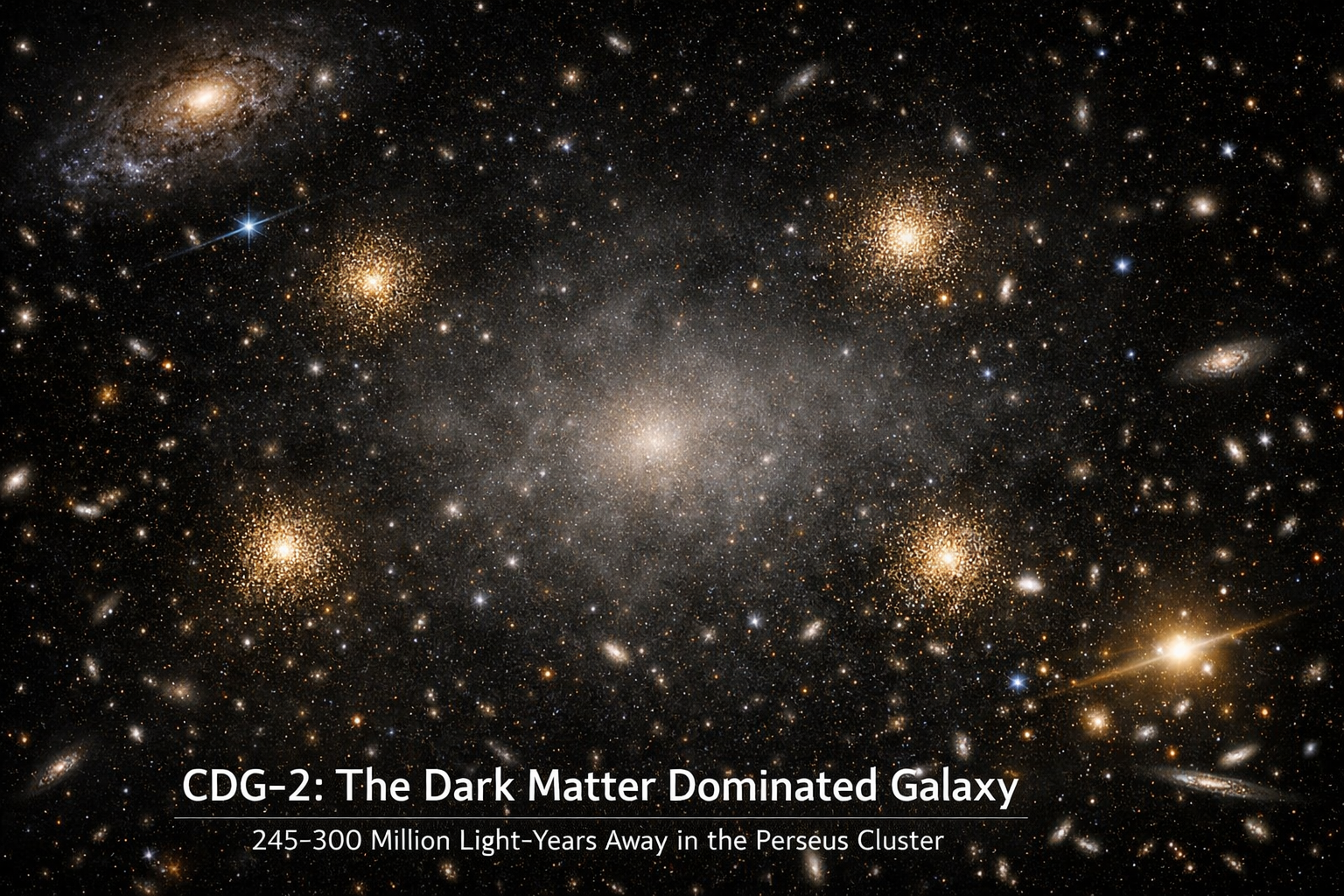
In a spectacular discovery that sheds some light on one of the most profound mysteries of the Universe, it was found that the astronomers have discovered what is perhaps one of the most dark matter-laden galaxies ever discovered, the object being so faint that it emits very little light and was only identified thanks to its surrounding star clusters. The galaxy, which is also called the Candidate Dark Galaxy-2 or CDG-2, seems to be practically a collection of the dark matter, with the normal stars only a small part of the whole mass. The discovery, which was made after careful studying of the photographs taken by some of the strongest telescopes in the world, may alter the minds of scientists on how galaxies develop and evolve within the cosmic web.
The CDG-2 is located about 245 to 300 million light-years away in the Perseus galaxy cluster, in the constellation Perseus, and was discovered using the new method which did not observe the starlight of the galaxy, but rather the globular clusters, or masses of old stars orbiting what otherwise would be a dark hole in space. Such clusters are considered as cosmic breadcrumbs that point towards a concealed structure that is mainly composed of an unseen gravitational mass. The discovery was based on the result of data of NASA Hubble Space Telescope, the European Space Agency-Euclid mission, and Japan Subaru Telescope combined to show a scattered thin halo of light surrounding the clusters, which means that there exists an underlying galaxy.
What Makes CDG-2 Extraordinary
Unlike typical galaxies that shine with the light of billions or even trillions of stars, CDG-2 barely glows. Early measurements suggest its total luminosity is equivalent to about six million Suns—far dimmer than most galaxies we observe. The four globular clusters used in detecting that faint light contribute very little, say about 16 percent of it. The remainder of the luminance is so diffused about the galaxy that it was almost completely ignored. What is really amazing though about CDG-2 is its mass composition: it seems that some 99 percent or more of its mass is its dark matter, matter, which does not emit, absorb or reflect light and can only be known by its gravitational influence on noticeable objects.
Even the dark matter is still one of the most mysterious aspects of the world. In the current cosmological theories, it can be stated that the dark matter is approximately 27 percent of the total energy density of the Universe and approximately 85 percent of its mass. It is very instrumental in the creation of galaxies and massive structures because it has the ability to exert gravity that causes the normal matter to clump. However, since the dark matter does not produce or interact with light, astronomers can only detect it indirectly usually by the effect it has on the movements of stars and galaxies or, as with CDG-2, by the existence of globular clusters that outline the otherwise invisible mass.
How CDG-2 Was Found
CDG-2 was not discovered through the crude eye observation of the brightsome stars or gas clouds. Rather, scientists applied a statistical method to discuss the existence of archival Hubble images of an abnormally high concentration of globular clusters in the Perseus cluster. These hives, as they were generally around very large galaxies, were considerably concentrated in a single area where no bright galaxy had ever been listed before. A follow up study involving Euclid and Subaru also produced a faint halo of diffuse light surrounding these clusters indicating that these were indeed part of a galaxy instead of random clumps of star clusters. This plan is a new way of detecting the galaxy, and it detects the objects which can barely be seen in the conventional surveys.
This is important since it is the first galaxy to be identified as a result of its population of globular clusters only. The ability of observing the galaxies indirectly through their indirect markers instead of observing them directly through starlight will result in opening new opportunities to observe other dark galaxies that have not been seen in decades. It suggests that our cosmic census of galaxies may be missing a hidden population, especially in dense environments like galaxy clusters where gravitational interactions can strip ordinary matter away.
The Role of Dark Matter in Galaxy Formation
The existence of galaxies like CDG-2 deepens the mystery of dark matter’s role in shaping the cosmos. Standard models of galaxy formation envision dark matter halos acting as gravitational scaffolding around which gas collapses to form stars and galaxies. In most galaxies, visible matter—stars, gas, and dust—accounts for a small but measurable portion of the total mass, with dark matter providing the dominant gravitational framework. CDG-2, however, appears to be an extreme case where star formation was severely suppressed or the gas that would have formed stars was stripped away, leaving a skeletal galaxy dominated by dark matter.
Astronomers believe that much of the normal matter needed to form stars—primarily hydrogen gas—may have been lost through gravitational interactions with other galaxies in the crowded environment of the Perseus cluster. This stripping process could leave behind a dark matter–rich halo with only a handful of star clusters showing its presence. The result is a galaxy that behaves dynamically like a typical galaxy under the influence of gravity but lacks the luminous matter that makes galaxies visible across the Universe.
The idea that dark matter can dominate a galaxy to such an extreme level has profound implications for astrophysics. CDG-2 provides an unusual natural laboratory for testing theories of dark matter and galaxy evolution. In particular, it allows astronomers to study how dark matter mass relates to visible tracers like star clusters, and whether current models of galaxy formation need to be revised to account for such extreme cases.
Scientific Significance and Future Research
This discovery is more than a cosmic curiosity—it challenges astronomers to rethink assumptions about the distribution of matter on galactic scales. If galaxies can exist with almost no visible matter, it suggests that dark matter may clump and hold galaxies together even when stars are absent or very sparse. This could illuminate aspects of dark matter physics that are not accessible through ordinary galaxies where visible matter dominates observational signatures.
Furthermore, detecting CDG-2 hints at the possibility of discovering other similar galaxies in different clusters or even closer to Earth. Surveys that combine deep imaging with statistical techniques for identifying globular cluster associations could uncover additional dark matter–dominated systems. Confirming and studying more dark galaxies will help scientists understand how common these objects are, how they evolve, and what they can tell us about the nature of dark matter itself.
The implications extend to cosmology as a whole. Dark matter is believed to influence not just galaxies but the large-scale structure of the Universe, including galaxy clusters, filaments, and voids. A more complete inventory of dark galaxies could refine measurements of dark matter distribution and density, improving models of cosmic evolution since the Big Bang.
This is not merely a story about another galaxy; it is a story about how astronomers are developing innovative methods to uncover objects that defy traditional detection techniques.
It is also a reminder that much of the Universe remains unseen. Galaxies like our Milky Way, with its billions of stars and glowing nebulae, are only the most familiar examples of cosmic structures. There may be countless more systems like CDG-2—nearly invisible, yet fundamental to understanding how matter, both visible and invisible, organizes itself on the grandest scales.
This discovery underscores the value of continued investment in observatories like Hubble, Euclid, and Subaru, which together provide the depth, resolution, and complementary perspectives needed to reveal these hidden cosmic phenomena. As new generations of telescopes, such as the upcoming Nancy Grace Roman Space Telescope and next-generation ground observatories, come online, the potential for uncovering more dark galaxies will only increase.
Conclusion: A New Frontier in Dark Matter Research
The identification of Candidate Dark Galaxy-2—a galaxy made almost entirely of dark matter—is not just a fascinating astronomical find; it is a scientific milestone that opens new frontiers in the study of dark matter, galaxy formation, and the unseen Universe. By using innovative detection methods and international collaboration across multiple observatories, astronomers have peeled back another layer of cosmic mystery.
As scientists continue to explore the cosmos with increasingly sophisticated tools and techniques, discoveries like CDG-2 remind us that the Universe still holds surprises that challenge our understanding and inspire deeper inquiry. In the quest to illuminate the dark Universe, this ghostly galaxy stands as both a mystery and a guidepost, pointing the way to new discoveries and deeper knowledge about the fabric of reality itself.