
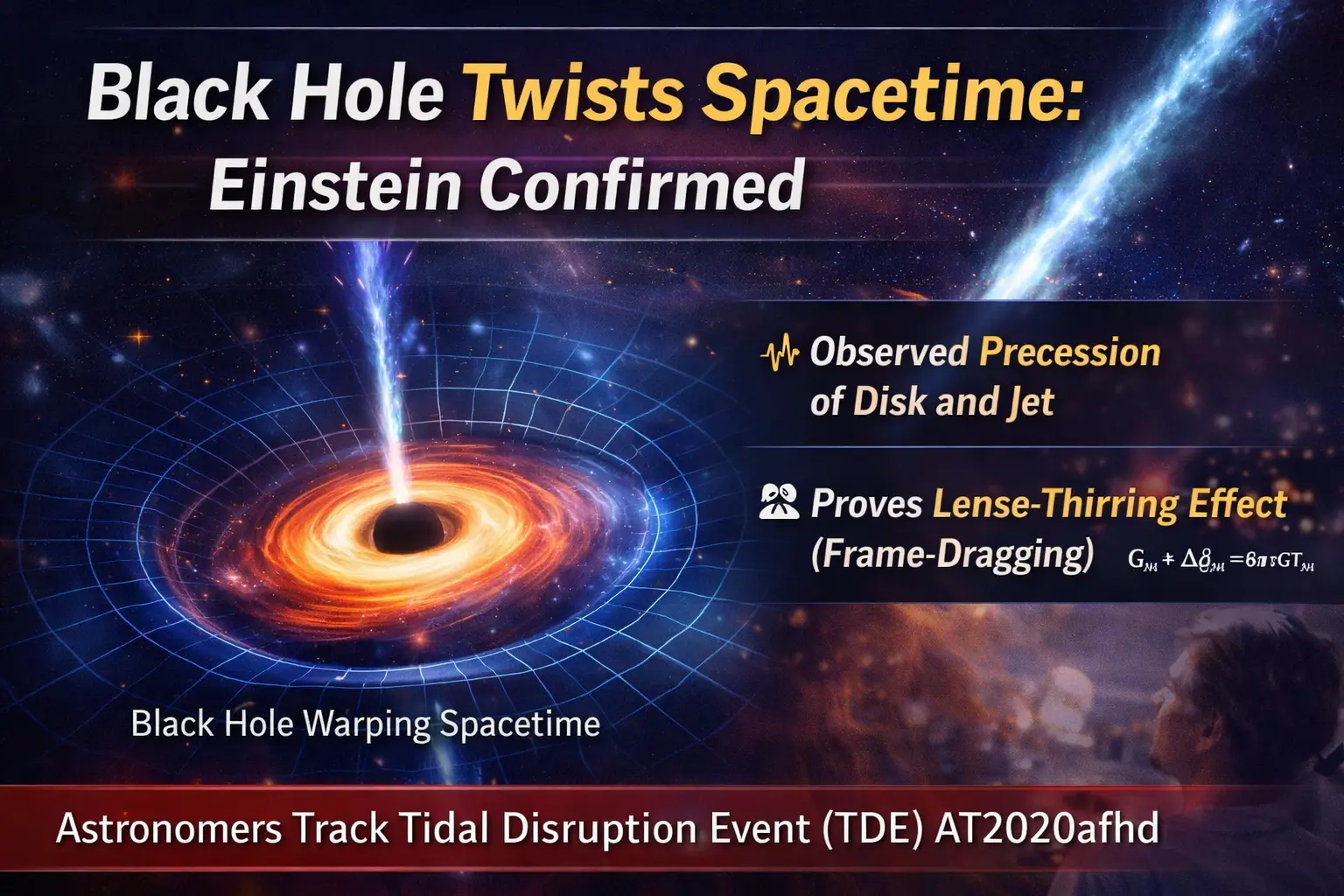
Astronomers say they have for the first time caught a spinning black hole physically twisting the fabric of spacetime around it — a phenomenon long predicted by Einstein and formally described by Josef Lense and Hans Thirring in 1918. The signal comes from a tidal disruption event (TDE) — the violent shredding of a star that wandered too close to a supermassive black hole — designated AT2020afhd. The international team tracked a tightly synchronized wobble in both X-ray and radio emission that repeats on a roughly 19.6–20-day cycle, a behavior best explained by Lense-Thirring (frame-dragging) precession of the disk and jet anchored to the black hole.
The observation grew out of long-term, multiwavelength monitoring of AT2020afhd. High-cadence X-ray measurements from NASA’s Neil Gehrels Swift Observatory and radio monitoring with the Karl G. Jansky Very Large Array (VLA) revealed a striking, regular “beat” — the X-ray flux rose and fell by more than an order of magnitude and the radio echoed that variation on the same cadence. That lock-step rhythm strongly suggests a single physical driver: the precession of the inner accretion disk and the relativistic jet as the black hole’s spin drags nearby spacetime.
What the team saw
The published analysis reports quasi-periodic variations with a period of 19.6 days. Models that include Lense-Thirring torques — relativistic frame dragging produced by a rotating mass — reproduce the amplitude and phasing of the X-ray and radio signals when applied to a disk-and-jet geometry misaligned with the black hole’s spin axis. In short, the disk precesses like a wobbling top, and the jet, anchored to the inner disk, precesses with it. Those coupled motions produce the observed synchronous pulses. The results, reported in Science Advances, represent the clearest direct evidence to date of disk-jet co-precession caused by frame-dragging in a TDE.
Why this matters
General relativity predicts that a rotating mass drags spacetime around with it; the effect is tiny around ordinary bodies and famously difficult to measure even near Earth (where experiments such as Gravity Probe B provided limited confirmation). Around a fast-spinning black hole, however, the effect becomes measurable in the dynamics of accreting matter and launched jets. Demonstrating disk-jet co-precession gives astronomers a new observational handle on black hole spin, the geometry of disk formation after a tidal disruption, and the physical link between inner-disk physics and jet launching. The finding therefore provides both a test of relativistic gravity and practical insight into how black holes power some of the universe’s most dramatic fireworks.
How the analysis was done
The research combined dense, long-term X-ray light curves with a campaign of high-cadence radio observations. The authors used time-series techniques to identify the periodicity, then fit physical precession models that account for disk viscosity, the gravitational torque from the spinning hole, and the way emission from the disk and relativistic shocks in the jet map onto observed X-ray and radio light. Importantly, the X-ray variations were not mirrored by smooth thermal cooling or single-pulse flares; they exhibited a repeatable pattern, making instrumental or local environmental explanations unlikely. The matched radio response — which arises much farther out along the jet — is the smoking gun linking disk motion to jet orientation.
Caveats and uncertainties
No single observation is the final word. The precession model fits the data well, but alternative mechanisms — such as binary companions, clumpy fallback streams from the disrupted star, or complex jet-medium interactions — can in principle produce variability. The authors argue convincingly that those alternatives either fail to reproduce the synchronicity between X-ray and radio or require contrived parameters. The team’s best-fit models even favor a relatively low black hole spin to reproduce the observed timescale, a result with implications for black hole growth histories that will need testing across more TDEs. arXiv+1
Broader implications
If frame-dragging signatures can be systematically observed in other TDEs, astronomers will gain a new, relatively direct method for measuring black hole spin and disk alignment. That matters because black hole spin influences how efficiently accretion converts mass into energy and how strongly jets can be launched — both central questions for high-energy astrophysics, galaxy evolution, and the feedback processes shaping star formation. The finding also underscores the value of coordinated multiwavelength surveys and rapid follow-up: sustained, high-cadence monitoring made this detection possible.
What’s next
Researchers will now look for similar quasi-periodic signatures in archive data and in future TDEs. Improvements in radio monitoring cadence and deeper X-ray coverage will increase the chance of catching disk-jet precession early. Complementary tools — optical spectropolarimetry, very-long-baseline interferometry (VLBI) to image jet orientation, and higher-energy X-ray spectroscopy — could reveal how the precession evolves and whether the same mechanism appears across the TDE population.
Editor’s take (from an experienced news editor)
This is the kind of discovery that functions on two levels: it’s both a dramatic confirmation of a subtle prediction of general relativity and a pragmatic advance for observational astrophysics. Frame-dragging is conceptually elegant but observationally elusive; showing it at work around a supermassive black hole brings the textbook math into the real universe in a compelling way. The study’s strength comes from its multiwavelength choreography — X-ray and radio teams watching the same cosmic heartbeat — and from clear, modelable periodicity rather than a single ambiguous flare. That said, the door is now open for follow-up skepticism and refinement: astrophysics progresses by reproducing such signatures across different systems and by subjecting models to falsification. If future TDEs show comparable disk-jet synchronization, we’ll have moved from a landmark single detection to a robust empirical tool for probing black hole spin, accretion geometry, and jet physics. For readers: this isn’t abstract math anymore — it’s watching spacetime being stirred like a cosmic spoon