
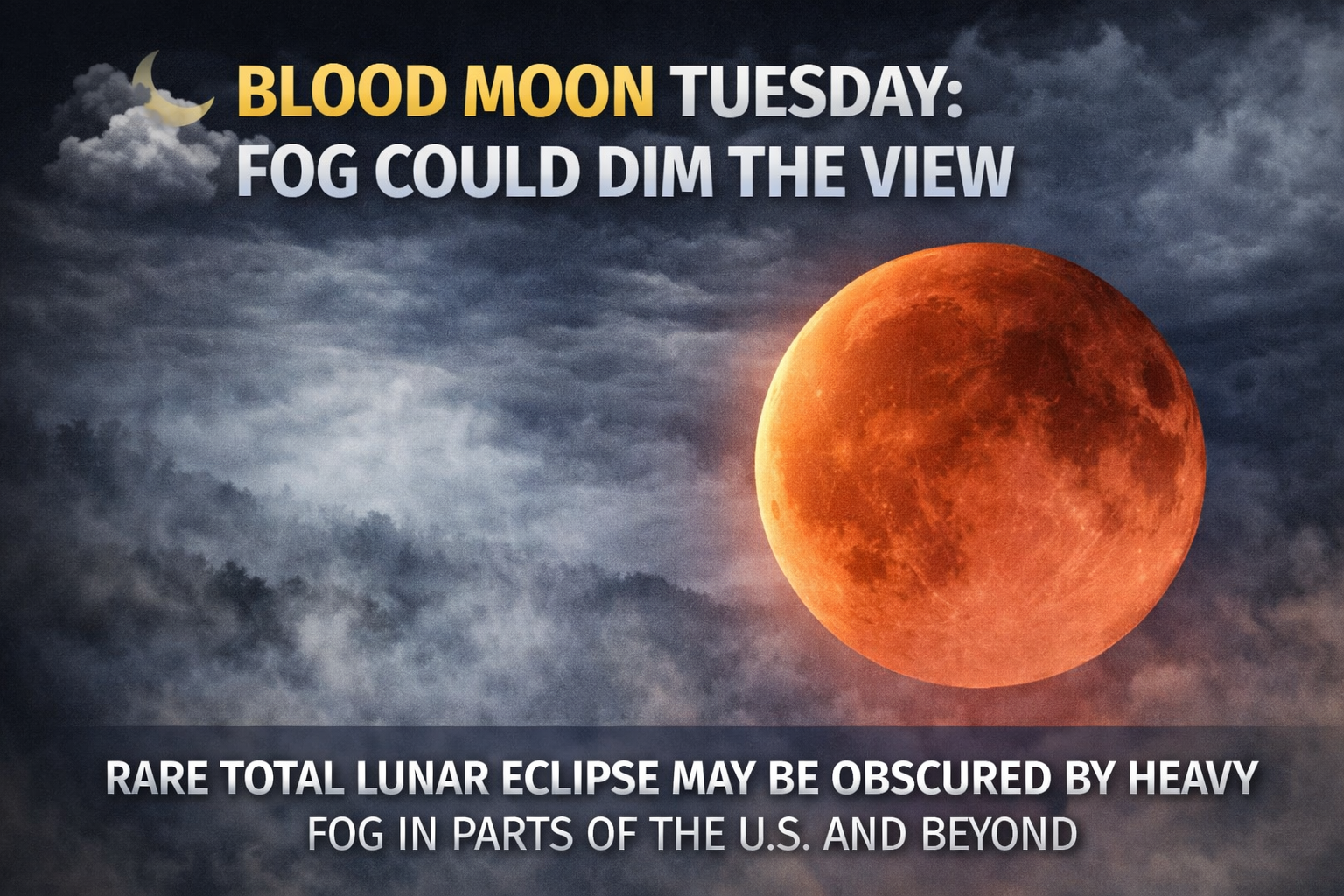
Early in the morning on Tuesday, there will be a rare astronomical phenomenon on the night sky, and the natural satellite of the earth will experience a total lunar eclipse, also known as a Blood Moon. When the earth comes between the moon and the sun, the effect happens and it throws its shadow on the surface of the moon, giving it a deep shade of reddish color. To the eyes of the skywatchers and those who are fond of astronomy, this is one of the most expected events of the night in the year. Nevertheless, in spite of the drama and wonder that even the eclipse itself promises, the weather conditions, specifically, the prevalence of fog and low clouds cover in the large areas of the United States, might mute the experience of many viewers.
The whole lunar eclipse will start at the early hours of Tuesday and the Moon will start entering the penumbra first, the outer part of its shadow on Earth just after midnight. The period when the Moon is completely covered in the umbra of the Earth, the red or copper-colored total phase, should last about 70 minutes, which is one of the longer total eclipses in recent years. This period will see those who watch the sky witness the Moon slowly darken and change color as the sunlight that penetrates the atmosphere on the Earth refracts and casts a warm, rosy light on the surface of the Moon.
Lunar eclipses have been celebrated among astronomers worldwide due to the fact that they provide a direct visual insight on the position of the Earth on the solar system. Contrary to solar eclipses, where special eyewear and timekeeping are required, lunar eclipses can be seen safely and without special equipment and can be seen on a much larger geographic scale, covering most of North and South America, Europe, Africa, and western Asia, provided the skies are clear.
What Causes a Blood Moon?
The complete lunar eclipse can happen only once the three heavenly bodies, namely, the Sun, the Earth and the Moon, are in a perfect alignment known as syzygy. When this coincidence occurs, the moon is not reached by the direct rays of the sun as the earth stands in the way. Nevertheless, the Sunlight still manages to light up the Moon, though, it is filtered and refracted by the atmosphere of the Earth. The shorter light waves of the sun (blues and greens) are scattered away, and the longer sunlight waves (reds and oranges) predominate, which give the Moon its peculiar blood-red look.
This eclipse is a part of an eclipse season a series of eclipses occurring as the Sun, the Earth and the Moon are all physically close enough to cause an eclipse. Even a full eclipse, a node crossing, must occur several times each year, and total lunar eclipses that can be seen by a broad area of the earth are even rarer.
The lunar eclipses have been enchanting human communities since thousands of years and have been explained in cultural, historical and scientific terms. The ancient civilizations generally believed that eclipses were omens or portents. Nowadays, when celestial mechanics are known scientifically, they are also a time of universal amazement, when both professional astronomers and amateur sky-gazers take an interest.
The Forecast: Fog and Cloud Challenges
Although the scientific processes of the eclipse on Tuesday are predictable and known, nature itself may be less accommodating. Weather predictions suggest that massive regions of eastern and central America would be covered with thick fog and clouds in the midmorning hours as the eclipse is at its peak. Fog develops when the humid air that is at the ground level cools down to the extent that its moisture condenses into tiny droplets suspended in the air, and thus making visibility difficult. Since most eclipse observers intend to view the event in outdoor sites, parks, backyards and high points the fog has the potential to greatly decrease the number of sites that will be clear to view.
Meteorologists have caused this hazard of the fog to the remaining moisture brought in by previous weather patterns that have switched through the area in addition to smooth conditions occurring during the night. Under these circumstances, moisture is able to accumulate around the ground and creates a thick layer of fog, which is widespread and dampens the visibility and takes up light. In places where the visibility is not so thick that the sky is covered entirely by fog, the Blood Moon may be seen to be dulled or even weak.
Local weather conditions will prove important to people intending to view the eclipse. Authorities, as well as amateur astronomers, are advising these people to check real-time predictions and think about traveling to regions where the skies will be clearer. Areas elevated higher and further inland (out of moisture of coastal areas) are more likely to have clearer skies but no one can predict this until the hours before the event.
When and Where to See the Eclipse
The eclipse will shift in time depending upon the geographical location, however, most of North America will see some of the major parts of the eclipse. On the Eastern Time Zone, the Moon will start getting into the full shadow of the Earth during the early morning hours, and, it is approximated, the totality will start a little before 4:00 a.m. local time and last more than one hour. In the Central, Mountain and Pacific Time Zones, the schedule changes to suit those zones with totality being seen at slightly earlier local times. Canadians, the Caribbean as well as the portions of South America will also have good chances to witness totality, assuming that the weather is good.
Longitude The eclipse will be later in the evening in Europe, Africa and western Asia, or rise over the horizon with the Moon. Conversely, in East Asia and Australia, one will not be able to see the total phase because the moon will be setting or already set behind the eclipse duration.
Lunar eclipses do not need eye protection to view as opposed to solar eclipses, which need filters and protection gears. The experience can be enhanced with the use of binoculars or telescopes so that the viewers could notice the details of the Moon surface when it gets dark and changes color. Other amateur astronomers are also intending to broadcast the action to viewers who may be in regions where clouds are present so that people across the world could share the experience.
Cultural Significance and Public Interest
Total lunar eclipses consistently draw high public interest because they are both visually arresting and accessible to a wide audience. Social media platforms are expected to flood with images, commentary, and livestreams from observers who catch even partial views of the Blood Moon. Science museums, astronomical societies, and planetariums have been promoting viewing parties and educational events tied to the eclipse, aiming to engage the public in discussions about astronomy, celestial mechanics, and the natural cycles of our solar system.
The term “Blood Moon” itself has become a popular descriptor for total lunar eclipses, capturing the dramatic reddish hue that the Moon adopts during totality. While the science behind the color has been understood for centuries, the evocative phrase continues to capture the imagination of the public and provide opportunities for educators to explain atmospheric optics and light scattering.
Reflections on Weather and Astronomical Events
As an experienced news editor who has covered astronomical events for decades, I have observed that the unpredictability of weather often becomes part of the narrative surrounding celestial spectacles. Rarely does the scientific community or the public get both perfect skies and perfect luck. Cloud cover, fog, and atmospheric haze have obscured comets, eclipses, and meteor showers throughout history, reminding us that Earth’s atmospheric conditions are an ever-present filter between human observers and the cosmos.
This interplay between weather and astronomy also highlights the importance of flexibility in observing plans. Enthusiasts who are able to travel or adjust their location based on real-time conditions often report the most rewarding experiences. In a world connected by digital communication, live streams from professional observatories and amateur astronomers alike mean that even if local conditions are unfavorable, people can still witness and appreciate the event online.
The fog forecast for Tuesday adds an element of anticipation to the Blood Moon spectacle. Viewing conditions may vary dramatically over short distances, creating an unpredictable patchwork of visibility. This, in turn, fosters a sense of adventure among skywatchers who eagerly check satellite imagery, local forecasts, and sky cameras in the hours before totality.
The Science Behind Lunar Eclipses
Total lunar eclipses are more than just beautiful phenomena; they are opportunities for scientific observation and public engagement. During totality, scientists can study how Earth’s atmosphere affects the transmission of sunlight and how particles and gases scatter and filter light. Data from multiple eclipses help researchers refine models of atmospheric composition, particularly in understanding how aerosols and dust affect the color and brightness of eclipsed moons.
Astronomers also use lunar eclipses as calibration points for instruments that measure reflectivity and albedo on the Moon’s surface. Because the only light reaching the Moon during totality has traversed Earth’s atmosphere, observations can provide indirect information about Earth’s own environmental conditions—offering insights into atmospheric clarity and composition.
In recent decades, countless lunar missions—from orbiters to landers—have provided unprecedented detail about the Moon’s surface and geology. But lunar eclipses remind us that Earth and its natural satellite remain gravitationally and visually intertwined, even as humanity plans to return astronauts back to the lunar surface in the coming years.