
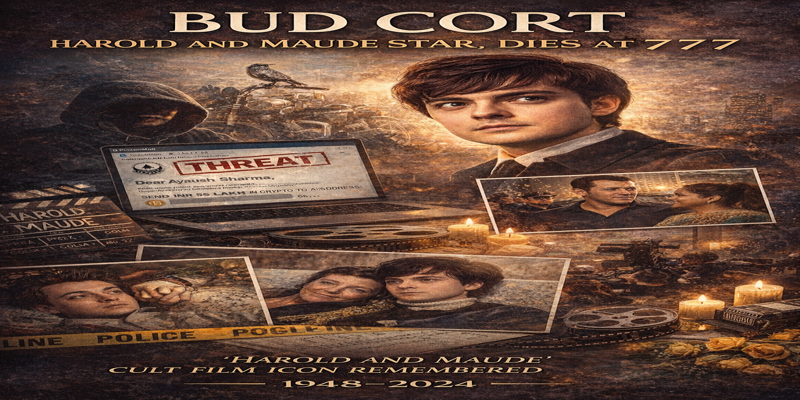
The actor Bud Cort, who played with the haunted boyishness in the 1971 cult film Harold and Maude, whose acting was as popular with a generation that preferred the offbeat and the melancholy, has died. Cort was 77. The death was verified to industry outlets by longtime friends that he had died in Connecticut after a lengthy illness, and his death was immediately followed by a period of mourning on social media in memory of an actor whose melancholic Comic gifts had left an outsized impact on American movies.
Cort was born Walter Edward Cox in New Rochelle, New York, in a very charming family and later took on the name Bud Cort for his stage name. It was because of his presence on the screen, which was disturbed and delicate, as though the directors could not resist it. He had acted in the early years on stage and on television, and had played supporting parts in films such as MASH* and Brewster McCloud, which made the way to his part in Harold and Maude easier.
Under the guidance of Hal Ashby and the script of Colin Higgins, Harold and Maude helped Cort develop into a cultural icon, as opposed to one that appeared to have a bright future. Nothing Cort had ever done was better than playing Harold Chasen: A deadpan ironist of the first order with a sudden tenderness. The part led to award nominations and critical attention, such as Golden Globe and BAFTA nominations. Though the movie initially biased mainstream critics and failed at the box office, it re-invented itself in the repertory theatre and on campus film societies – becoming a classic of countercultural American film.
Cort was eclectic and quietly impressive in his filmography during the decades that followed. His supporting and character roles appeared in such divergent films as The Life Aquatic with Steve Zissou, Dogma, and Heat, directed by Michael Mann, as well as in a few animated series in which he gave voice. Cort also performed in theater and television, but periodically came back to projects where his unusual abilities in timing and emotional understatement could be applied. With most of the performers who become synonymous with one character, the legacy is both admiration by the devotees, but also fewer mainstream roles. The variety of roles Cort played in her career showed that she was more than just the face on a movie poster.
The life of Cort outside the camera was full of struggle. The years of reporting reminded a big car crash that happened in the 1980s, which had a toll on his health and the trajectory of his career, and sources maintain that the later years were a battle with medical problems. Dorian Hannaway, a long-time friend and TV producer who confirmed the death of Cort, told him that the actor had been living in Connecticut before his death, and asked that the family be left alone to make preparations.
There was a response within the film fraternity. It was pointed out by directors, actors and critics that Cort was courageous to tackle material that was potentially uncomfortable, and that he was able to put awkwardness on a human scale instead of merely quaint. Midnight screenings, campus film-club screenings and the gradual spread of the word that spread Harold and Maude as fans recounted a movie generations rediscovered. To a lot of the audience, the Harold of Cort was not a joke but a reflection: a character with whom people learnt how to find a laugh and a soul in sadness.
The death of Cort provokes the consideration of the strange afterlife of cult cinema. Cult films earn cultural capital because they generate fan loyalty, revisionist reviews and extensions in other cinemas, unlike box-office blockbusters whose popularity is quantified in the number of tickets sold. The reason is that the actors in that world can have long and meaningful careers of influence even when they do not necessarily enjoy mainstream celebrity. The example of Cort demonstrates that influence can be silent but long-term and was contained in playlists, school curricula, screenings of the movies at the end of the day and in the personal memory of the audience that saw themselves reflected in the strange, kind characters.
Procedural information regarding services is yet to be published. Cort leaves behind family and close friends who have requested privacy; in the next few days, moviegoers will celebrate his memory by screening the film, writing essays and discussing it, reintroducing Harold and Maude to new audiences and reminding older ones why the film remains relevant to them.
His most identifiable acting is not so, but his career to date is the erratic beat of Hollywood itself, a place that both glorifies creativity and frequently finds it difficult to maintain it. Cort never took the leading-man route to success that others had after the first wave of publicity that had surrounded Harold and Maude. Instead, he stumbled, not intentionally, not necessarily, into character roles, single films and projects in which individuality was treasured more than predictability.
To a large extent, Cort was a part of a wave of actors that surfaced in the New Hollywood period of the late 1960s and 1970s. It was the period when rough-cut features and grotesque tales momentarily took the place of smooth studio formulae. Filmmakers such as Robert Altman and Hal Ashby, among others, were ready to take risks, so that actors like Cort could explore more complicated, morally grey roles. His movie presence, a little clumsy, intellectually alert, emotionally detached yet exposed, fitted exactly the moment in motion picture history.
But Hollywood cycles never cease. With the emergence of blockbuster movie-making in the late 1970s and 1980s, the low-key character-oriented stories took a backseat. Cort was subtle, ironic, and slightly subversive, and his style did not lend itself to the more high-concept narration that followed. As he kept on working, the cultural focus moved elsewhere.
Cort, however, never disappeared. His subsequent film performances in movies such as Heat and in The Life Aquatic by the director Wes Anderson with Steve Zissou proved that the directors who concentrated on unique actors still pictured him. Anderson, especially, has always been fond of actors whose role has been a part of the history of the cinema, and the appearance of Cort in such a production was not nostalgia but a reminiscence.
Cort also worked meaningfully in the voice acting industrially, to which he gave his trademark, soft but tinged with irony. Voice work: This was one area that legacy might ignore, but it enabled him to reinvent himself and no longer be the subject of physical typecasting. It serves as a reminder that a long lifespan in entertainment may need to adjust and modify itself instead of having to reinvent itself.
In secret, Cort was a perceptive and cogitative man concerning fame and its corruptions. Cort did not seem to be a person affected by the pretentiousness of fame in the early years of his stardom and was able to bear his cult status modestly, unlike many actors whose initial success can become corrupted into bitterness when not maintained. Throughout the years, interviews showed how the artist realized that Harold and Maude had grown bigger than he was, that it was as much of the audience as it was the creators.
The ability to become a part of personal identity for the viewers is uncommon among films. Often, fans of Harold and Maude agree that they have never thought of watching the movie as an entertainment experience but as a revelation. The topics of death, defiance and non-traditional love set in the movie were particularly appealing to youthful viewers who were seeking alternatives to conventionality. Cort, playing Harold, who fakes grand suicides but secretly longs to have a point of contact, had a thin line to walk between satire and sincerity. The character might have been mean or corny in other, less attentive hands. Cort made him human