
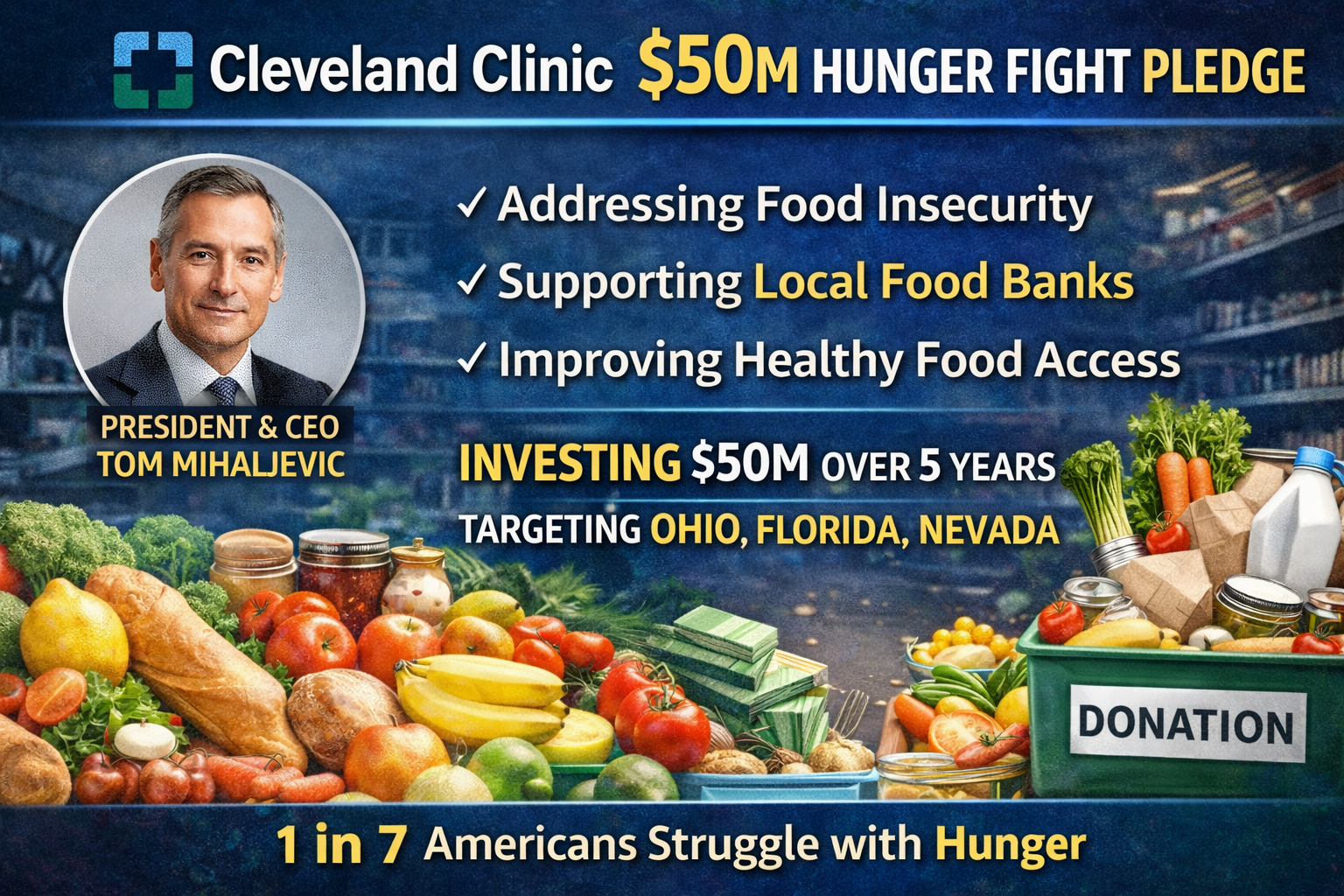
Cleveland Clinic has made a major step towards fighting food insecurity and how it affects the health of the people by declaring that it will invest about 50 million dollars over five years to combat hunger and increase the availability of healthy food in the community it serves. The program will target areas such as Northeast Ohio, Florida, and Nevada, where the health system has large facilities. The investment is one of the biggest long-term community investments in the recent history of the organization. It indicates a tendency towards the increasing acknowledgement that health outcomes are closely connected with social and economic circumstances.
The statement reflects a wider trend in the healthcare industry that focuses more on social determinants of health – on food access, housing, transportation, income, and other factors that play a role in physical and mental health. Focusing on overcoming hunger as one of the fundamental underlying issues, the Cleveland Clinic is expected to enhance both short-term and long-term health results of vulnerable populations.
Leadership focuses on community accountability
According to the President and CEO of the Cleveland Clinic, Dr. Tom Mihaljevic, the development and prosperity of the organization come with a chance to invest in the community surrounding it. He pointed out that healthcare organizations should not see the hospital walls, but find ways of resolving the causes of disease and health differences.
As Mihaljevic states, regular exposure to healthy food is the basis of general well-being. In its absence, the patients have increased risks of chronic illnesses like diabetes, hypertension, and cardiovascular diseases. The new pledge seeks to fill the gaps that cannot be addressed by traditional clinical care only, enhancing collaboration with the community organizations and increasing food assistance programs.
Food Insecurity in the United States
Food insecurity has been a constant problem in the country. According to statistics of the U.S Department of Agriculture, millions of Americans have a hard time obtaining adequate and healthy food annually. Homes that are food insecure are often faced with the option of spending money on food, shelter, utility or health.
Children and older adults are the most susceptible. Unhealthy childhood nutrition may result in developmental stressors, low academic achievements and higher exposure to chronic illness in adulthood. In older people, a lack of healthy food may aggravate the underlying pathology and decrease the quality of life. These challenges have been aggravated in most communities by the increasing food costs and economic uncertainties.
Investing heavily in five years, the Cleveland Clinic will offer a long-term solution, not a temporary one, so that the partner organizations can grow their capacity and become creative in solving hunger.
Collaboration with the Local Food Banks and Community Organizations
Much of the promised money will be used to assist food banks and nonprofit groups that work to distribute food and groceries. In the state of Ohio, one of the potential partners is the Greater Cleveland Food Bank. The same collaborations will be implemented in Florida and in and around Las Vegas, so that they can ensure that the resources are sent to areas where need is demonstrated.
It will not only help it purchase food but will also help it build infrastructure. This involves the enrichment of storage, extension of the distribution channels, making investments into refrigeration and transportation, and improving the data systems to better determine the at-risk communities. The initiative will establish long-term improvements and not short-term solutions by developing organizational capacity.
Increasing the Availability of Nutritious Choices
In addition to the direct food distribution, the initiative will reinforce the programs that will help provide more access to fresh food and healthier meal choices. Such efforts can consist of collaborations with local farmers, mobile markets to underserved areas, school-based food programs and nutrition education programs.
Healthcare professionals are slowly starting to appreciate that calories do not do the trick, but quality counts. High intake of processed foods and low intake of fresh fruits and vegetables are some of the causes of chronic illnesses that burden the subjects and health systems. The program also aims to improve the cause of diet-related diseases by promoting the intake of balanced and nutritious food.
Also, a portion of the funds can be utilized to fund patient-centered nutrition programs in healthcare facilities, including food pantries in clinics, nutritionally customized food programs for patients with chronic conditions, and healthy grocery vouchers.
Establishing on the past Community Investments
The Cleveland Clinic has also undertaken community health programs to eliminate disparities in the past. The previous initiatives comprised granting funds to local food banks, summer meal programs among children, and home delivery of groceries to homebound patients and educational programs on healthy cooking and lifestyle modifications.
These foundations are the basis of the new $50 million promise, although the scope and length of investment are greatly multiplied. The five-year period makes partner organizations predictable to enable them to plan more on staffing, infrastructure upgrades, and outreach programs with more confidence.
This is a long-term strategy that is consistent with a wider national healthcare trend of focusing on preventive care and population health management. Instead of treating disease, prevention of diseases before they occur is an aspect that institutions are investing in.
Economic and Social Impact
The solution to hunger can have ripple effects beyond an individual’s health outcome. Healthier nutrition has shown to enhance school performance among children, high productivity among working adults, and lower health care spending in general. In communities where the support of food is high, the cases of hospitalization due to diet-related ailments are frequently low.
Further, if the money is invested in local food systems, it can trigger the economy. Helping local farms, supply chains, and networks is a way to provide employment and support local economies. With this, the pledge can help to bring both social and economic resilience to the benefited areas.
Community leaders have shown hope that the program will assist in stabilizing families that experience financial difficulties. With housing stability, education, and healthcare, the households can better afford to allocate their resources to food expenses.
Greater Vision of Community Health
The statement is indicative of a changing perspective on the definition of a healthcare institution in the 21 st century. Many non-profit health systems are starting to consider themselves as anchor institutions, organizations with strong economic and social presence in their communities. The presence of such influence also creates the chance of effecting a significant change.
Cleveland Clinic invests heavily in hunger relief, thus indicating that community health goes much further than clinical care. The initiative understands that food security cannot be isolated from medical care, and sustainable health gains cannot be achieved unless sectors work together.