
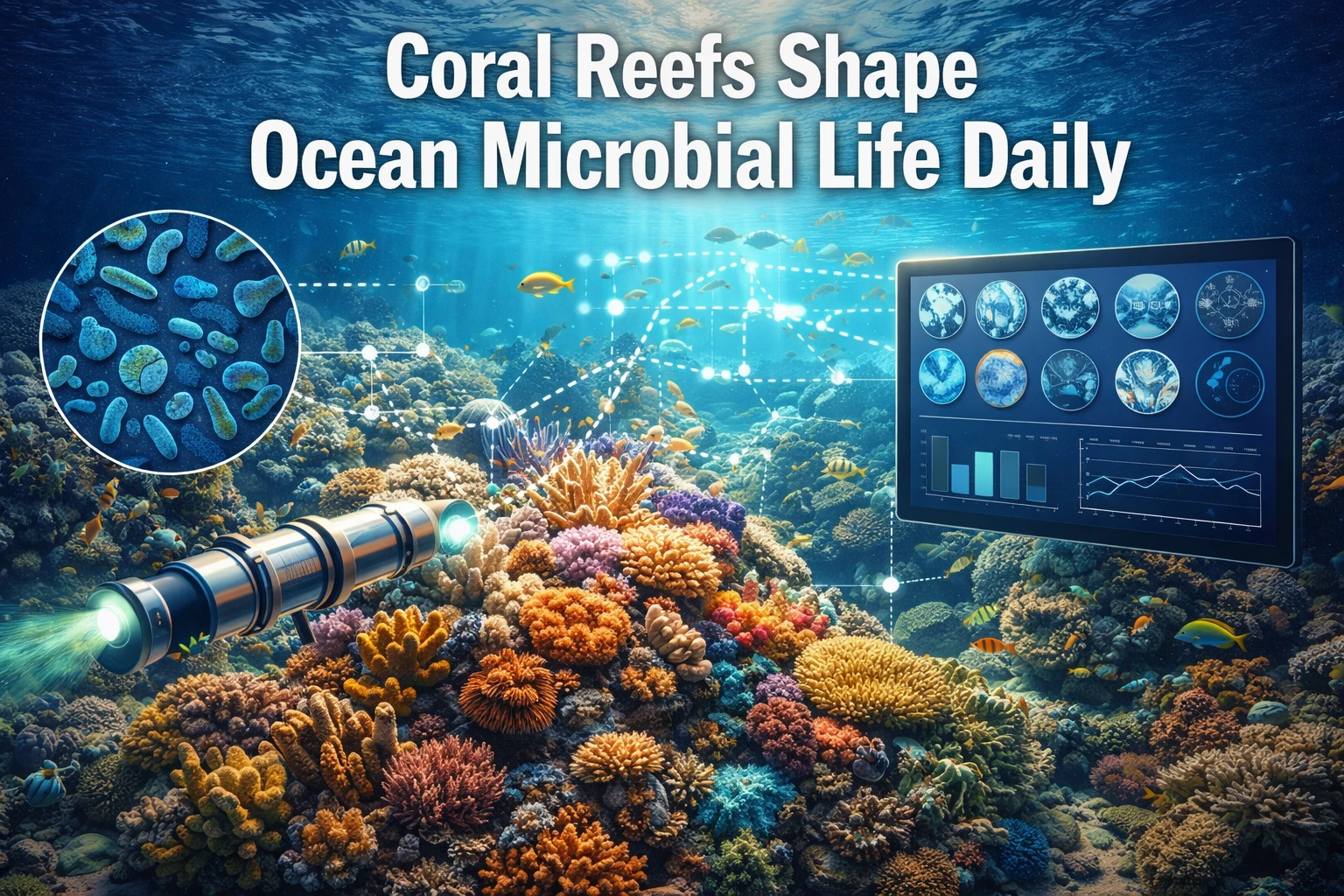
In a landmark discovery that redefines our concept of coral reefs, researchers have discovered that reefs do much more than provide a habitat to fish and marine organisms; they are actually dynamic organizing structures of the surrounding ocean waters of microbial life. This discovery, reported in the Journal of Science Advances, has found that coral reefs affect the daily rhythms of microscopic life, which essentially affects the movement of energy and nutrients in the ocean ecosystem.
The coral reefs have been praised as biodiversity hotspots. They cover a very small area, approximately 1 per cent of the ocean floor, yet carry over 25% of the ocean life, both large and small, predatory and invertebrate.
New Research is now shedding light on a shadowy side of reef behavior: the manner in which the reefs themselves actively determine the daily behavior of microbes, including bacteria, microalgae, and microscopic predators, in the water immediately over the reefs.
An Underwater Clock: Daily Microbial Rhythms
It was carried out by a group of marine researchers of more than 15 nationalities, headed by Dr. Herdís G. R. Steinsdóttir and Dr. Miguel J. Frada of Hebrew University of Jerusalem. Scientists targeted a coral reef in the north of the Gulf of Aqaba, which is located in the Red Sea, and took water samples every six hours in winter and summer conditions.
As opposed to discovering a static microbial environment, scientists witnessed amazing cycles in microbial population on a daily basis. Bacteria and microalgae were found to be lower than in the adjacent open waters, especially during the daytime above the reefs. By night, though, the number of microscopic predators, small creatures that consume bacteria, so-called heterotrophic protists, increased up to 80%.
These shifts weren’t random. The daily and seasonal repetitions in patterns demonstrate that the reef was not an inanimate background to microbial activity; it was a timekeeper of a sort and dictated its biological rhythms to the rest of the microscopic world.
“We found that the reef is not just passively surrounded by microbes,” Dr. Frada said in a press statement. “It actively structures microbial life in time, creating daily patterns that repeat across seasons and influence how energy and nutrients move through the ecosystem.”
How Reefs Shape Microbial Diversity
Among the most important findings of the study was the role that the reef played in a family of microorganisms called Symbiodiniaceae, which are small dinoflagellates that coexist with the corals and provide them with important nutrients by the process of photosynthesis. These genetic signals of the organisms were highest in the middle of the day in the reef waters, indicating that not only were they living in the tissues of coral, but also responding to the changing light conditions and the metabolic processes of the coral by exchanging the surrounding water.
This communication brings out the extent to which the reef and the microscopic life are interwoven. Contrary to the better-known scene of reef fish zipping between the branches of the coral reef, this finding indicates that reefs organize a microscopic world in nutrient cycles and the general functioning of the ecosystem.
Why Microbial Patterns Matter
Understanding these microbial rhythms is far more than an academic exercise. Microorganisms are the base of ocean food chains. They are very important in biogeochemical cycles – the processes by which elements such as carbon and nitrogen move in and out of the environment. This is because changes in microbial composition can have far-reaching ripple effects on as much as plankton blooms to fish populations.
Above all, these microbial changes can provide scientists with an early warning mechanism for reef health. Since microbes are highly sensitive to environmental stressors, including increasing ocean temperatures, acid and pollution, following daily microbial cycles may provide a sensitive measure of reef health way before it becomes clear at a larger scale on an individual coral reef or even a whole fish population.
Reefs in a Changing Ocean: New Tools for Conservation
The threats to coral reefs worldwide are increasing due to global climate change, growth in ocean temperatures, acidification and human activities, which include overfishing and pollution. These dangers are associated with mass bleaching instances, in which corals lose their symbiotic algae, the very organisms that assist them in supporting their metabolism. Corals may starve and demise without these partners in causing reef collapse.
This new study provides a new dimension to the convoluted image of coral reef conservation. Although a lot of emphasis has been placed on saving the fish as well as the larger reef organisms, the microbial world might also play a significant role in dictating reef resilience as an invisible world. With the help of monitoring the changes between the dawn and evening, night and day, scientists can possibly spot minor shifts in reef ecosystems long before devastating losses happen. The findings of this study highlight the reality that reefs do not form a fixed system, according to one expert who was well acquainted with the results of this research. They are also dynamic and self-regulating ecosystems that create and maintain life below the waves at both the micro and macro scale, including the fish and coral life that can be visible, and the micro-communities that cannot.
Editorial Perspective: Rethinking Reef Ecology
As an experienced science news editor, this discovery feels like a renaissance moment in marine ecology. For decades, coral reefs have been studied primarily as physical structures and biodiversity hubs — places teeming with colorful fish and dramatic life forms. But this new research invites us to look deeper, literally and figuratively, into the oceans’ microscopic underpinnings.
The idea that reefs act not just as habitat but as microbial timekeepers challenges long-held assumptions about ecosystem dynamics. It reframes reefs as active agents in their environment, shaping life not only through physical presence but through biological rhythms that echo across scales.
In an era of rapid climate change, innovative approaches to monitoring marine ecosystems are desperately needed. Traditional measures, such as surveying coral cover or fish abundance, capture only snapshots. By contrast, microbial dynamics — tightly linked to environmental conditions and biological interactions — could provide continuous, fine-grained insight into ecosystem health.
This breakthrough also highlights a key lesson for science journalism: the most transformative discoveries often lie at the smallest scales. What we cannot see with the naked eye — the interplay of microbes, light, and nutrient cycles — may ultimately reveal the future of entire ecosystems.
As research progresses, the hope is that these insights will not only deepen our understanding of coral reefs but also fuel greater commitment to their protection. In a world where oceans are under unprecedented stress, every tool that helps safeguard their future is invaluable — and the tiniest organisms may hold some of the biggest answers.