
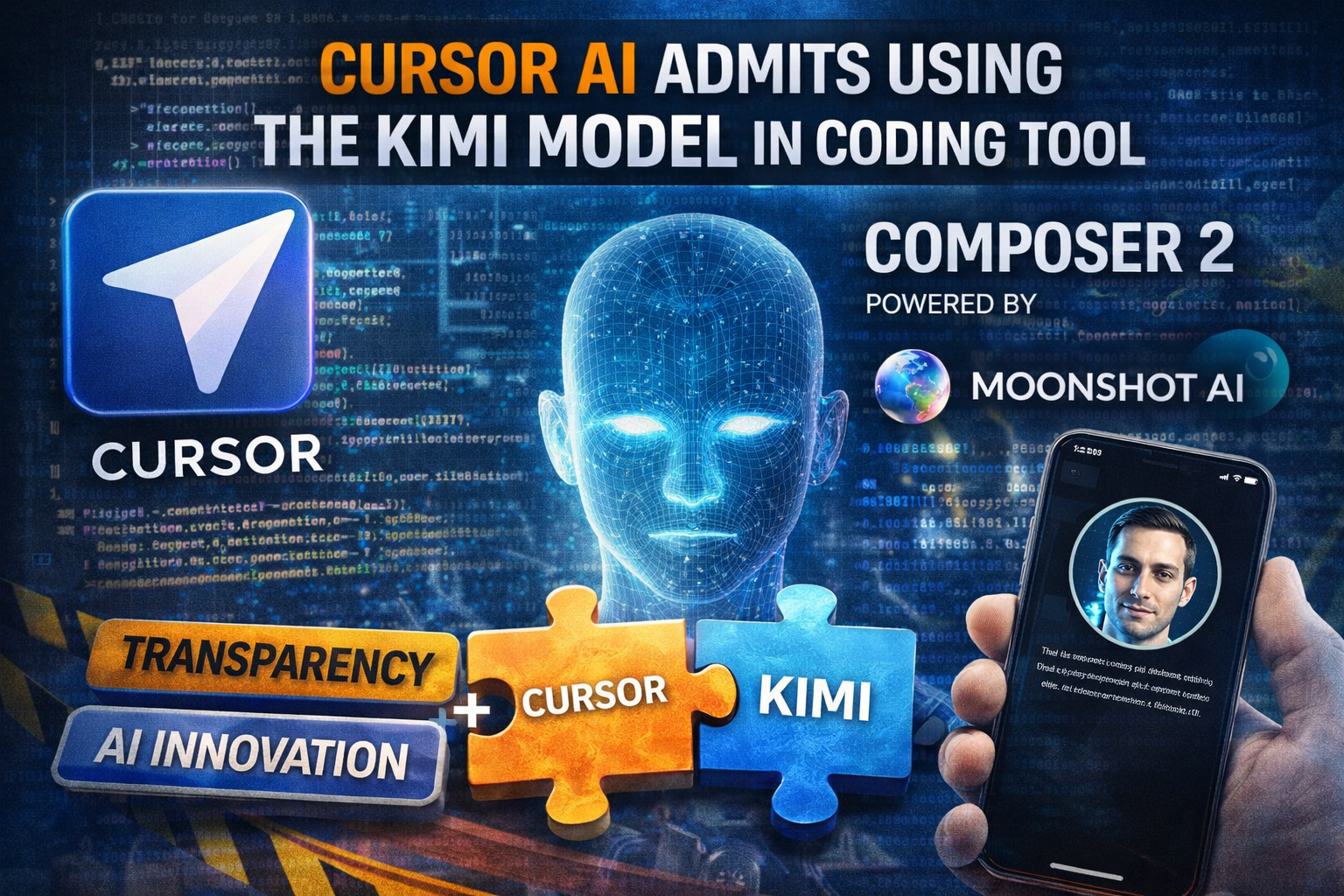
Cursor has acknowledged that its latest coding model, Composer 2, was built using technology from Moonshot AI. This confirmation comes after speculation from developers who noticed similarities between Cursor’s outputs and those generated by Moonshot’s Kimi model. The admission has sparked widespread discussion in the artificial intelligence community, especially around how companies present their technological capabilities.
Cursor had initially positioned Composer 2 as a highly advanced, near “frontier-level” coding system. However, it was later clarified that the model incorporates Kimi as a foundational layer while adding its own proprietary enhancements on top. This places Cursor among a growing number of companies that build AI products by combining existing models with custom improvements.
Understanding Composer 2’s Capabilities
Composer 2 is designed as an AI-powered coding assistant that allows developers to write, debug, and understand code using natural language prompts. As part of the broader “AI coding assistant” trend, tools like this aim to simplify software development and make programming more accessible.
Cursor’s editor integrates directly into workflows, helping users generate code snippets, refactor existing programs, and even build applications from scratch. The company has gained popularity among developers for its speed and ease of use. By leveraging a strong base model like Kimi, Composer 2 is able to deliver advanced reasoning and coding capabilities, particularly in handling complex instructions and large codebases.
The Role of Kimi in the System
Kimi is an open-source large language model known for its strong performance in coding and long-context reasoning tasks. Developed by Moonshot AI, it has gained recognition as one of the more capable alternatives to proprietary Western AI systems.
In Composer 2, Kimi reportedly contributes a portion of the model’s overall intelligence and computational structure. Cursor has stated that while Kimi forms part of the base, significant additional training and optimization were applied to tailor the system specifically for coding tasks. This layered approach allows companies to accelerate development rather than building models entirely from scratch.
Why the Disclosure Triggered Debate
The controversy surrounding Cursor’s announcement is less about the use of Kimi and more about how it was communicated. In the AI industry, it is common practice to build on open-source models. However, transparency about these foundations is increasingly expected by users and developers.
Cursor did not initially disclose the extent of its reliance on Kimi when launching Composer 2. This led to criticism once the connection became public, with some arguing that the company’s marketing may have overstated the originality of its model. The delay in disclosure has raised questions about how AI companies define and present innovation.
AI Development Is Becoming Layered
The situation highlights a broader trend in artificial intelligence: most modern systems are no longer built from the ground up. Instead, they are created by stacking improvements on top of existing models.This approach allows for faster innovation and lower costs, as companies can focus on refining performance rather than recreating foundational technology. Open-source models like Kimi play a crucial role in this ecosystem, enabling smaller companies to compete with larger players.
At the same time, this layered development model makes it harder to clearly define ownership and originality. As more companies adopt similar strategies, the distinction between “new” and “modified” AI systems becomes increasingly blurred.
Geopolitical Dimensions of the Story
The involvement of Moonshot AI adds a geopolitical dimension to the discussion. As a Chinese company, Moonshot represents China’s growing influence in the global AI landscape. Its Kimi model has been part of a broader effort to compete with leading AI systems developed in the United States. Cursor’s use of Kimi reflects how interconnected the AI ecosystem has become, despite political and economic tensions between countries. Companies are increasingly willing to adopt the best available technology, regardless of its origin, as long as it meets performance and licensing requirements.
This cross-border collaboration also raises questions about data security, technological dependence, and the future balance of power in AI development.
Editorial View: Transparency Matters More Than Ever
From an editorial perspective, this development underscores a critical issue in the AI industry credibility. Using an open-source model like Kimi is not a problem in itself. In fact, it is a practical and widely accepted approach that drives innovation forward.The real concern lies in how such decisions are communicated. When companies promote their products as entirely proprietary without clearly acknowledging underlying technologies, they risk creating a gap between perception and reality. This gap can lead to mistrust, especially among developers who rely on accurate information to make decisions.
At the same time, it is important to recognize that Cursor has contributed its own work to enhance Composer 2. Building on an existing model does not diminish the value of those improvements. However, clarity about what is original and what is inherited is essential for maintaining credibility.There is also a broader lesson here for the industry. As AI systems become more complex, companies must adopt more transparent communication practices. Users are becoming more informed and expect honesty about how technologies are built.
Implications for Developers and the AI Ecosystem
For developers, the revelation may not significantly impact how they use Composer 2. Performance, reliability, and usability remain the primary factors in choosing tools. If the model delivers strong results, its underlying structure may be of secondary importance.
However, transparency still plays a key role in long-term trust. Developers need to understand the origins of the tools they use, particularly when it comes to licensing, data privacy, and future updates.For the AI ecosystem as a whole, this case highlights the importance of setting clearer standards around disclosure. As more companies adopt hybrid development models, open acknowledgment of foundational technologies could become the norm rather than the exception.
Shifting Definitions of Innovation in AI
The Cursor-Kimi situation reflects a deeper shift in how innovation is defined in artificial intelligence. Instead of focusing solely on building entirely new systems, progress is increasingly measured by how effectively existing technologies are improved and adapted.This shift challenges traditional notions of originality. In AI, innovation often lies not in starting from zero, but in refining, combining, and scaling what already exists.Cursor’s Composer 2 is an example of this new model of innovation, one that blends open-source foundations with proprietary enhancements to create competitive products.
Meta Description
Cursor admits using Moonshot AI’s Kimi model in Composer 2, raising concerns over transparency, AI innovation, and trust.