
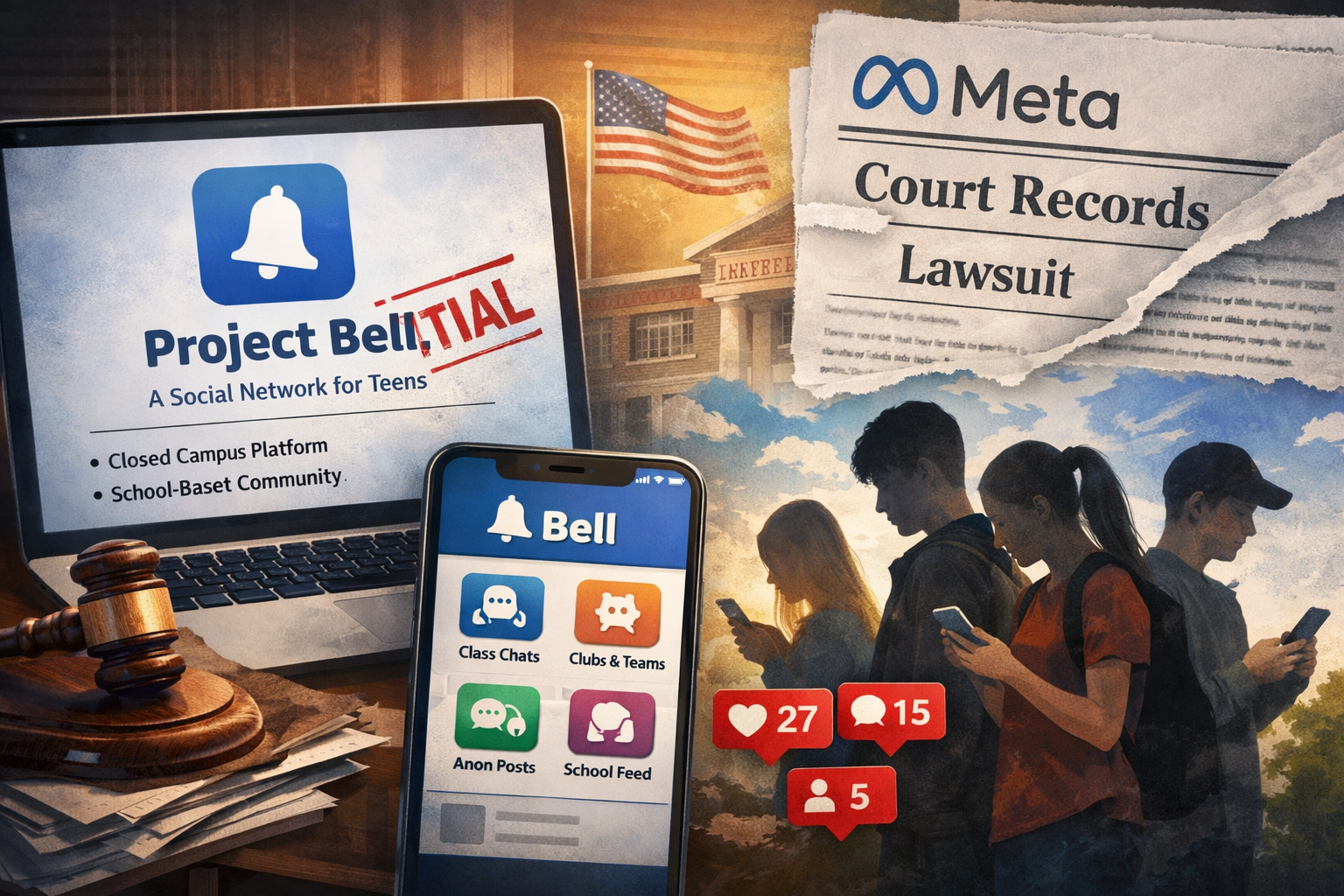
Court records in a current lawsuit against Meta Platforms have shown the firm at one point developed a separate social networking application specifically for teens known as Bell. The project itself was an internally developed project, deemed to target high school students and was to be an entirely closed social ecosystem directly connected to the communities of schools. Even though Bell had never been published online, its elaborate planning files have emerged as collateral evidence in more extensive legal cases that investigate the effects that social media networks have had on young adults. The presence of the project has been heavily questioned, with the regulators, families and state authorities still questioning the manner in which large technology corporations treat the youth.
The in-house presentations were said to state a clear strategic purpose: to establish a digital space that would allow students to interact with a peer group in their respective schools only. Bell would have been organized around proven school identities, unlike the larger organization of Facebook, which links individuals to large social networks. Students would come on board with school credentials and socialize in a limited campus-based community. The documentation indicates that the company realized that there was an opportunity to digitalize the daily social life of high school.
Features and Design Strategy
Bell was reportedly designed as a “closed campus” platform, meaning users could only interact with verified classmates. The proposed features included group chats organized by classes, sports teams, and extracurricular clubs, along with school-wide discussion boards. Messaging tools would have allowed students to communicate directly, and there were indications of potential anonymous posting features similar to other youth-focused apps that gained popularity in earlier years. The structure appears to have been crafted to mirror the physical dynamics of a school environment within a digital space.
Internal strategy documents outlined ambitious adoption goals, with targets to reach a large percentage of U.S. high schools within a relatively short timeframe. Expansion into international markets was also reportedly considered. These projections suggest that Bell was more than a casual experiment; it was a serious strategic initiative aimed at strengthening the company’s foothold among teenagers. At the time, younger audiences were increasingly gravitating toward newer platforms, and traditional Facebook usage among teens was declining. By launching a high school–centered network, Meta appeared to be seeking a way to re-establish relevance among Generation Z users.
Legal Context and Ongoing Scrutiny
The resurfacing of Bell is accompanied by the fact that Meta is exposed to various legal actions that claim that its applications, such as Instagram, have contributed to mental health issues among the young people using them. Plaintiffs claim that algorithms that are built to achieve the highest engagement, like the system of displaying feeds, notifications, and social validation principles, may promote the development of compulsive use and negative comparison habits. Within this broader juridical context, critics are interpreting the concept of Bell to mean that the company strategically decided to focus on teenage engagement despite the mounting concern about the digital well-being in society.
Social media companies are accused of creating products that were highly attractive to adolescents and which they were aware of, since the increasing body of research on the subject has connected excessive use of social media to anxiety, depression, sleep disturbances, and problems with body image. Despite the fact that Bell never saw the light of day, it seems that critics believe that the development of this product is indicative of a business-level mentality that perceives teenagers as a vital source of growth. In this sense, even the project of an exploratory nature in regard to minors should be examined with much scrutiny, especially when the targets of their internal development are set as the prerequisite.
Meta has indicated that Bell was never published and was an exploration concept. The representatives of the company have also highlighted that technology companies tend to experiment and test new ideas that fail to make it to consumers. They have also suggested the recent youth-safety measures, such as requesting stricter privacy defaults of minors, parental supervision options and messaging restrictions to avoid contact with unknown adults. The company claimed that any product aimed at teens would have needed a lot of safety frameworks and human moderation before collaborating.
Business Incentives and Ethical Concerns
Adolescents are an extremely lucrative audience for social media corporations. Adolescent interaction styles can become brand loyalty and platform use in adult life. Business models that rely on advertising are highly reliant on the activity of the users, and youthful users tend to create considerable engagement. Commercially, youth product development fits the growth goals and competitive strategy.
Nevertheless, marketing to minors brings some ethical issues that are not the same as those marketing to adults. Teenagers are at a critical development period, and their experiences on the internet can influence self-esteem, social relationships, and mental health greatly. Some argue that such aspects of the persuasive design as notifications, likes, and content generated by algorithms can have a disproportionate impact on younger users whose impulse control and social identity are still being established. The idea of an exclusive high school social network brings up other issues of peer pressure and digital exclusion, as well as possible cyberbullying in a closed system.
Meanwhile, there are some observers who also observe that a verified school-based platform would make certain risks theoretically lower as it would restrict the interaction with known peers and deny unknown adults access. A managed campus model may be more transparent and restraint than open forums. The success of these types of safeguards, though, would rely greatly on implementation, oversight, and transparency. Even a closed system may recreate or magnify already existing social pressures without strict content control and demarcation.
Editorial Perspective on Corporate Intent
Bell is important not just in its design, but also in what it says about internal strategy. The technology companies work in cycles of trial and error, with many of the prototypes never having seen the light of day. However, when such prototypes are aimed at teens, the ethical bar of judgment is increased. The targets of internal growth that were related to youth adoption imply that adolescents were considered to be the focus of the strategic planning in the long-term.
The reappearance of Bell prompts further study of the intersection of corporate innovation and social responsibility. Regulators and the general population increasingly require transparency with regard to internal discussions, and more transparent accountability structures and proactive safeguards. Although Bell as a project per se was shelved, the wider discussion that it has sparked is whether big technology companies are capable of expansion and at the same tim,e take the issue of youth well-being seriously. As the legal cases proceed, domestic policies such as Bell can have a major role in defining the way people view the social media companies treating the youngest consumers.