
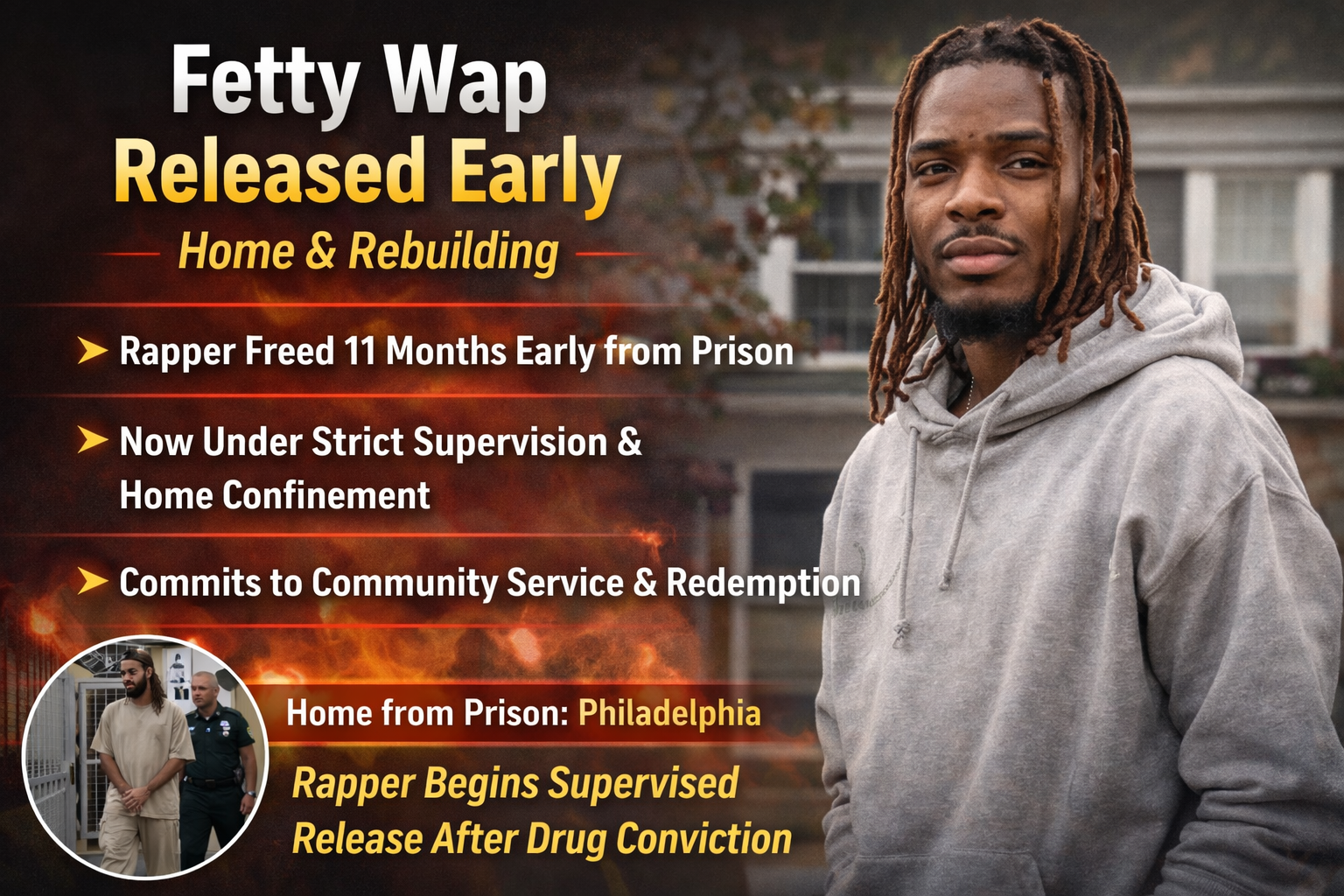
Paterson, New Jersey Willie Junior Maxwell II, or Fetty Wap, was released by the federal government on January 8, 2026, almost 11 months earlier than anticipated, serving more than three years of a six-year prison term over a high-profile drug trafficking case.
The 34-year-old hip-hop musician, who in the past had songs like Trap Queen topping the charts and pop culture, was moved out of the low-security FCI Sandstone prison in Minnesota to be under house arrest in Philadelphia. He will remain to serve part of his term under intensive supervision until November 8, 2026, the Federal Bureau of Prisons affirmed, and the conditions of this probation include regular drug testing, financial reporting, and the prohibition of opening new bank accounts without the consent of probation officials.
From Breakout Star to Federal Custody
Fetty Wap was an artist who started as a local in New Jersey. Still, after releasing the song, Trap Queen, in 2015, he was able to gain international fame as one of the songs that became a staple on the Billboard Hot 100 and received multi-platinum certification. His career, however, took a theatrical twist after his arrest in October 2021 at Citi Field in Queens, New York, before a planned Rolling Loud performance. The federal indictment claimed that the rapper and a crew of terrorists had conspired to carry over 100 kilograms of narcotics, namely cocaine, heroin, fentanyl and crack cocaine, to New Jersey and Long Island.
Three months later, Maxwell was found guilty of conspiracy to distribute cocaine in August 2022 and sentenced to six years in federal prison and five years of supervised release in May 2023. The prosecutors who were handling his sentencing have said that his celebrity status perhaps led to the operation and how the drug business affected the vulnerable communities.
Early Release and Homecoming
The early release came as a surprise to many fans and observers of the case. Records from the Federal Bureau of Prisons had previously indicated a projected release in December 2026 following slow adjustments to Maxwell’s sentence over late 2025. Good conduct time, credits for participation in rehabilitation or programming, and administrative decisions are believed to have played roles in the early release, common in many federal cases when inmates meet criteria for reduced time. Though specific legal reasons weren’t fully disclosed, a combination of compliance and policy likely factored into the decision.
Social media lit up with “Home,” the simple announcement Maxwell shared via his Instagram Story immediately after release, as supporters and fans welcomed the rapper back into the public sphere.
Focusing on Redemption and Community Work
Fetty Wap showed a lot of thanks to his supporters in prison in his first words after returning to the outside world. He stressed the wish to pay back by serving the communities, giving back to society by providing more opportunities to study, introducing the youth to early technological skills, and vision care- a personal goal he claims will enable the youth to present as their best selves.
This community work emphasis is a large turnaround from his youthful years, when his songs and his image frequently tended to be connected to lifestyle issues, which critics claim to have mixed up glorifying street life with portraying it. It is yet to be determined whether the activities Maxwell engages in after his release will substantially change such a story, but his declared intentions are an indication that he is ready to leave the role that made him famous behind.
Supervision and Restrictions Ahead
While he is free from prison walls, Fetty Wap isn’t entirely without constraints. His home confinement in Philadelphia means he lives under strict supervision for most of 2026. He must comply with regular drug testing, probation check-ins, and financial monitoring. The court also prohibits him from opening new bank accounts without authorization, a measure meant to ensure transparency in earnings and reduce the risk of relapse into past activities.
Depending on compliance with these conditions and broader behavior, the probation department may further influence how much autonomy he regains in the coming years. If issues arise, the court could require outpatient treatment or impose additional measures.
Context: His Career and Legacy
The story of Fetty Wap, the former breakout hitmaker who was sentenced to federal prison, has been discussed extensively regarding the role of influential people and the impact of their actions. His early life contributed to the formation of a melodic trap sound in the mid-2010s, with multiple successes on the Billboard top-10 lists and huge streams.
However, his legal hassles have ended a career that many people would have liked to see a lot longer and an even more commercially bountiful one. Whether or not he will ever regain the artistic momentum, how he will juggle creativity and supervising requirements and what role he will take in the changing world of hip-hop after his official supervised release period is over are now the questions.
Industry & Public Reaction
Reaction from the music community has been mixed. A segment of fans celebrates his return and hopes for new music or public appearances. Others remain cautious, reminding observers of the gravity of his criminal conviction and the suffering caused by drug distribution networks in many communities.
Some commentators on social and music forums point to the resurgence of his older tracks, particularly “Again, which found new life on platforms like TikTok and the Billboard TikTok Top 50 last year, as evidence that his cultural impact endures despite his legal setbacks.
My View as a News Editor
The initial prison release of Fetty Wap is symbolic as an outsider due to the larger trends of celebrity justice and redemption stories. On the one hand, a person who demonstrated compliance and demonstrated his intentions to be active in a positive way in the community deserves an opportunity to reintegrate after being kept for a long part of his term. Reintegration and rehabilitation are important pillars of a justice system. Nevertheless, it is also critical not to allow the celebrity status to dominate accountability, in particular, in the areas related to the distribution of substances causing addiction, violence, and loss of life in most neighborhoods.
The fact that Maxwell has chosen to focus on community service and educating the younger generation on different matters is a good move. If nothing is fabricated, all the suffering that comes along with this part of his life might be translated into something better. However, time will determine whether this will actually make a real impact or will be a PR story. The change of the rapper to a community influencer is not an overnight event, but it takes a long time, sincerity, and positive outcomes that cannot be quantified by the number of likes on social media.
As a cultural event, Fetty Wap is a comeback to be examined in a way that allows us to reflect on the principles that we have been glorifying and the second chances that we provide, as well as how influential figures use their power to do good on a large scale. It is still to be seen whether he uses this chapter to rebrand his legacy, but it is an open question that is worth watching in the year to come.