
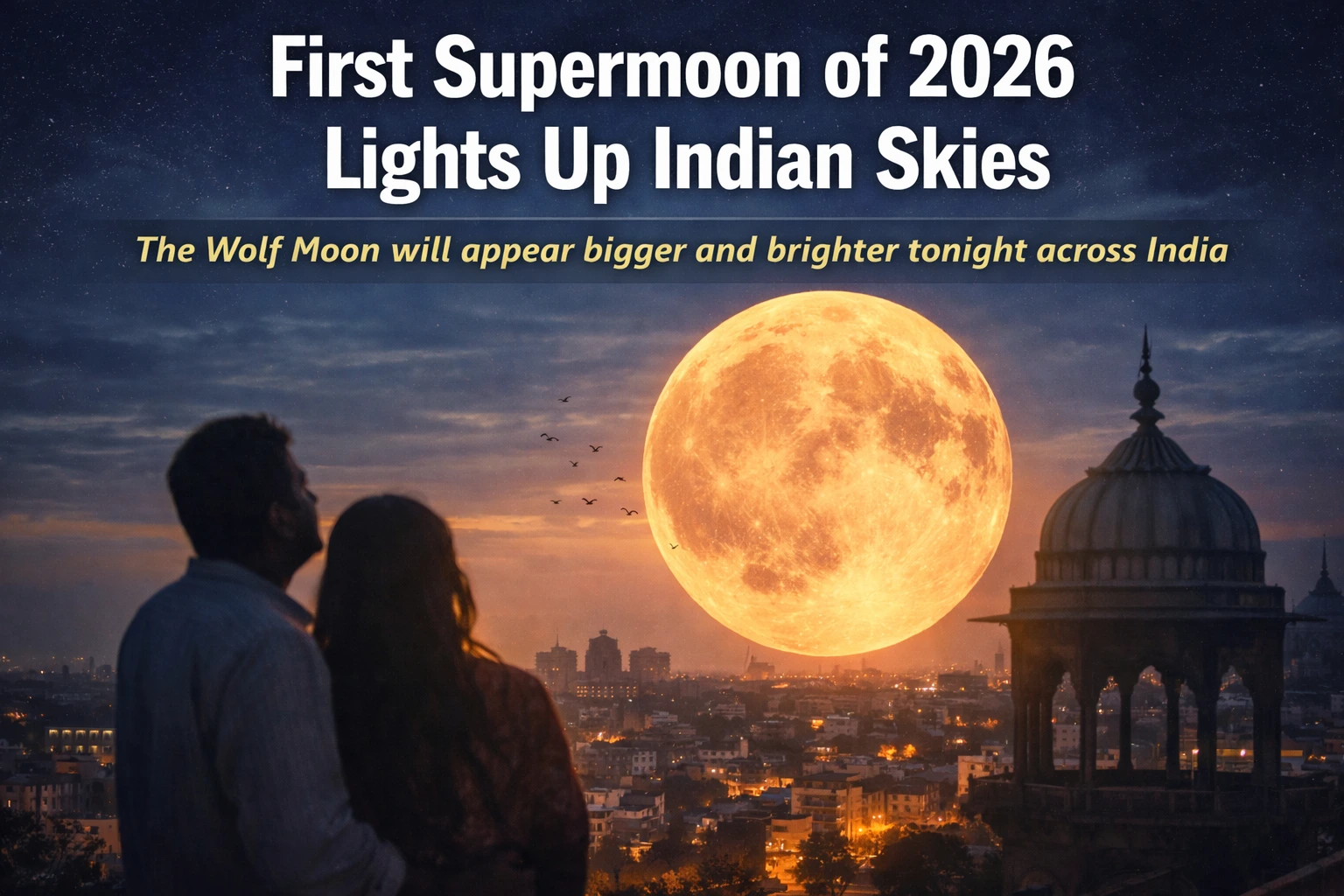
The night sky is set to dazzle skywatchers across India and the world with the first supermoon of the year tonight. Known as the Wolf Supermoon, this celestial event occurs when the Moon’s orbit brings it unusually close to Earth at the same time it becomes a full Moon, resulting in a dramatic display of brightness and size. Skywatchers are being urged to look up shortly after sunset to catch a glimpse of this rare cosmic spectacle.
The first full Moon of 2026 will be the supermoon of this year, and according to astronomers, the moon will be up to approximately 30% brighter and 14% bigger than the weakest full Moon of the year because it will be close to the Earth.
The phenomenon is deemed to show up in the whole of India, as seen on the eastern horizon soon after the sun sets, and on the western skies soon before dawn, to give people in the region a spectacular lunar show on a clear night.
What Is a Supermoon?
The term supermoon is a popular term that is not scientific but is applied to describe a full Moon that is nearest to the Earth (perigee) in the 27-day cycle of its orbit around the Earth. Such closeness causes the Moon to seem larger and brighter than a normal full Moon.
January is known as the Wolf Moon because the folklore of the Northern Hemisphere gave a name to every full Moon throughout the year, according to the time of the year or natural occurrence. The Wolf moon usually signifies the extreme winter season, and it got its name because of the howling of the wolves that is usually heard during this season in previous centuries.
The NASA statistics show that the Moon will be approximately 362,000km away from the Earth, which will increase its brightness in the sky this evening.
Best Time and Visibility in India
In India, the best time to view the Wolf Supermoon will be shortly after sunset, roughly between 5:45 p.m. and 6:00 p.m. IST on January 3, as the Moon rises in the eastern sky.
From there, it will be visible throughout the night, gradually moving toward the western horizon by dawn.
Owing to the fact that when the Moon rises it will be low on the horizon, it may also appear in orange-yellow because of the atmosphere on the earth scattering the light and this will occur due to the moon illusion.
Stargazers are recommended to locate a place where the eastern horizon can be seen to its full effect.
Why This Supermoon Matters
The Wolf Supermoon marks the first of several lunar highlights in 2026 — including lunar eclipses and additional supermoons later in the year — but it’s currently the only one visible in the early months.
The astronomy sources also state that it is the final one of the four consecutive series of supermoons, so it is a very special night for lovers before the next super moon comes out in November 2026.
The supermoon is a highly educative and interactive experience, besides being aesthetically pleasing. Education Science enthusiasts can take an interest in such events, and it gives a new generation of all ages a leeway to understand more about the laws of celestial bodies, the geometry of the orbit and the orbits of the natural satellites of the Earth.
Tips for Viewing and Photography
For casual skywatchers, no telescope or binoculars are necessary — the supermoon’s enhanced size and brightness make it visible to the naked eye.
A camera equipped with manual exposure/setting and a telephoto lens will record spectacular pictures of the moon’s surface and its luster in the night sky for photographers. Moonrise shooting can also give the most dramatic images as the difference between the lit Moon and the rest of the twilight.
Other astronomers also observe that combining the supermoon with other celestial activities like visible planets (like Jupiter) or nearby constellations may make the experience even more to be remembered.
Cultural and Scientific Significance
In many societies Full moons have always had a cultural connotation. According to numerous customs, the initial full Moon of a new year is the sign of a new beginning, introspection or transformation. Although the name of the wolf moon is mythological in basis, the actual science behind the occurrence presents the coming together of both culture and astronomy, where natural phenomena seen in the world can be represented as belonging to the culture.
Supermoons are also scientifically associated with slight impact on tidal energy due to the fact that the Moon is a bit closer to the Earth. The effects are not drastic enough to cause significant disruptions, but they may lead to the slightly increased tides in the coastal areas.
Events such as supermoons keep the general population interested in space and heavenly processes in the wider context of astronomy. They are also in addition to other heavenly phenomena of the year 2026, such as solar and lunar eclipses, making this year fruitful to both the skywatchers and researchers.
Editorial Note: A Skyward Start to 2026
As an experienced news editor focusing on science and astronomy coverage, the Wolf Supermoon offers a poetic and scientific start to 2026’s celestial calendar. It is a time when screens and city lights take over much of our daily life, and natural phenomena such as this make us remember that there is a bigger universe outside the atmosphere of the planet.
The Moon – our nightly faithful friend – still surprises and delights even at the time of the phenomena that happen each year. Although the size and the brightness differences might be minimal, they unite millions of people all over the world into a common observation and wonder experience.
Signs such as these are not just beautiful, but call to look up, to ask questions, to educate, and to remember that some ordered but fearful heavenly motions determine the position of the Earth in space.