
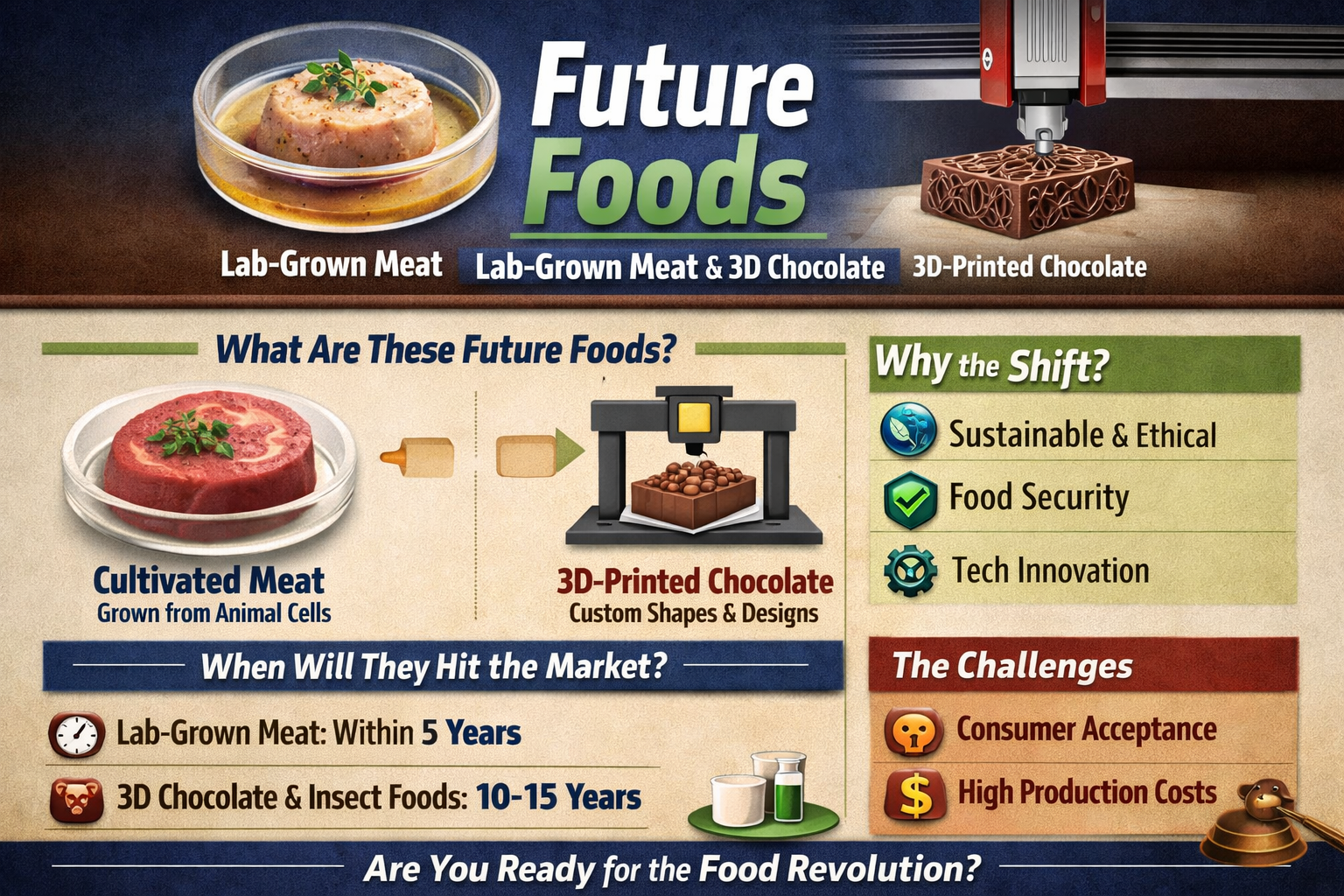
The food sector is awaiting an imminent technological revolution, and technologies like foie gras produced in laboratories and chocolate created through 3D printing are leaving the laboratory stage and are heading to the shelves of supermarkets. A recent report cites how such futuristic food ideas that were formerly regarded as science fiction may have found their way into the mainstream diets in no more than 10 to 15 years. The changes can be seen as a general trend towards sustainable, efficient, and technology-driven food systems that would supply a large population of the world with enough food without excessive environmental degradation.
Regulators and scientists are studying these new food technologies with particular attention, and this means that the process of novelty to mainstream consumption may occur faster than anticipated. With the pace of innovation, whether these foods will come or not is not a question anymore, but rather how the society will receive them.
What Are These Future Foods?
The center of this transformation is the cultivated or lab-grown meat, such as foie gras, which is traditionally made controversially, having to be force-fed to ducks or geese. By contrast, lab-grown ones are prepared using a tiny sample of animal cells and replicating them in sterile cultures like bioreactors. The process does not require the rearing and slaughtering of animals, and its goal is to imitate the flavor and texture of traditional meat.
The other food innovation area, in conjunction with this, is 3D-printed chocolate. The chocolate and other edible substances can be molded into detailed patterns or tailor-made nutritional profiles using special printers. Such technology is yet to be fully developed, but it has the potential to offer personalized nutrition to people, particularly those with dieting or health care requirements.
The other inventions are edible insects, cheese that is brewed in the laboratory, and food produced during fermentation, where the gases such as carbon dioxide are converted into protein based products.
How quickly will these foods be available? Timeline: How Soon Will These Foods be?
According to experts, some of these products may be made available to consumers in the next five years, especially the lab-grown meats, which are currently being tested in terms of safety.
The more complicate or unorthodox foods, including 3D-printed products and insect-based foods, will require 10-15 years to become popular and accepted by regulators.
This schedule is an indicator of technological maturity and stringent safety evaluations. Food regulators are considering all possible risks, such as allergens, toxicity, and long-term health impacts, and only approve these products to be consumed by the population.
The reason The Food Industry Is Changing
There are various pressures in the world influencing the fast-emerging alternative food technologies. Among the most important ones is the necessity to feed an increasing population without putting more pressure on the natural resources. Conventional livestock production consumes vast tracts of land, water, and feed, which are some of the causes of environmental degradation (deforestation and greenhouse gases).
The alternative provided by lab-grown meat and other innovations is more sustainable since they do not use many resources and have minimal impact on the environment. Also, the technologies are ethical in terms of animal welfare, especially in the production of delicacies such as foie gras.
Food security is another important motive. Growing food in controlled settings will enable nations to cut down on imports and build more robust supply chains. This especially matters amidst climate change, which is still affecting the conventional farming.
Challenges and Concerns
Although there are future food promises, there are a number of challenges. Consumer acceptance is one of the greatest obstacles. Lab-grown or technologically produced foods are still not readily accepted by many people, which can be explained by the fact that they are believed to be unsafe, untasty, and unnatural.
Another major hindrance is cost. The cost of lab-grown meat is rather high when compared to the conventional farming techniques at the moment, even though the cost is likely to be lowered in the future due to the scale of technology. It will require a lot of investment and innovation in order to scale up production to satisfy world demand.
It is also vital that regulation is involved. Before these new foods can be granted for consumption, authorities need to ensure that the foods are of high standards of safety. These involve assessment of possible health hazards and transparency on labeling to inform the consumers.
Concerns also exist regarding the effect of the same on the traditional farming industries. With the rapid uptake of alternative food technology, farmers and the rural population might not be able to enjoy economic opportunities, and the question of balancing innovation and livelihoods arises.
The part played by technology in determining diets.
Technology is also playing an increasingly important role in influencing not only the production of food, but also its consumption. 3D printing, as an example, would allow much more personalized diets based on the nutritional requirements of a particular person. This may specifically be useful in the health sector, where patients need a certain combination of nutrients.
In the same way, the development of biotechnology is also making it possible to develop new types of foods altogether, and the distinction between what is natural and what is not is ambiguous. These trends are disrupting the conventional definitions of food and are compelling society to redefine what is good or acceptable.
A Shift in Consumer Mindset
These innovations will have to be brought nearer to reality, but a change in consumer mentality will be necessary. Trust will be built, and adoption promoted through education and transparency. Such essential aspects as clear labeling, openness in communication regarding the production processes, and evidence of safety will play a crucial role in clearing the skepticism.
Early adoption may be led by younger generations who are usually more receptive to technological change and a green agenda. In the long run, these foods may be considered ordinary dietary foods as they will be more readily available and relatively inexpensive.
A Turning Point to Global Food System
The introduction of lab-grown foie gras, 3D-printed chocolate, and other new foods is a new beginning in the development of the world food system. Such technologies are capable not only of solving some of the most urgent problems of our time, such as environmental sustainability, but also food security and ethical consumption.
Nonetheless, only with decent regulation, close implementation, and popularization will they be successful. The shift to the new food paradigm will be gradual, and yet the trend is evident: science and technology will have as potent an influence on the future of food as tradition and culture.