
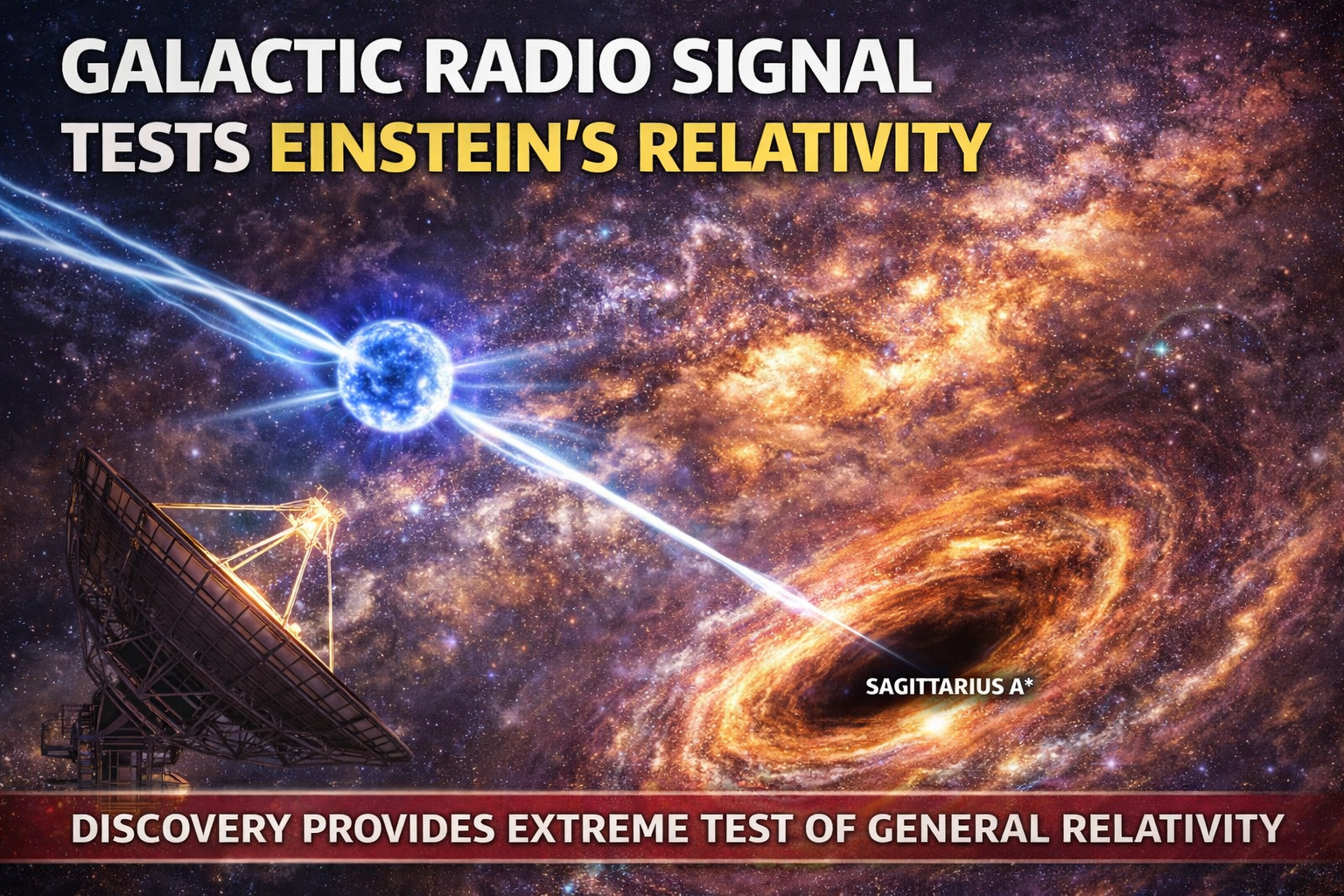
Astronomers have discovered a signal at the very core of our galaxy that has the potential of giving one of the most stringent tests ever of the general theory of relativity as developed by Albert Einstein. This potential pulsar, a quickly rotating neutron star which bursts emitting radio waves on regular intervals, was identified close to the supermassive black hole of Sagittarius A, and has caused a stir in the community of astrophysics due to the potential information it gives regarding the nature of the gravity in one of the most extreme environments of the Universe.
This finding is important because it would allow the investigation of space and time bending in a manner that has never been achieved in the past. Provided this pulsar is confirmed, it will be the nearest pulsar to be found to this gravitational monster at the core of the Milky Way, and may offer a natural laboratory in which the effects predicted by general relativity can be studied on a grander scale than those that have ever been observed.
On February 9, 2026, the study was announced in The Astrophysical Journal by a group of researchers headed by Karen I. Perez, who is a postdoctoral researcher affiliated with Columbia University and the Breakthrough Listen project. The team has made one of the most sensitive surveys of pulsars ever done on the Galactic Center using the National Science Foundation Green Bank Telescope, analyzing over 20 hours of radio data. What came out of such an analysis was an interesting signal by a candidate millisecond pulsar at a period of approximately 8.19 milliseconds of rotation; very fast by the standards of normal neutron stars.
Pulsars are neutron stars, the remains of very large stars which had supernova explosions, which were condensed into bodies as small as only 20 kilometers in diameter and yet were more massive than our Sun. These stars as they rotate release the beams of radio waves through their magnetic poles that cover space like beacons on a lighthouse. These radio pulses are very regular when they coincide with the earth, in fact they are sometimes more accurate than atomic clocks. The fact that pulsars are sensitive instruments enables them to be used in the test of the laws of physics, such as general relativity.
Pulsar in the Shadow of a Black Hole
The most interesting part about this possible discovery is that the pulsar is located very dangerously near Sagittarius A+, the supermassive black hole that the galaxy is anchored to. The area has a bad reputation among the astronomers due to its high gravitational pull, its turbulent stellar motions and its heavy concentrations of dust and gas that are very difficult to view. In the past these conditions have rendered the pulsars in the Galactic Center very difficult to detect despite decades of search.
In case it is, in fact, a pulsar, the scientists are wary, highlighting that further observations are required to confirm this, but it would be the first pulsar found so near a supermassive black hole. The closest fast-spinning neutron star to Sagittarius A was previously known is a magnetar, a related object but with a much longer rotation period and varying magnetic characteristics. A milliseconds pulsar verification in such a setting would provide a completely new perspective on the behavior of gravity at the scales where classical and quantum physics come together.
Why is that so important? Since we still cannot test Einstein general relativity, which was created over a hundred years ago, to much stronger extents, but at any rate, only in conditions that are much less extreme than those surrounding a black hole. General relativity is a theory of gravity that does not consider it as a force, but a curvature of space and time due to mass and energy. These curvatures become extreme in the strong gravitational field around a black hole, and some other theories have proposed theoretical alternatives to general relativity that predict minute distortions in the motion of objects or the passage of time itself.
Scientifically, this would be realized by scientists observing the times of the pulsar radio pulse as it rotates and interacts with Sagittarius A. According to the scheme of Einstein, the pulses are expected to reach with small though determinable delays or phases, depending on the manner in which the mass of the black hole distorts space and time. Any consistent nonconformity to such predictions can be an indication of new physics – a possible hint at how general relativity might be reconciled with quantum mechanics, one of the outstanding issues of current theoretical physics.
Probing Gravity’s Extremes
The presence of a confirmed pulsar in the orbit of Sagittarius A+ would enable scientists to measure such effects as gravitational redshift – the rate of light or radio wave oscillations in a strong gravity field – and frame dragging – the rotation of the space-time of a massive object. The effects have been deduced elsewhere, e.g. in the orbit of stars near to black holes or when detecting gravitational waves produced by colliding neutron stars, though never with the accuracy potentially provided by a millisecond pulsar.
The discovery is also consonant with the larger attempts in astrophysics to push the understanding of the theory of Einstein to the furthest extremes. As an example, the existence of the gravitational waves recorded by the LIGO and Virgo observatories has proved the predictions of the predictions of general relativity in the trembling space-time caused by the disastrous collisions of black holes and neutron stars. But even such tests, though of monumental character, are of a different kind than the one of timing the ticks of a pulsar in the gravitational field of a supermassive black hole, which are measured with a high degree of precision.
Furthermore, the mere fact that the signal was received supports the progress in radio astronomy. The Galactic Center has been a hard nut to crack due to the interstellar gas and dust which scatter and absorb radio waves and masks the signals which are easily detectable in other places. The fact that the survey at Breakthrough Listen of looking at a promising candidate occurred not only speaks to the sensitivity of advanced technology such as the Green Bank Telescope but also to a creative application of the data obtained to search extraterrestrial intelligence to discover an underlying astrophysical fact.
Despite the excitement, scientists are careful not to claim a definitive discovery just yet. Additional observations are needed to confirm that the signal truly originates from a pulsar and not another exotic source. In radio astronomy, nature often surprises researchers with signals that mimic expected patterns or come from unexpected astrophysical phenomena. The history of pulsar hunting is full of false starts and tentative candidates that ultimately proved to be something else.
However, the early results are promising, and the team’s decision to publish the data openly invites independent analysis and complementary research from astronomers around the world. If confirmed, this pulsar will become one of the most valuable astrophysical tools ever found — a cosmic clock ticking under conditions where spacetime is stretched and strained by gravity to a degree no laboratory on Earth could ever replicate.