
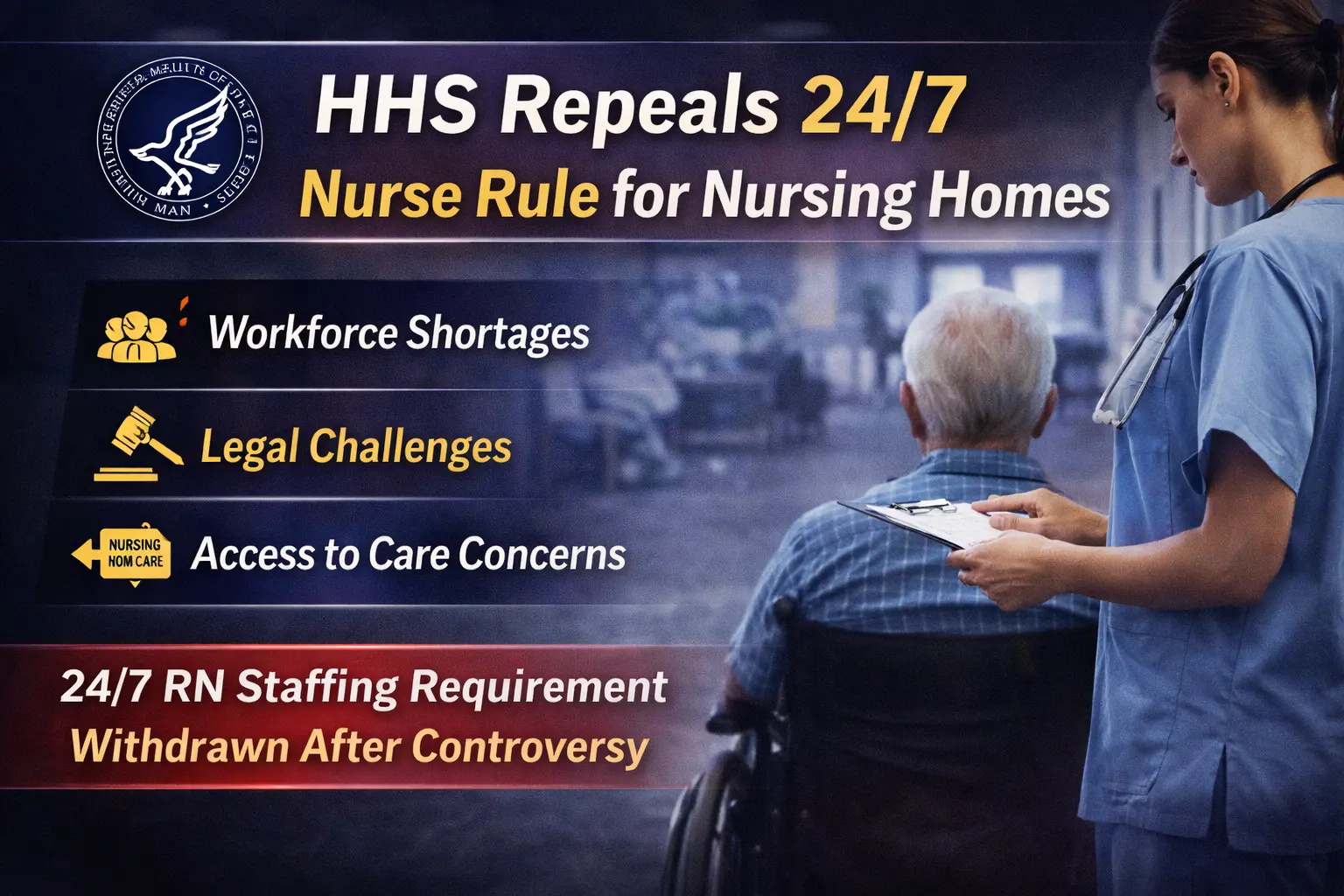
The U.S. Department of Health and Human Services (HHS) officially removed a regulation that would have required nursing homes to ensure the presence of a registered nurse (RN) 24 and 7 days a week. The decision is a significant regression of a Biden administration proposal to achieve better staffing levels in the long-term care facilities following the horrific impact of COVID-19 on nursing home patients.
Since then, the repeal has become the center of another controversy within the healthcare industry, with providers, legislators, and patient groups debating whether federal staffing requirements contribute to improving or complicating access to care.
The Rule that caused the Problem
Centers for Medicare and Medicaid Services (CMS) established the initial regulation in 2024 to establish the minimum staffing at nursing homes receiving Medicare and Medicaid funding. This stated that every resident was required to receive at least 3.48 hours of nursing care per day and that at least some of the hours had to be provided by registered nurses or certified nurse aides.
Among the key provisions of the rule, it was that an RN was required to be present in nursing homes at all times. Advocates opined that it is needed to have an RN around the clock to respond to medical emergencies, monitor aids, and ensure the safety of patients.
More Reasons Why the Rule was Never Implemented Entirely
Although it was an attempt to assist, the business of the nursing home reacted instantly to the staffing requirement. Operators reported that it became impossible to comply due to acute shortages of workers, particularly in rural and tribal areas. Most of the facilities claimed that they could not find enough skilled RNs, even if they were willing to pay more.
Subsequently, there were legal issues. The rule was struck down in 2025 by a federal judge who claimed that CMS had exceeded its authority by proposing stringent staffing restrictions without Congressional authorization. That ruling was in effect a hold on the mandate in that the newly appointed management at HHS had an opportunity to reconsider the policy.
Why HHS Wants to Repeal
HHS indicated that the repeal was necessary to ensure people do not receive care, rather than revert to quality standards. Authorities indicated that the implementation of the 24/7 RN regulation would have seen certain nursing homes, particularly in locations that have minimal facilities, reduce the number of patients they attend to or even shut down.
The government added that a federal requirement applicable to all people did not consider the workforce variations across the regions and might have eased the problem of access rather than improving it. The repeal was changed as an interim final rule, which permitted HHS to move fast and still allowed the populace to provide their view.
The Nursing Homes Industry groups were pleased with the outcome. According to trade groups and nursing home owners, the repeal takes into consideration the reality that there is an ongoing staffing problem that no law can resolve in one day.
The providers claimed they prefer high-quality care, but they also stated that staffing needs with less money or programs to train more workers are not sustainable. Most individuals claimed that the current standards of payments in Medicaid are already at levels that cannot sustain the current costs of operation. Hence, no extra RNs can be hired to meet the expected levels.
Caregiver and patient advocate anger.
This was the cause of great concern among patient advocacy groups. Residents and their families’ representation groups claimed that the removal of minimum staffing regulations will leave one of the few safeguards against understaffed institutions.
Proponents pointed to the literature that demonstrated that an increase in the number of workers caused a decrease in falls, infections, prescription errors, and preventable deaths. To them, the repeal is a disturbing portent of the fact that accountability has been moved aside to allow industry comfort, which may endanger innocent citizens.
How the Repeal Will Affect Those in Nursing Homes
Actual different impacts on residents and their families are likely to be experienced once the repeal is repealed. Others might not see any difference if they have a high number of staff members. In contrast, other facilities might continue with a limited number of nurses, particularly during the night.
The absence of federal minimums will largely leave staffing decisions to state legislation, facility budgets and local job market conditions. Other individuals are concerned that it may expand the gap between the quality of care available in well-endowed metropolitan facilities and in under-funded rural homes or for-profit homes.
The Bigger Policy Problem
The repeal throws another problem of the U.S. healthcare policy into focus since time immemorial: should national standards be universally applied or adjusted to the local demands? The number of staff required can enhance the quality of treatment, but it cannot create nurses out of nothingness.
Increasingly, the experts are coming to the view that the problems of staffing in nursing homes lie deeper than just lower wages, burnout, and the absence of training, and long-term care is perpetually underfunded by Medicaid.
According to the Editorial View: Not a solution, but a retreat that had to be made
The repeal did not go to win or to lose in an editorial light; it is a realization of the boundaries of policy. The first rule was morally but not practically easy to follow. The demand to have 24/7 RN care without fixing the issue related to the staffing and payment gaps first left the pressure on the hospitals that were least equipped to address it.
However, in case the provision is repealed without a good alternative, then understaffing might become a way of life. The federal regulators are correct that the law will not be the solution. Nonetheless, it is not sufficient to discard them and not provide them with investment, incentives, and responsibility.
Unless it is a reset and not a repeal, this will keep the long-term care system caught between its desires and its capabilities. The true test of HHS will be that it adheres to this decision with real workforce development, specific funding, and specific quality supervision.
What’s Next
HHS has launched a public comment period on the interim final rule, and both sides of the issue are getting ready for the next step. Congress may also become involved again, especially when it comes to funding for nurse education, rural healthcare support, and changes to Medicaid reimbursement.
For now, the repeal makes a terrible fact clear: to make nursing home care better, we need more than just rules. We need long-term political will, money, and a real commitment to treating caregivers as important professionals rather than just workers.