
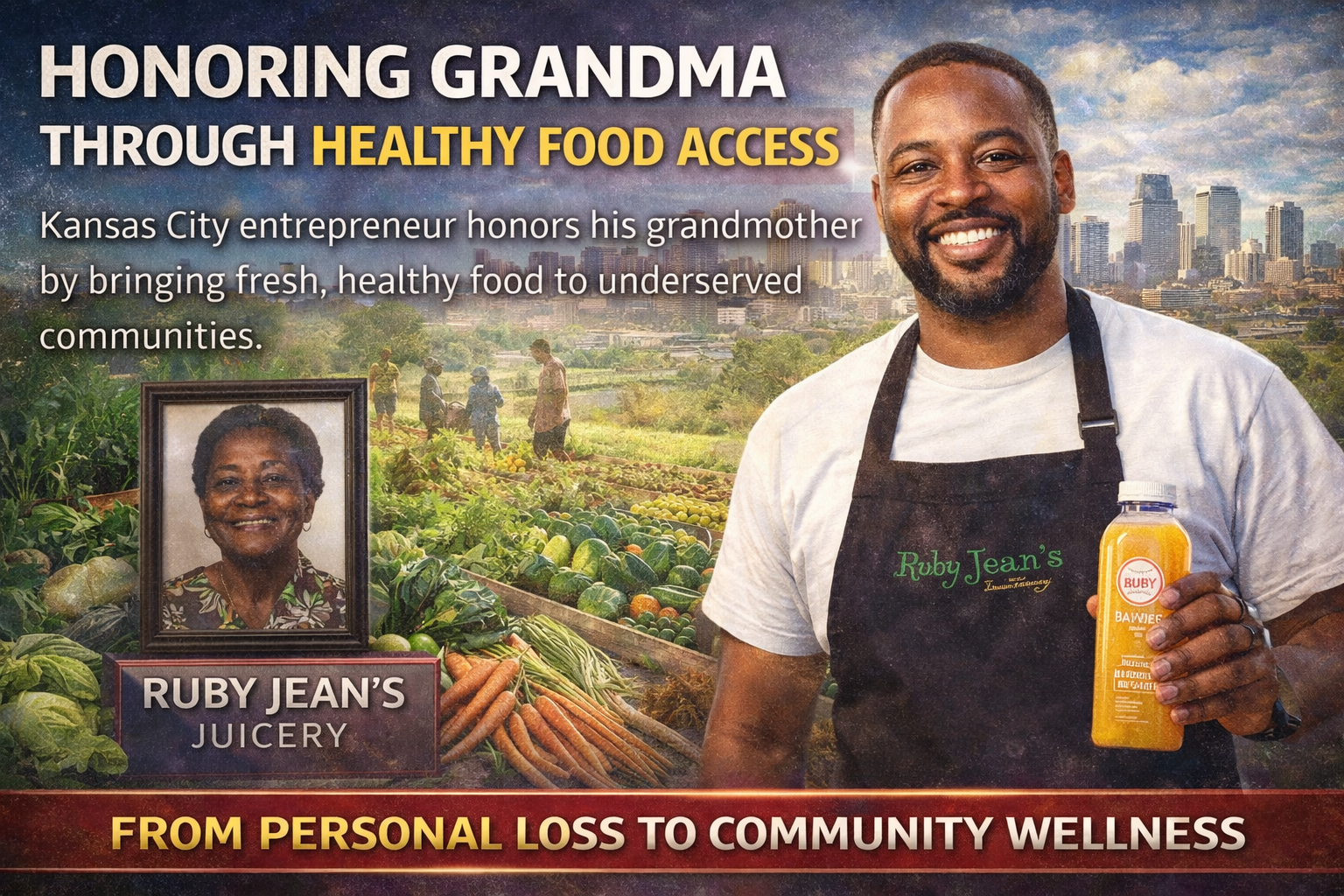
Kansas City — Chris Goode, at the age of 14 years of age, has lost one of the important figures in his life, his grandmother, Ruben Jean. She succumbed to complications of type 2 diabetes, hypertension, and kidney disease that are highly diet-related as well as lifestyle-related. To most people, this would be a personal memory of loss. To Goode, however, it turned into the kernel of a movement that has blossomed into one of the most impactful health-based food brands to date in Missouri, and a strong illustration of community strength.
Goode has been a long-time proprietor of Ruby Jean’s Juicery, one of the businesses that he established on the east side of Kansas City in order to address a long-standing issue that affected historically underserved communities in America, i.e., the lack of access to affordable, fresh, and nutritious food. The juicery, named after his grandmother, is much more than a juice bar at this point, as it is a symbol of health equity, community empowerment, and generational change.
Roots in a Food Desert
The east side of Kansas City has been grappling with a problem commonly referred to by experts as food deserts, an area in which the residents have poor accessibility to full-service grocery stores and fresh produce. This fact is not merely a matter of convenience; it is a matter of health results. Research indicates that neighborhoods where there is no healthy food are prone to a higher level of chronic illness, such as diabetes and heart disease. Several decades of redlining and economic disinvestment have resulted in the community east of Troost Avenue having fewer food options and more disease burden.
The very idea of Goode starting his juicery in the very building where he used to go as a child has a very symbolic meaning. It is reclaiming space and identity – a local son coming back to serve his community in a manner that respects both his grandmother and the thousands of families that are going through the same health issues that his grandmother had to.
He said that he made this mental note to himself, such as, man, people are going to know about my grandma. They will know who she was, what they were… I was not aware of what the mechanism would be.
Between Inspiration and Enterprise
The path that Goode took on his way to advocating healthy food started with an inspirational point. It was on a visit to Los Angeles that he watched the documentary Fat, Sick & Nearly Dead, which narrates how a man changed his health through a juicing program. It was an eye-opener: could the same laws of food and prevention be included in the solution in the home country?
That incident gave rise to what [Goode] describes as a movement in local media houses. It is the most important thing that exists because the knowledge of a healthier existence is an access to well-being.
The opening of the first 100 percent health-oriented food business on the east side of Kansas City was not an easy task. Over the years, the population in this section of the city had little access to any alternative food other than fast food and food stores – foods which are known to cause chronic diseases. Ruby Jean Juicery offered something different: cold-pressed juices, smoothies, and vegetarian items, which are healthy and tasty.
Growth Beyond Expectations
The success of Ruby Jean soon spread out of its flagship branch. Goode has distributed his juice products to retailers such as Whole Foods stores through partnerships and innovation, which is why his brand is available to customers in the United States of America. By so doing, he succeeded in what most of the small business originators can only fantasize about, and that is mass distribution without losing the original purpose.
Ruby Jean, according to the recent coverage, employs high-pressure processing technology to increase the shelf life of juices without heating or preservatives. This enables the products to access far-flung communities and, at the same time, ensure that their nutrients are not lost, and this is a technical way the brand has managed to compete in a saturated market.
But the ambitions of Goode are not limited to business development. He has also insisted on several occasions that his north star is longevity, not only of his company, but of the people his work is meant to serve. To him, longevity is not just about living longer, but it is living better and more opportunity-filled, no matter what ZIP code you live in.
The Greater Health Equity Movement
The foundation of Ruby Jean functions today, along with the business, in the continuation of this mission. Its community programs involve free juice to kids, gardens that promote sustainable food production, neighborhood clean-ups and wellness programs. These initiatives are indicators of an increasing awareness that food availability, education and community involvement should be interlocked.
The work by Goode is in line with more organizations and leaders in the Kansas City region who discuss food inequity. Such organizations as KC Health Initiative concentrate on urban agriculture and nutrition education as a solution to the problem of food insecurity and empowerment of the family by knowledge and cultural affiliation.
Equally, local initiatives, such as community gardens and mutual aid food distributions, are transforming the way people obtain fresh food and healthy meals. These efforts also recognise that access to food is not simply an economic issue, but also a question of dignity, culture and community resilience.
Mediation: Reflection on a Personal Mission With a Wide Scope
Being a news editor and working on the coverage of the community health issues throughout the years, the most impressive part of the journey of Goode is the interaction between personal motivation and systemic change. It is not merely a narrative of a prosperous businessperson, but it is a narrative of how an individual can spur more extensive discussions on the subject of health equity.
Far too frequently, the discourse of food deserts and nutrition inequalities revolves around figures – the number of stores that have been lost, the disease rates, or the economic differences. But Goode makes us remember that behind every figure, there are actual people, actual families and actual histories. By remembrance of his grandmother’s memory by making his community healthier, a personal loss is turned into a community win.
Another important point brought out by his approach is that health equity does not occur by chance. It involves deliberate decisions, community investment, and models of business, which are people-oriented instead of profit-oriented models. Ruby Jean Juicery, in a number of aspects, is a living example of what a socially conscious business can do.
In addition to this, the story breaks stereotypes concerning underserved neighborhoods. It demonstrates communities not as passive participants in structural inequity, but as active agents in solution design, be it by entrepreneurship, nonprofit models or grassroots organizing.
Looking Ahead
While progress has been made, there’s still much work to be done. Long-standing disparities in food access and chronic disease rates will not be solved overnight. But the model that Goode and others are advancing one that combines economic opportunity with health advocacy offers a promising blueprint for other cities grappling with similar challenges.
In the end, Chris Goode is more than a juice maker. He represents a new generation of community builders individuals who see business not just as commerce, but as a vehicle for healing and transformation. And in honoring his grandmother’s legacy, he has given a powerful gift to Kansas City and beyond.