
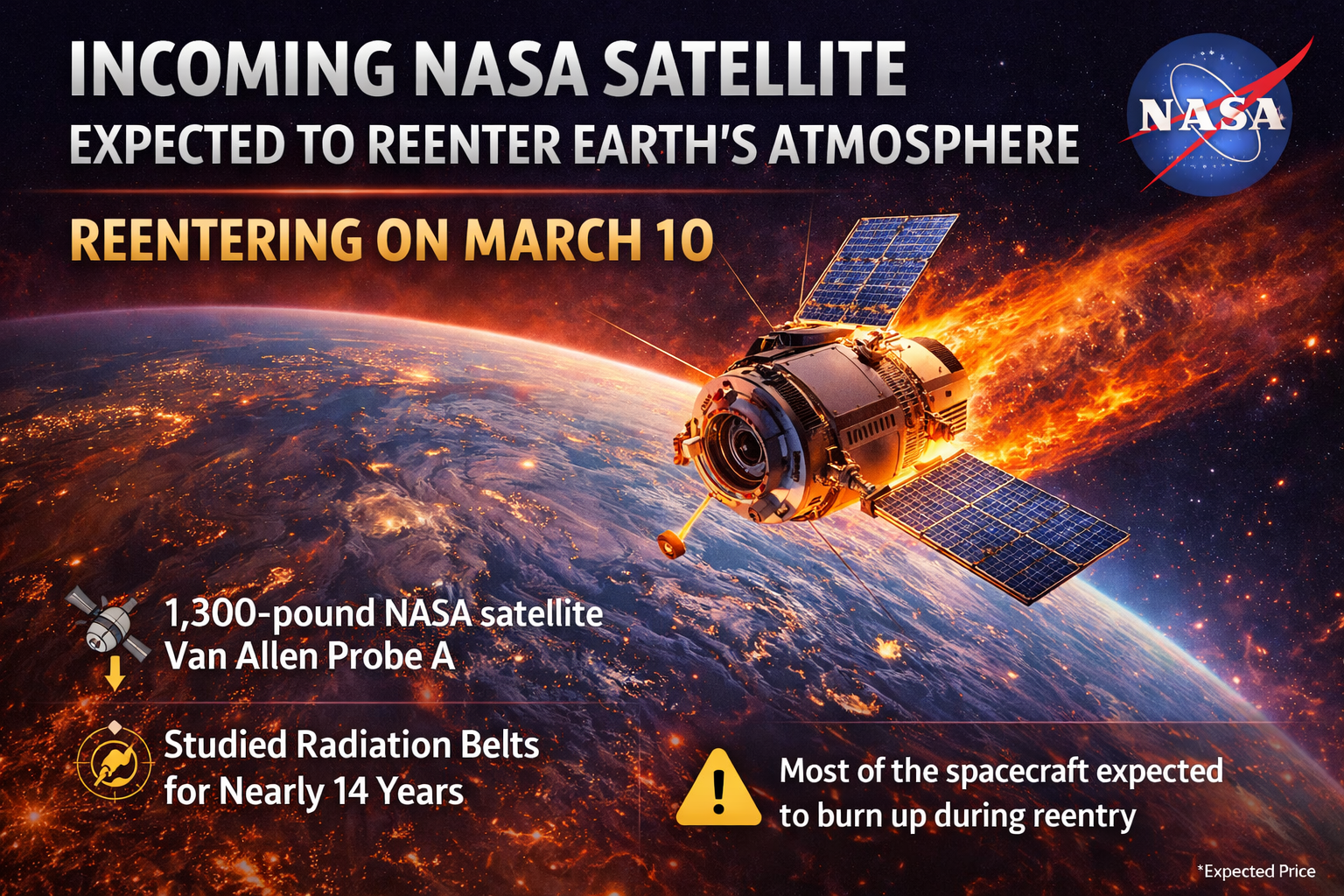
A retired NASA satellite weighing about 1,300 pounds is expected to reenter Earth’s atmosphere on March 10, drawing attention from scientists, space agencies, and the public. The spacecraft, known as Van Allen Probe A, has spent nearly fourteen years in orbit studying the radiation environment surrounding Earth. Its mission helped scientists better understand the dangerous zones of energetic particles that exist in space, known as the Van Allen radiation belts. After completing its primary mission and running out of fuel, the satellite’s orbit has gradually decayed over time. According to tracking data from the U.S. Space Force, the spacecraft is predicted to fall back into Earth’s atmosphere around 7:45 p.m. Eastern Time on March 10, although the exact timing could vary by several hours because orbital decay is difficult to predict precisely. Although the idea of a satellite crashing to Earth may sound alarming, scientists say the risk to people on the ground is extremely small. Most of the spacecraft will burn up in the atmosphere during reentry, with only small fragments potentially reaching the surface.
The Mission of the Van Allen Probes
The satellite scheduled for reentry was originally launched in August 2012 as part of NASA’s Van Allen Probes mission, formerly called the Radiation Belt Storm Probes. The mission included two identical spacecraft—Probe A and Probe B—designed to study the radiation belts that surround Earth.These belts are regions of intense radiation trapped by Earth’s magnetic field. They consist of charged particles originating from the Sun and cosmic rays that become captured by the planet’s magnetosphere.
The Van Allen radiation belts were first discovered in 1958 by physicist James Van Allen, and they remain one of the most important features of near-Earth space. The belts pose potential hazards for satellites, astronauts, and spacecraft electronics because the high-energy particles can damage sensitive instruments.NASA launched the Van Allen Probes to better understand how these radiation belts form, how they change during solar storms, and how they affect spacecraft operating in orbit.
Over the course of their mission, the twin satellites collected valuable data about the behavior of charged particles in Earth’s magnetic environment. The probes also discovered unexpected phenomena, including the temporary formation of a third radiation belt, which appeared during periods of intense solar activity.
End of Mission and Orbital Decay
Although the Van Allen Probes were originally designed for a mission lasting about two years, both spacecraft exceeded expectations and continued operating for several additional years. Their extended lifespan allowed scientists to gather a large volume of data about space weather and radiation dynamics.However, by 2019, both spacecraft had exhausted their fuel supply and were officially deactivated. Once inactive, the satellites could no longer maintain their orbital positions or perform maneuvers to avoid orbital decay.Gradually, the gravitational pull of Earth and atmospheric drag began lowering the orbit of Probe A. Over time, this process caused the spacecraft to descend closer to the atmosphere until reentry became inevitable.Orbital decay is a common fate for satellites operating in low Earth orbit. Many spacecraft are intentionally directed to reenter the atmosphere at the end of their missions, while others naturally lose altitude over time.
What Happens During Reentry
When a satellite reenters Earth’s atmosphere, it travels at extremely high speeds—often more than 17,000 miles per hour. As the spacecraft encounters increasingly dense layers of air, friction generates intense heat that causes most components to burn up.This process is similar to the fiery streaks seen during meteor showers. The majority of satellites disintegrate completely before reaching the ground.For larger spacecraft, some components may survive reentry and fall to Earth as debris. However, these fragments are usually scattered across remote areas such as oceans or uninhabited land.Experts emphasize that the likelihood of debris striking populated areas is extremely low. Statistically, the chance of a person being injured by falling space debris is estimated to be less than one in many billions.
Tracking the Reentry
The U.S. Space Force and other international tracking organizations monitor satellites and orbital debris using radar and optical observation systems. These systems allow scientists to estimate the time and location of reentry events. However, predicting the exact moment of reentry remains challenging because atmospheric conditions change constantly. Variations in solar activity can expand or contract the upper atmosphere, which affects how quickly satellites lose altitude. As a result, predictions often include a time window of several hours before and after the estimated reentry time. In the case of Van Allen Probe A, experts have provided an approximate reentry estimate but continue updating calculations as new data becomes available.
The Growing Issue of Space Debris
The reentry of the Van Allen Probe highlights a broader issue facing the space industry: the increasing amount of debris in Earth orbit. Since the dawn of the space age, thousands of satellites and rocket components have been launched into space. Many of these objects remain in orbit long after their missions end. Some debris fragments are extremely small—sometimes no larger than a paint chip—but they still travel at extremely high speeds. Even tiny particles can damage spacecraft or satellites if collisions occur.International space agencies have developed guidelines to reduce space debris. These include designing satellites that can safely deorbit at the end of their missions and limiting the creation of additional debris.
Scientific Contributions of the Mission
Despite its dramatic final return to Earth, the Van Allen Probe A spacecraft leaves behind a legacy of important scientific discoveries.
The mission provided detailed measurements of particle acceleration and magnetic field interactions within the radiation belts. These observations improved scientists’ understanding of how solar storms influence Earth’s space environment.
The probes also helped researchers develop better models for predicting space weather events. These predictions are important for protecting satellites, astronauts, and power grids from the effects of solar radiation.
In addition, the mission contributed to improved spacecraft design by helping engineers understand the radiation risks faced by satellites operating in Earth orbit.
Why the Radiation Belts Matter
The Van Allen radiation belts play a crucial role in space exploration and satellite operations. Because these regions contain high-energy particles, spacecraft traveling through them must be carefully shielded. Satellites that spend extended periods within the belts may experience electronic damage or system failures if they are not properly protected. Understanding the behavior of these radiation zones is also essential for future human missions beyond Earth orbit. Astronauts traveling to the Moon or Mars must pass through these regions during their journeys. By studying the radiation belts, NASA scientists have gained valuable insights that will help make future deep-space missions safer.