
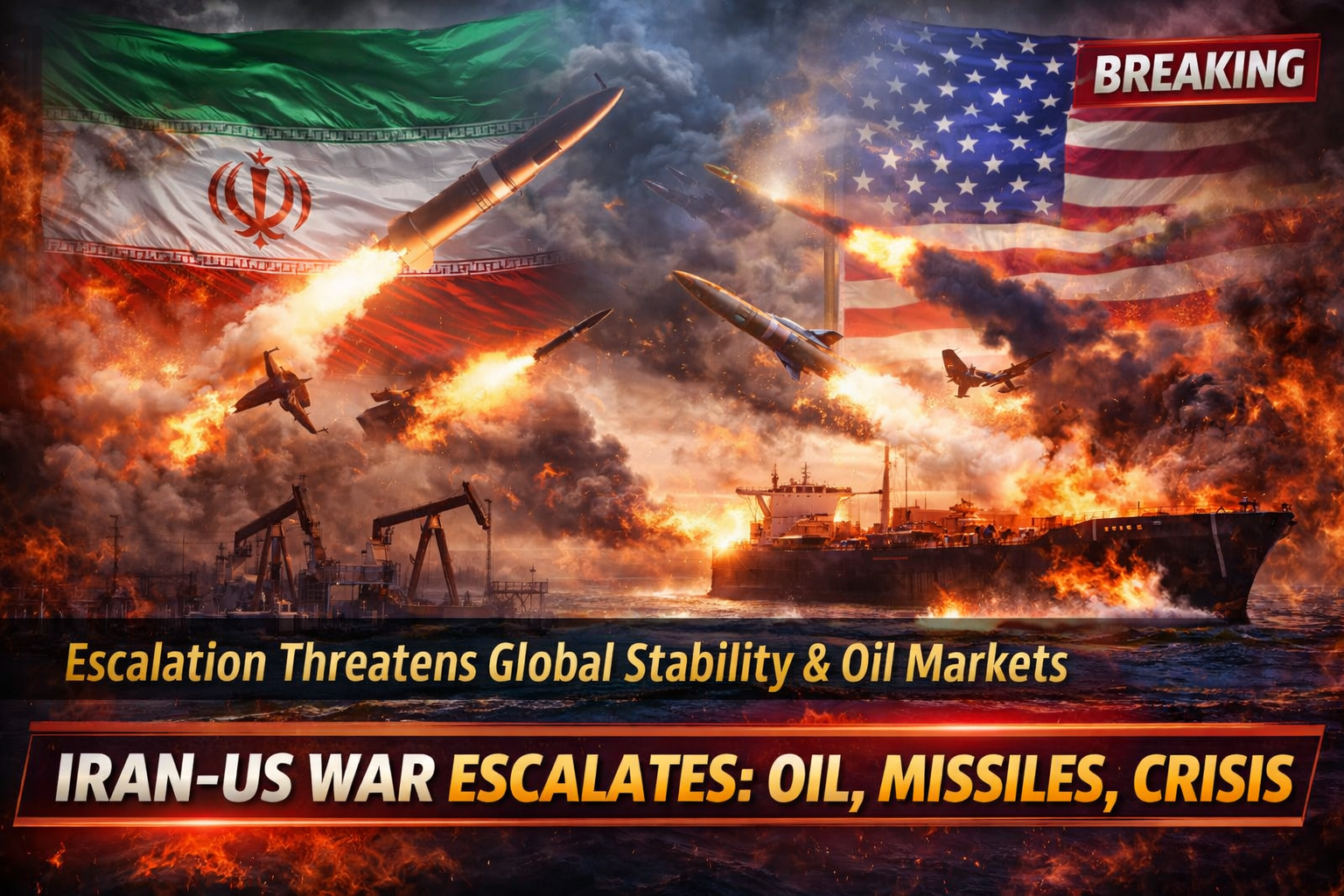
The current war between the United States, Israel, and Iran has already taken a very unstable stage where military attacks have escalated, and geopolitical tensions as well as economic losses have been very high in the world markets. What started as surgical attacks on Iranian nuclear and military installations has quickly transformed into a regional crisis with a number of countries and hot spots.
The current trends have shown an increasing threat of aggressivity. The Iranians have made missile and drone attacks and have not only injured personnel but also destroyed important infrastructure within the US military bases in the Middle East. The United States and Israel have, in turn, followed up with coordinated strikes on Iranian targets, including nuclear-related facilities and military bases. Such attacks indicate the transition of the limited engagement to the long-term confrontation, and it is concerned with the potential of the long-term conflict.
One of the most important centers of interest in the crisis is the Strait of Hormuz, which is one of the most crucial oil transit points in the world. The move by Iran to limit or partly close down access to the strait has caused panic in the international energy market. This is a very narrow waterway through which almost 20 percent of the global oil supply passes, and any obstruction to the passage is a great threat to the stability of the global economy. This has caused a sharp rise in oil prices, and markets have responded violently to the threat of long-term supply tightening as well as the unrest in the region.
Military planning has also been affected by the strategic relevance of the Strait of Hormuz. The United States is also said to be considering various alternative ways of winning the war at sea, and one of those is the deployment of the Navy and the possibility of air-sea operations to reduce the Iranian control. Nevertheless, these actions have high costs, such as the threat of further growth of the region and open conflict with the forces of Iran.
In the meantime, Israel has increased its military activities and has been striking deep into the territory of Iran, including Tehran. These moves are in a wider campaign to disempower the military capability of Iran and put off any further aggression. The Israeli leadership has insisted that the capabilities of Iran to make nuclear arms and ballistic missiles have been severely weakened. However, Tehran has refuted the arguments and has been responding with force.
Regional players have also been involved in the conflict, making the situation worse. Gulf countries like Saudi Arabia and the United Arab Emirates have denounced Iranian attacks and demand more serious actions to stem the military capacity of Tehran. Some nations are demanding a quick fix to this issue. Still, others are demanding that any form of agreement should put a permanent limit on the capacity of Iran to destabilize the region. This disagreement underscores the difficulty of having a coherent diplomatic reaction.
In the diplomatic arena, there are signals that are mixed about the possible negotiations. The US leadership has indicated that it may reach a point where talks with Iran may see a resolution coming after a few weeks, and ground troop deployment may not be required. Nevertheless, the Iranian officials have openly refuted the talks, claiming that such statements are false information. This discontinuity highlights the weak and unsure character of diplomacy in the present setting.
Humanitarian and economic effects of the war are also becoming very clear. An increase in oil prices has added to inflationary forces in the global regions, which has impacted all aspects of fuel prices and supply chains. The financial markets have been volatile, and this is indicative of the worry of investors about the wider consequences of the crisis. The loss of civilian lives and displacement are also on the increase in the region, and the damage to infrastructure adds to the humanitarian cost.
The threat of further deterioration of such a situation with more players is another important issue. The Iran-supported forces and allied militias in the Middle East have also threatened to get into the conflict, and this has posed a threat of having a multi-front war. Meanwhile, countries such as the United Kingdom and the European Union members urged restraint and stated that diplomatic measures should be used to avoid a broader disaster.
It has introduced a new twist to the conflict with the use of sophisticated weapons such as drones, ballistic missiles, and even cyberattacks. These technologies allow military conflicts to spiral fast and make them more unpredictable. The fight is further complicated by the fact that cyber operations are being conducted to attack the critical infrastructure and government systems, making the distinction between conventional and hybrid warfare unclear.
It is also possible that the conflict can be de-escalated within a thin margin, in spite of its magnitude. The world organizations and the world powers are busy taking up these roles of mediation and prevention of any further worsening. The success of such initiatives, however, relies on the goodwill of all the participants to let go and put the future stability first rather than the strategic gains.
With the situation still in progress, the Iran-US crisis remains one of the most important geopolitical crises in recent years, and its implications on international security, energy markets, and international relations are far-reaching.
Meta Description
US-Iran war intensifies with missile strikes, Hormuz crisis, rising oil prices, and global tensions amid fragile diplomacy.