
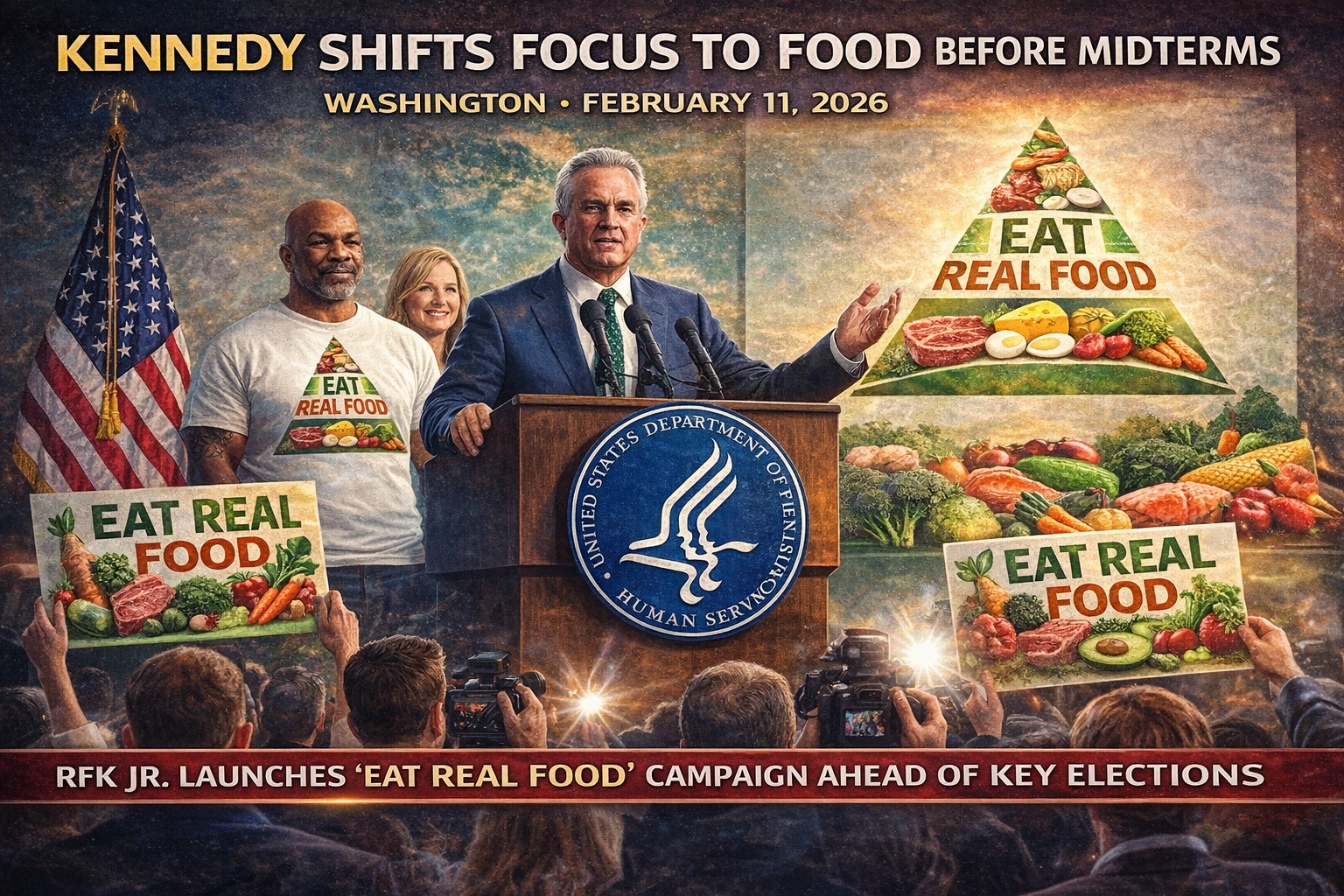
Washington, Feb. 11, 2026 – With the 2026 midterm elections just two years away, Health Secretary Robert F. Kennedy Jr. is redirecting his public attention to healthy eating, even though his first year of office was characterized by the aggressive changes he made to federal vaccine policy. Mr. Kennedy held an extremely produced event at the Department of Health and Human Services on Wednesday that was promoting his Eat Real Food agenda. It included the appearances of celebrities, proficient videos and musical introductions, which indicated the emergence of food policy as a primary pillar of his Make America Healthy Again movement.
Boxer Mike Tyson led the event after appearing in a Super Bowl commercial supporting the movement. Secretary of Agriculture Brooke Rollins also participated in the event with Mr. Kennedy, where they were both trying to promote healthy food as attainable, affordable, practical, and something every American family can afford. Mr. Kennedy vowed a consistent wave of measures in the next few months to reform the food that is served in prisons, schools and hospitals. He did not give particular details of the policy but pointed out that the federal government would be more concerned with ensuring the quality of the food in institutions.
The change indicates political facts that have been brought out by the recent polls. A survey conducted by Republican pollster Tony Fabrizio and Bob Ward looked at voters in 35 competitive districts in Congress concerning the Make America Healthy Again movement. Food and agriculture reforms were widely popular, but only one out of five voters backed the idea of rolling back any existing vaccine advice – one of the largest priorities during the first year under Mr. Kennedy as health secretary. The pollsters came to a conclusion that vaccine scepticism is widely disapproved, even among the voters who are generally in support of the MAHA agenda.
The Trump administration has urged Mr. Kennedy to prioritize issues that can bring together voters and minimize the attention of the public towards vaccine policy, according to a person close to the internal deliberations who responded on anonymity. The actions related to the vaccines are still performed in the department, though now the message has changed. In the recent past, regulators have rejected a potentially promising flu vaccine drug. Moreover, the director of one of the main federal panels on vaccination recommended that polio and measles vaccines be optional. Kennedy has been recognized as potentially valuable politically by President Trump in person.
Mr. Trump has indicated in a recent cabinet meeting that he read about an article in which it is said that Mr. Kennedy can be a very great help to the Republican Party in the midterms and that he hopes that Mr. Kennedy will be loyal to the administration. During the event on Wednesday, Mr. Kennedy complimented the president and attributed to him the credit of introducing change in the federal health policy. In the 2024 campaign, Mr. Kennedy had been hard on Mr. Trump, labeling him as a bully and a threat to democracy. However, on Wednesday, he indicated that a serious change in Washington started due to the leadership of President Trump. The whole event was more of a ceremony and less of a conventional policy rolling out. Chef and television chef Andrew Gruel made a speech.
The audience was addressed by Film producer Brett Ratner, who produced the Super Bowl commercial featuring Mr. Tyson and recently directed a documentary on former First Lady Melania Trump. There were also comments by designer and branding executive Peter Arnell, who said, We did not create a Super Bowl commercial. We started a movement.” The crowd demonstrated boiled placards with colorful pictures of steak, salmon, broccoli, apples and carrots with Eat Real Food written on them. Joe Gebbia, the billionaire Airbnb co-founder who made a pivot to the administration as the first chief design officer of the nation, designed the new branding of the campaign, such as an inverted food pyramid and an interactive website, called RealFood.gov.
Mr. Kennedy also proposed new eating habits in January that reverse the traditional food pyramid with foods like steak, cheese and whole milk on the top. He proclaimed the end of the so-called war on saturated fat and put a greater emphasis on criticizing ultraprocessed foods. The administration has positioned the changes as a response that is needed due to the prevalent concern about obesity, diabetes and diet-related chronic disease. The republican governors and lawmakers have adopted some of the food agenda. A number of governors advocate denying people on the federal Supplemental Nutrition Assistance Program (SNAP) the opportunity to use their benefits to buy sugary sodas. The initiative has been said to be a win-win for all parties, as representative Mike Haridopolos of Florida, who was present at the Wednesday event, puts it.
Democrats are, however, saying that food messaging will not counter wider concerns of health policy. The Congressional Budget Office published estimates on Wednesday that indicated that under Republican plans, there would be 1.2 trillion in Medicaid reductions in 10 years. According to Brad Woodhouse, the president of the advocacy group Protect Our Care, people tend to concentrate on health coverage cuts rather than food policy programs. The massive facts are that the people have more confidence in the democrats than republicans regarding the health care matter, according to Mr. Woodhouse. The discussion on food policy changed dramatically since Mr. Kennedy came to office. It is the same message that had been used by Republicans in the past, when they had criticized any attempts by the former First Lady Michelle Obama to encourage people toward healthier eating as government meddling in their personal lives. Other personalities opposing Mr. Kennedy on vaccines have also come to the rescue of the food initiative.
Dr. Bobby Mukkamala, the president of the American Medical Association, joined hands with the health secretary in the event on Wednesday. Despite the feud between the A.M.A. and Mr. Kennedy regarding the issue of vaccine policy, Dr. Mukkamala teamed up with him to note the relevance of dealing with the problem of diet-related health issues. Dr. Ezekiel Emanuel, an advisor to the former President Joseph R. Biden Jr., called the food program good, though he warned that people should not focus too much on eating a lot of red meat, as this is linked to heart disease. He also termed the Super Bowl advertisement as a constructive move. In support of the campaign by Mr. Kennedy against ultraprocessed foods, Dr. David Kessler, a commissioner at the Food and Drug Administration of the Republican and Democratic administrations, has assisted. Dr. Kessler provided a petition to the F.D.A. requesting it to further characterize and control ultraprocessed foods, as well as to have the food industry conduct safety research on some of its ingredients.
Calley Means, one of the senior advisors to Mr. Kennedy, indicated that the administration would look into the petition of Dr. Kessler and react to the same. The food focus is not the first occasion when Mr. Kennedy is trying to change the subject matter and forget about vaccines. Last year, at his confirmation hearings, his advisors urged him to minimise the concern over vaccines. Charles Eisenstein, the speechwriter of Mr. Kennedy in his 2024 presidential campaign, told him that the speechmakers tried not to focus their messaging on vaccine debates. As the midterm elections are coming in, the food agenda of Mr. Kennedy is now placed on his front burner, as the administration looks to win a wide cross-cutting of voters, and tries to balance the debate on vaccine policy.