
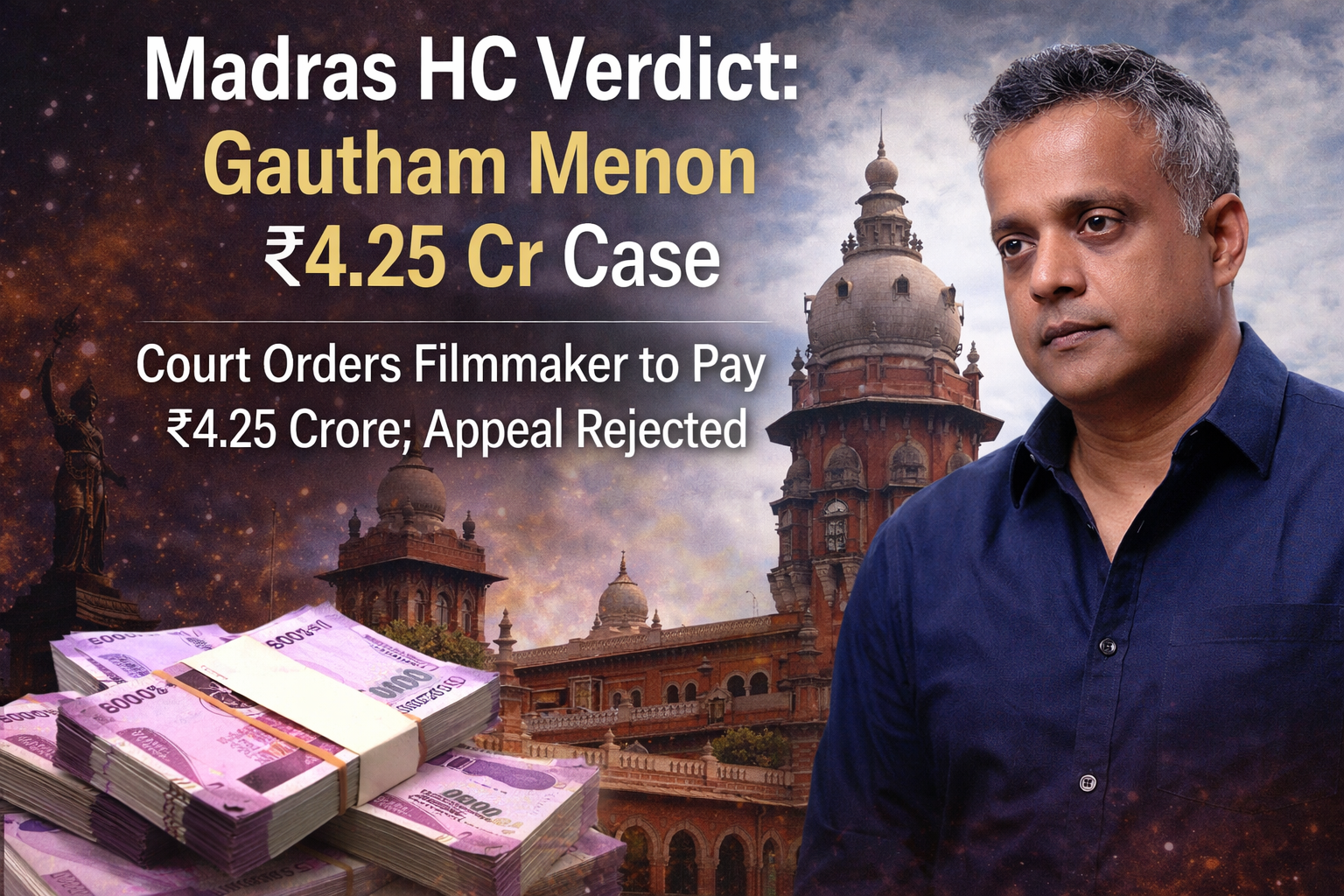
Under a major change of laws that has rocked the South Indian film industry, an appeal made by renowned filmmaker Gautham Vasudev Menon and his production company Photon Factory has been rejected in a case in the Madras High Court. The court affirmed a previous decision that required the filmmaker to settle a long-standing financial dispute of 4.25 crore.
Background of the Dispute
The case can be dated back to more than a decade ago, when Menon had a professional agreement with the production house R.S. Infotainment. The court records indicated that Menon had been paid an advance of 4.25 crore to do a film, which was not actually done.
The project was planned to be done alongside actor Silambarasan TR, though it did not happen, and as a result of this, the filmmaker and the production house did not agree on the monetary side of the project. With time, the conflict was transformed into a judicial one, as the producer wanted to receive the money back.
In 2022, one judge of the Madras High Court decided in favor of the production company and ordered Menon to pay the money back. Nevertheless, the filmmaker appealed the decision and, gaining hope of a reversal of the ruling, he appealed.
Court Observations and Final Verdict
After hearing the submissions and evidence of both sides, the division bench of the Madras High Court rejected the appeal and reinstated the earlier judgment.
The court ordered Menon and his company to make a 4.25 crore payment of money, including the interest, which was said to be 12 percent per year, as well as money to R.S. Infotainment.
This ruling, in effect, puts an end to a longstanding court battle that had dragged on over the years and strengthened the responsibility of contractual duties in the film industry.
According to legal scholars, the ruling of the court emphasizes the significance of respecting the financial contracts, especially in the creative industry, where the delays and cancellations of projects are not of an ordinary occurrence.
Impact on the Film Industry
The judgment has triggered debate among the Tamil film fraternity, whereby financial conflicts between the filmmakers and the producers are not uncommon. Nevertheless, the instances when the litigation process has reached a high level and the damage is significant are likely to gain popularity.
According to the industry observers, this decision might act as a warning to both moviemakers and film production companies. Contracts, particularly those of high monetary investment, should be signed in an open and responsible manner.
Further, the case shows the dangers of film financing, whereby projects are always subject to various factors such as the availability of actors, market factors, and the overall direction of the project.
Gautham Menon: Professional life and works
This is a legal pitfall, though Gautham Vasudev Menon has still been an icon in Indian cinema. Menon is known for his peculiar storytelling style, which has seen him directing a number of commercially successful and critically-acclaimed movies in the Tamil, Telugu and Hindi industries.
He produces works that are usually touching on romance, action and emotional intricacies, thus gaining him a following of fans. He has been working with the most popular actors over the years and has made a significant contribution to modern Tamil cinema.
Though the court struggle ends illogically to him, Menon has not ceased his activities in the industry, and is said to be working on various projects.
Legal and Financial Implication
The case is legally in favor of one of the most important principles: that advance paid on creative projects is legally binding and that it is to be reimbursed in the event that the requirements of the contract are violated. The economic cost of delayed conflicts can also be pointed out by the fact that the interest is also a part of the debt repayment. This case is a lesson to the filmmakers and film producers to ensure that agreements, timelines and deliverables are clear. Moreover, according to financial analysts, these conflicts can cause the loss of credibility and subsequent collaboration of a filmmaker, especially in the case of massive sums of money.
Moreover, this decision can promote more serious due diligence procedures prior to the conclusion of the agreements, and both parties are likely to request more extensive legal protection. Producers might be more reluctant to send out big advances with no performance guarantees, and moviemakers might demand more explicit terms when it comes to project delays or cancellations. It may result in a better-ordered contractual world in the film industry. Moreover, financiers and investors might have to reconsider the risk factors when financing a movie production since there should be improved monitoring and accountability systems to avoid any similar conflict.
Editorial Opinion: A turning point on accountability
This decision seems like a general move towards accountability and professionalism in Indian cinema as an expert in the entertainment sector.
Formal contracts that are coupled with informal understanding have been used in the film industry over the decades. Although this flexibility has been shown to make creativity possible, it has also caused conflict in cases where expectations are not met.
The strong approach taken in the case by the court passed a very strong message: creative freedom does not give people and companies the right to escape financial responsibilities.
However, one should also take into consideration the unpredictability of filmmaking. Projects fail because of factors that are outside the control of a director, such as a clash of schedules or competitive forces in the market. Thus, much-needed accountability should be accompanied by safeguards that should be included in the contract in case of such uncertainties.
Finally, this case might bring about more organized and legally viable contracts within the industry and minimize the chances of future occurrences of similar disputes.