
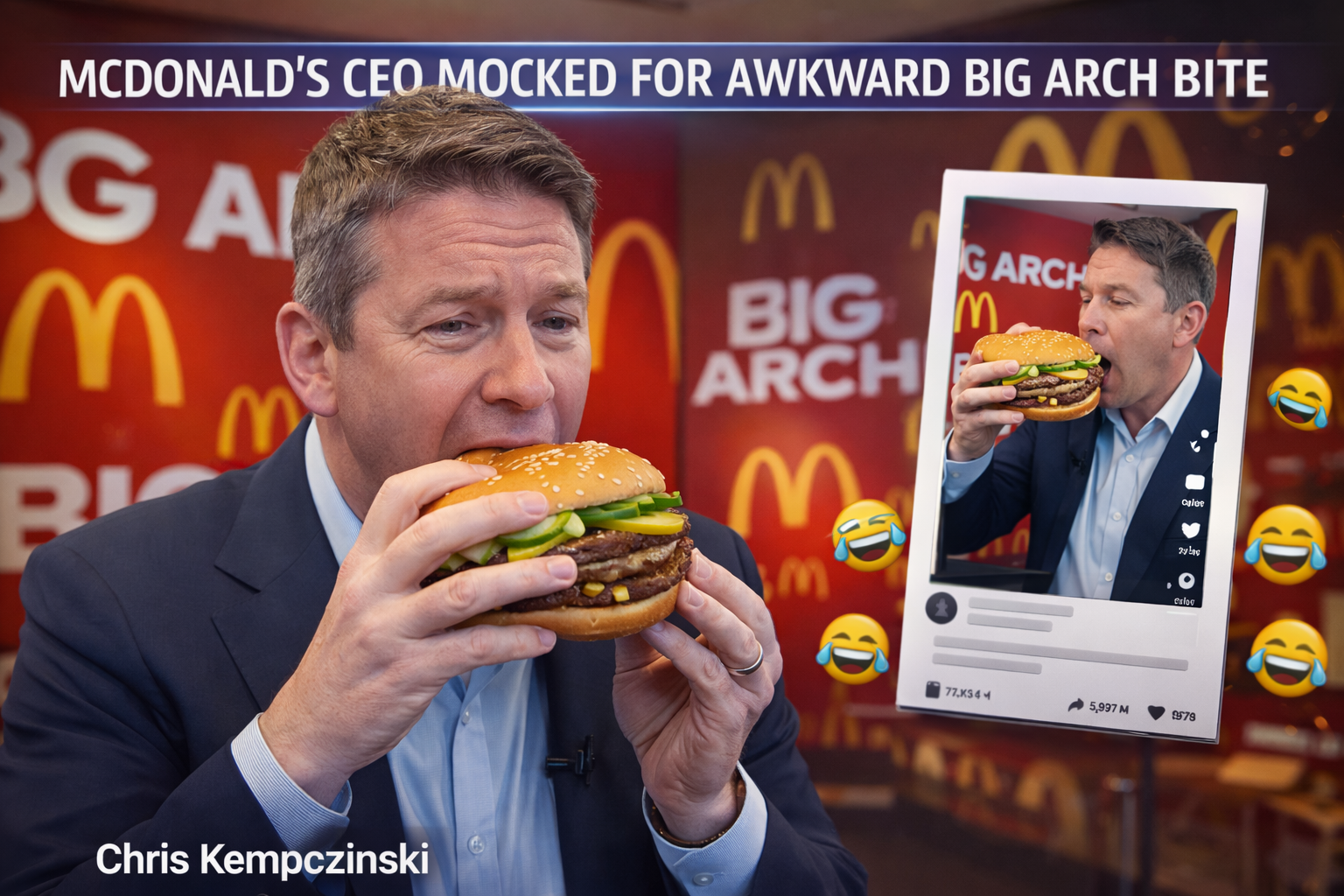
At an event that must have aimed to promote the new Big Arch burger by McDonald’s, the CEO and Chairman of the company, Chris Kempczinski, ended up being the subject of a viral social media blaze not over the burger but over how the CEO ate it.
In a brief video that was published on social media last month, Kempczinski tried the new flagship sandwich of the fast-food giant, which is a super-sized burger consisting of two quarter-pound beef patties, three slices of white cheddar, crispy and raw onions, lettuce, pickles, and a special Big Arch sauce. The burger was designed to provide a high-end experience, and it launches in the U.S. on March 3, 2026, following successful launches in Canada and in some European markets.
Kempczinski, in the video, has enthusiastically presented the burger as this product before frequently trying to take a bite out of the larger-than-life sandwich. What came after was not quite as bold and hearty as one would think a burger enthusiast should get. Instead, he was shown on camera pickup a segment of the Big Arch and putting it in the tentative position in his mouth, and with what many observers said was a completely minuscule bite, looking confused and at a loss on how to attack the sandwich.
The video went viral on such sites as TikTok, Instagram and Reddit, with users taking great joy in indicating the distance between a fast-food chief and his own fare. There were light pokes at his lack of knowledge about what to eat at McDonald’s, such as the joke that Man has the aura of a kale salad, to more incisive jabs at his use of a corporate tone of voice and his posture.
Social Media Response: Not a One-Second Guffaw
Casual humor was not the only type of social media response. A Reddit post detailed the effort as being the pinnacle of corporate embarrassment, with another one jokingly stating that the CEO appeared to be in need of instructions on eating a burger. Other comments indicated that the video was uncomfortable enough that it seemed to have been shot in multiple takes and then smashed together – a comment on editing which demonstrates how online consumers are examining each frame.
When Kempczinski used the word product to refer to the burger, a minor detail, many users capitalized on this to create a bigger critique in regard to corporate tone deafness. To the audience of social media, it sounded sterilizing when trying to advertise food in a video and refer to it as a product.
Deliberate or not, the response helps bring out the extent to which viewers are critical of the presence of corporate leaders on social media. In a society where informal, authentic content tends to win the day – and the clicks – a CEO attempting to video his lunch can go viral in under a few hours.
What Is the Big Arch Burger?
The Big Arch burger is the most recent line that McDonalds has taken towards making its menu more interesting by offering a large menu product that targets those customers who have been seeking something more luxurious than the classic Big Mac or the Quarter Pounder. The sandwich has been relaunched following tests in other countries and is expected to deliver a big taste with its abundant toppings and thick sauce.
According to industry reports, the sandwich contains more than 1,000 calories, which is approximately equal to a whole meal of Big Mac with fries and a drink. It puts McDonald’s in the same category as other fast-food chains that are upgrading their premium burger meals.
Marketing Stunt or Misstep? A Closer Look
As an editorial, this episode highlights a larger tendency in the marketing of corporate organizations: the desire to make the CEO more humanized with likable content. Ideally, the appearance of a company leader in its nature can create authenticity when they appear unfiltered and even eat the product. However, when put into action, it may as well reveal a disconnect between brand image and viewer expectations.
In this case, the video appears to have backfired due to the absence of elements that people today desire in a successful social content: spontaneity, making the message clear, and an impression that the personality on the screen genuinely enjoys the experience. Rather than presenting the Big Arch as a dish that should be tried, the videos gave rise to memes, roast threads, and jokes about how the corporate elite is lost in touch with normal life.
It has also got a bigger picture that is worth mentioning: McDonald’s has been through the social media trap in recent years. Later in 2025, Kempczinski came under fire due to another promotional video that was construed as an attempt to shove off the issues of customer finances. This event led to negative commentary regarding the brand being in a rather grim tone.
Viewer Feeling: Comedy With the Cynic
A lot of the reaction to the Big Arch video is commendable and focused on the laughs – people love to laugh at a high-powered CEO who is clumsy with a burger. However, the laughter has a shade of doubt regarding the effectiveness of corporate leaders speaking in a time when people want genuine interactions with brands. The gap between the slick corporate content and the natural influencer one appears bigger than ever.
It has a lesson for marketers and executives: marketers cannot create authenticity by holding a CEO in front of a camera with a product in their hand. Today, viewers are discerning; they are attracted to sincere passion and familiarity, rather than a written text and promotional bits taken on stage.
Branding in the Social Media Age
The Big Arch burger itself can continue to be a success at the McDonald’s counters across the country. The reviews written early on internationally have been quite positive, and many of the customers making purchases in other countries have taken the sandwich with its strong flavour and excellent quantity.
The personal brand of a CEO, particularly that of the face of such viral content, is another thing. The video by Kempczinski is a lesson to learn: in the era of social media, each bite, be it literal or not, counts. A rather mere promotional initiative on the side of the leaders could soon turn into a cultural experience that says much more than what is on the plate.
The brands and the leaders of the same would be better reminded that authenticity is much more memorable than a well-planned moment would ever be. In case McDonalds would like to popularize the Big Arch into a cultural phenomenon, maybe the most effective way would be to allow customers to speak with their mouths instead of having the corporate executive become the butthead.