
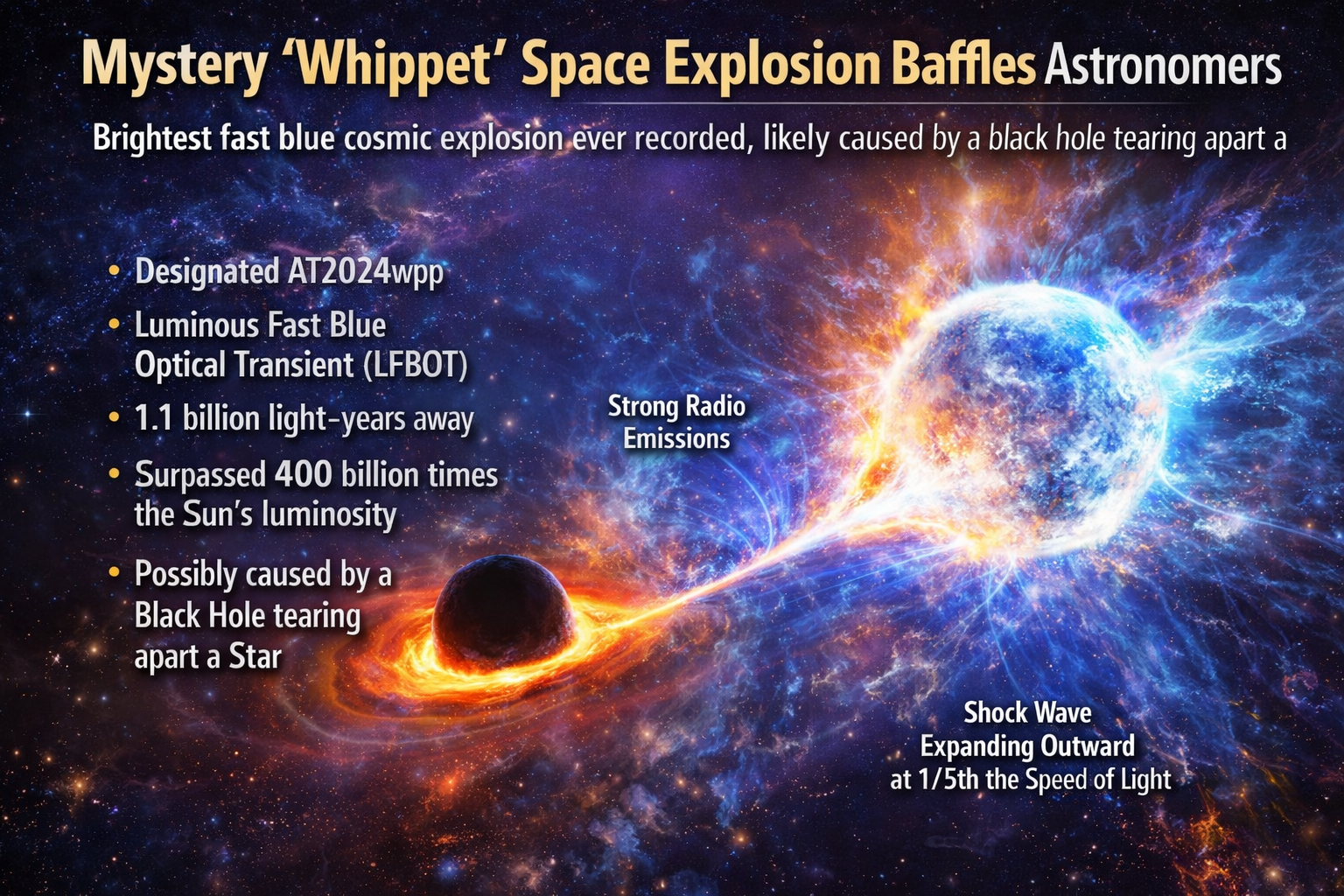
Astronomers have identified one of the most powerful and puzzling cosmic explosions ever observed, an event nicknamed the “Whippet.” Officially designated AT2024wpp, the phenomenon is now considered the brightest example of a rare class of cosmic events known as luminous fast blue optical transients (LFBOTs). These explosions appear suddenly, shine intensely for a short time, and fade rapidly, making them extremely difficult for scientists to study. The Whippet explosion has captured the attention of the astronomical community because of its extraordinary brightness and unusual physical characteristics. The event was so powerful that it briefly radiated energy equivalent to hundreds of billions of suns, making it far more energetic than typical stellar explosions such as supernovae.
Researchers believe the explosion may have occurred when a massive star was torn apart by the immense gravitational forces of a nearby black hole. However, despite extensive observations across multiple wavelengths, the exact mechanism behind the Whippet remains uncertain. The discovery highlights how much scientists still have to learn about the most extreme phenomena in the universe.
Discovery of the Whippet Explosion
The event was first detected in September 2024 by astronomers using the Zwicky Transient Facility (ZTF) at the Palomar Observatory in California. This facility scans the sky repeatedly to detect sudden bursts of light that could signal supernovae, asteroid impacts, or other transient cosmic phenomena. When researchers noticed the rapid surge of brightness associated with AT2024wpp, they immediately recognized that the event was unusual. The source brightened extremely quickly and emitted intense blue light, indicating extremely high temperatures.
Follow-up observations were conducted using a range of telescopes, including the Liverpool Telescope, NASA’s Swift space telescope, and major ground-based observatories. These observations confirmed that the object was extraordinarily luminous and produced powerful X-ray emissions, hallmarks of the mysterious LFBOT class of cosmic explosions. The explosion was located about 1.1 billion light-years away from Earth, in a distant galaxy that appears faint in astronomical images. Despite this enormous distance, the event was bright enough to be detected by multiple instruments across the world.
What Makes the Whippet Unique
Fast blue optical transients are already known to be extremely energetic events, but the Whippet surpassed previous records in terms of brightness and energy output. Scientists estimate that the event released energy equivalent to about 400 billion times the luminosity of the Sun, placing it among the most intense cosmic explosions ever observed. Unlike typical supernovae, which can remain visible for weeks or months, LFBOTs evolve extremely rapidly. They brighten quickly, sometimes within just a few days, and then fade away before astronomers can collect large amounts of data. This rapid evolution is one of the reasons the Whippet has generated such excitement among researchers. Because astronomers detected the event early, they were able to observe it across a wide range of wavelengths—from ultraviolet and optical light to radio and X-ray emissions. These observations provided valuable clues about the physical processes driving the explosion.
A Rare Class of Cosmic Events
The Whippet belongs to a small and mysterious category of cosmic explosions known as luminous fast blue optical transients, or LFBOTs. Only a handful of such events have been detected over the past decade. The first well-studied example was discovered in 2018 and nicknamed “the Cow” (AT2018cow), which stunned astronomers with its unusual brightness and rapid evolution. Since then, several similar events have been detected, but they remain poorly understood.
LFBOTs typically share several characteristics:
- They appear extremely bright, sometimes outshining entire galaxies for short periods.
- They emit intense blue light, indicating very high temperatures.
- They evolve rapidly, fading within days or weeks.
These characteristics make them fundamentally different from traditional stellar explosions such as supernovae. The Whippet, however, appears to be the most luminous example of this phenomenon ever recorded, providing an important new data point for scientists trying to understand this rare class of events.
A Black Hole Devouring a Star?
One of the most compelling explanations for the Whippet explosion is that it represents a tidal disruption event, in which a star is torn apart by the gravitational forces of a black hole. When a star drifts too close to a black hole, the intense tidal forces stretch and compress the star in a process sometimes called “spaghettification.” The star is ripped into streams of gas that spiral toward the black hole, forming a glowing disk of superheated material. As this material falls inward, it releases enormous amounts of energy, producing bright flashes of radiation that can be detected across the universe. Observations of the Whippet suggest that a powerful shock wave expanded outward from the explosion at roughly one-fifth the speed of light, interacting with dense gas surrounding the system. This shock wave produced strong radio emissions and helped scientists trace the structure of the surrounding material.
Hidden Gas Around the Explosion
One of the most puzzling aspects of the Whippet event was the apparent lack of chemical signatures in early observations. Normally, astronomers can identify elements such as hydrogen or helium in stellar explosions through distinctive spectral lines. In the case of AT2024wpp, these signatures were initially missing. Later observations using powerful radio telescopes—including the Very Large Array (VLA) and ALMA Observatory—revealed the presence of a dense shell of gas surrounding the explosion site. Scientists believe that intense X-ray radiation from the explosion stripped electrons from the surrounding atoms, effectively hiding their spectral fingerprints. This discovery resolved the mystery of why early observations seemed to show little surrounding material despite evidence of a powerful explosion.
Shock Waves Traveling at Extreme Speeds
Measurements of the expanding debris from the Whippet revealed astonishing velocities. The shock wave produced by the explosion traveled outward at nearly 20 percent of the speed of light, an extraordinary speed for stellar debris. This expanding shock collided with the dense shell of gas surrounding the system, producing the bright radio signals detected by astronomers. Eventually, the shock wave reached the outer boundary of the gas cloud and began to fade, allowing scientists to study how the environment around the explosion changed over time. These observations helped astronomers reconstruct the sequence of events leading to the explosion.
What This Means for Astronomy
The discovery of the Whippet explosion provides important insights into how black holes interact with nearby stars. If the event was indeed caused by a black hole tearing apart a massive star, it offers a rare opportunity to observe this process in detail. Such events help astronomers understand how black holes grow and how they influence their surrounding environments. In addition, studying LFBOTs could help scientists identify hidden black holes in distant galaxies. These explosive events act like cosmic beacons, revealing locations where black holes are actively consuming stars. The Whippet may therefore represent an important step toward understanding the population of black holes throughout the universe.