
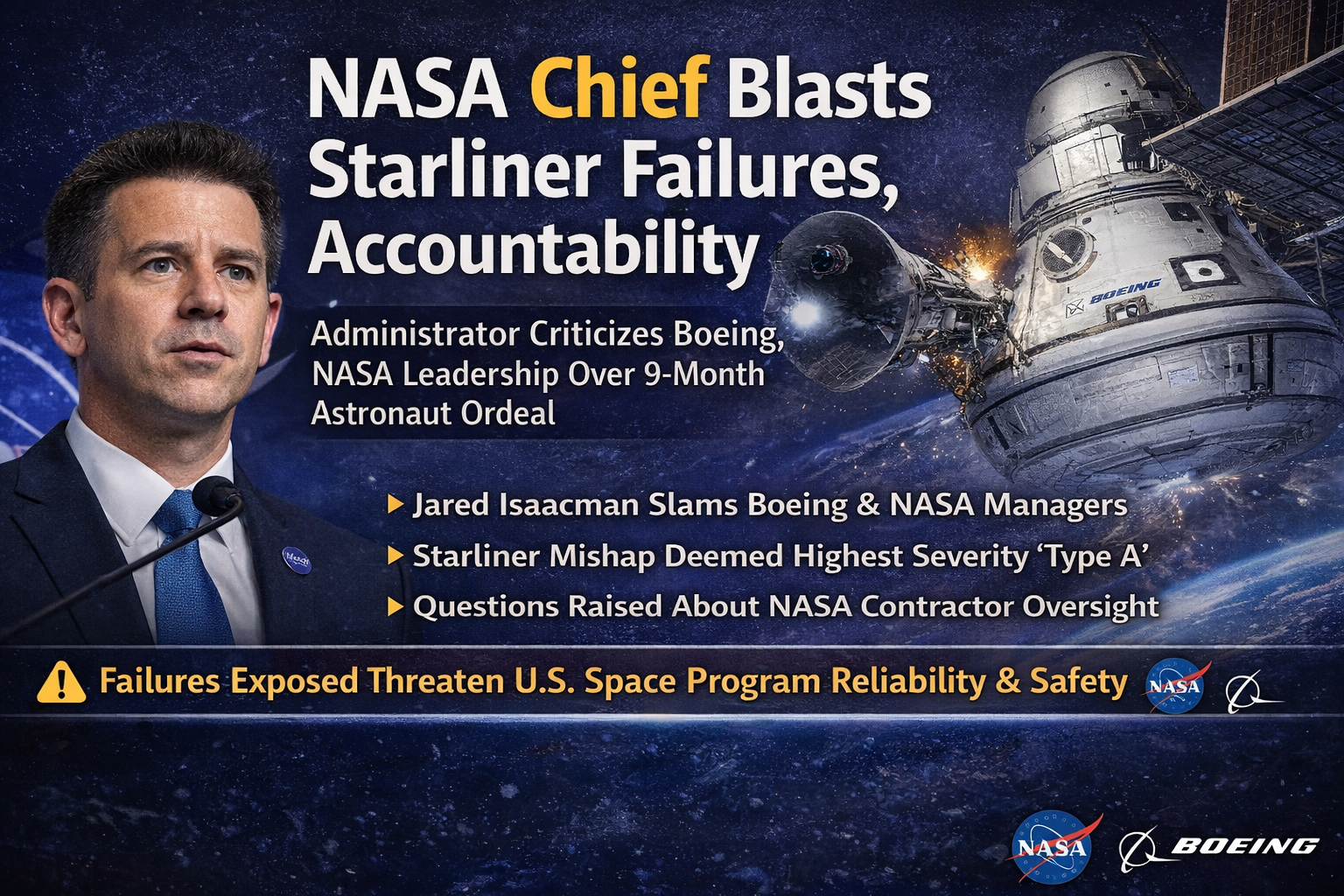
NASA’s newly appointed administrator Jared Isaacman delivered an unusually sharp rebuke this week over Boeing’s ill-fated CST-100 Starliner test flight — a mission that instead of lasting about a week extended into nearly nine months in low Earth orbit, leaving two NASA astronauts far longer than planned aboard the International Space Station (ISS). In a sweeping assessment of the mission and its aftermath, Isaacman placed blame not only on Boeing’s engineering and leadership but also on NASA managers for decisions that, in hindsight, jeopardized crew safety and program integrity.
A Mission Gone Wrong
Launched on June 5, 2024, the Boeing Starliner spacecraft was intended as a key milestone under NASA’s Commercial Crew Program, a strategy begun in 2011 to use private industry partners to ferry astronauts to and from the ISS. Starliner’s initial crewed flight carried two veteran astronauts — Barry “Butch” Wilmore and Sunita “Suni” Williams — on what was expected to be an eight-to-14-day test mission demonstrating the vehicle’s readiness for future operations.
Instead, a cascade of technical problems, particularly involving the spacecraft’s propulsion and thruster systems, prevented Starliner from returning the crew on schedule. Against expectations, the spacecraft — though reaching and docking with the ISS — was later judged unsafe for a crewed return, prompting NASA and Boeing to send it back to Earth empty. Wilmore and Williams remained aboard the ISS until they could return home safely on a SpaceX Crew Dragon capsule in March 2025.
Harsh Words From NASA Leadership
At a press conference marking the release of a comprehensive investigative report into the Starliner mishap, Administrator Isaacman did more than recount technical shortcomings. He publicly criticized Boeing’s leadership and decision-making processes, making it clear that technical issues — while serious — were only part of the problem. The larger failure, he argued, was organizational and cultural.
“Starliner has design and engineering deficiencies that must be corrected,” Isaacman said at the briefing, “but the most troubling failure revealed by this investigation is not hardware.” His comments emphasized that decision-making and leadership missteps — both at Boeing and within NASA — created a culture that was “incompatible with human spaceflight.”
NASA has reclassified the Starliner mishap as a “Type A mishap”, the agency’s most serious designation — the same category historically assigned to catastrophic events such as the Challenger and Columbia space shuttle disasters. While no lives were lost, the assessment reflects NASA’s judgment that the Starliner mission could have resulted in loss of life or major damage.
Public Accountability and Internal Reflection
In an internal letter and in remarks to NASA employees, Isaacman was unusually candid about what went wrong. He criticized both Boeing and NASA for failing to recognize and address the severity of the situation early on, in part due to internal pressures to sustain momentum in the Commercial Crew Program and maintain competition between Boeing and SpaceX.
Isaacman’s critique included a self-reflection on NASA’s own management failings. He acknowledged that there were “perceptions among managers on both sides that risk was being minimized,” and that NASA officials did not intervene quickly enough to resolve concerns about Starliner’s safety or to bring the astronauts home sooner.
NASA Associate Administrator Amit Kshatriya, speaking alongside Isaacman, echoed this sentiment. He described how the agency “almost did have a really terrible day,” referencing the potential for fatal outcomes if thruster malfunctions had prevented docking or safe return.
Engineering Problems and Ongoing Issues
The report highlights a series of technical anomalies that began early in the mission, including multiple helium leaks and reaction control system thruster failures. These issues complicated the spacecraft’s ability to perform critical maneuvers and ultimately rendered the vehicle unreliable for a crewed return flight. Boeing continues to investigate and address these propulsion challenges, but a definitive root cause has not yet been established.
Although Boeing asserts it has made “substantial progress” on corrective actions and cultural reforms, NASA has stated clearly that it will not authorize another crewed Starliner flight until the underlying problems are fully corrected and validated through rigorous testing.
Strategic Consequences for the U.S. Space Program
The fallout from the Starliner mission has broader implications beyond the immediate technical failure. With Starliner grounded, SpaceX remains the only active U.S. provider capable of ferrying astronauts to and from the ISS, having completed numerous successful Crew Dragon missions under the same Commercial Crew Program.
NASA’s reliance on SpaceX underscores both the promise and pitfalls of its public-private partnership model for human spaceflight. Designed to foster competition and redundancy, the Commercial Crew Program now operates with only a single provider certified to carry crews — a situation that NASA leaders have said is less than ideal for long-term resilience, especially as the ISS approaches planned decommissioning in 2030 and new private space stations emerge.
In his remarks, Isaacman emphasized that NASA must learn from this episode and implement meaningful reforms — not only in engineering practices but also in organizational culture and oversight. The agency plans to address structural and procedural issues that contributed to the mission’s problems, with the goal of preventing future occurrences and ensuring the safety of crewed missions.
For Boeing, the path forward will require rebuilding confidence in Starliner’s safety and performance while demonstrating that changes in management and engineering culture have taken hold. Whether Boeing can restore credibility with NASA and within the broader spaceflight community remains an open question, and the outcome will shape the landscape of American human spaceflight for years to come.