
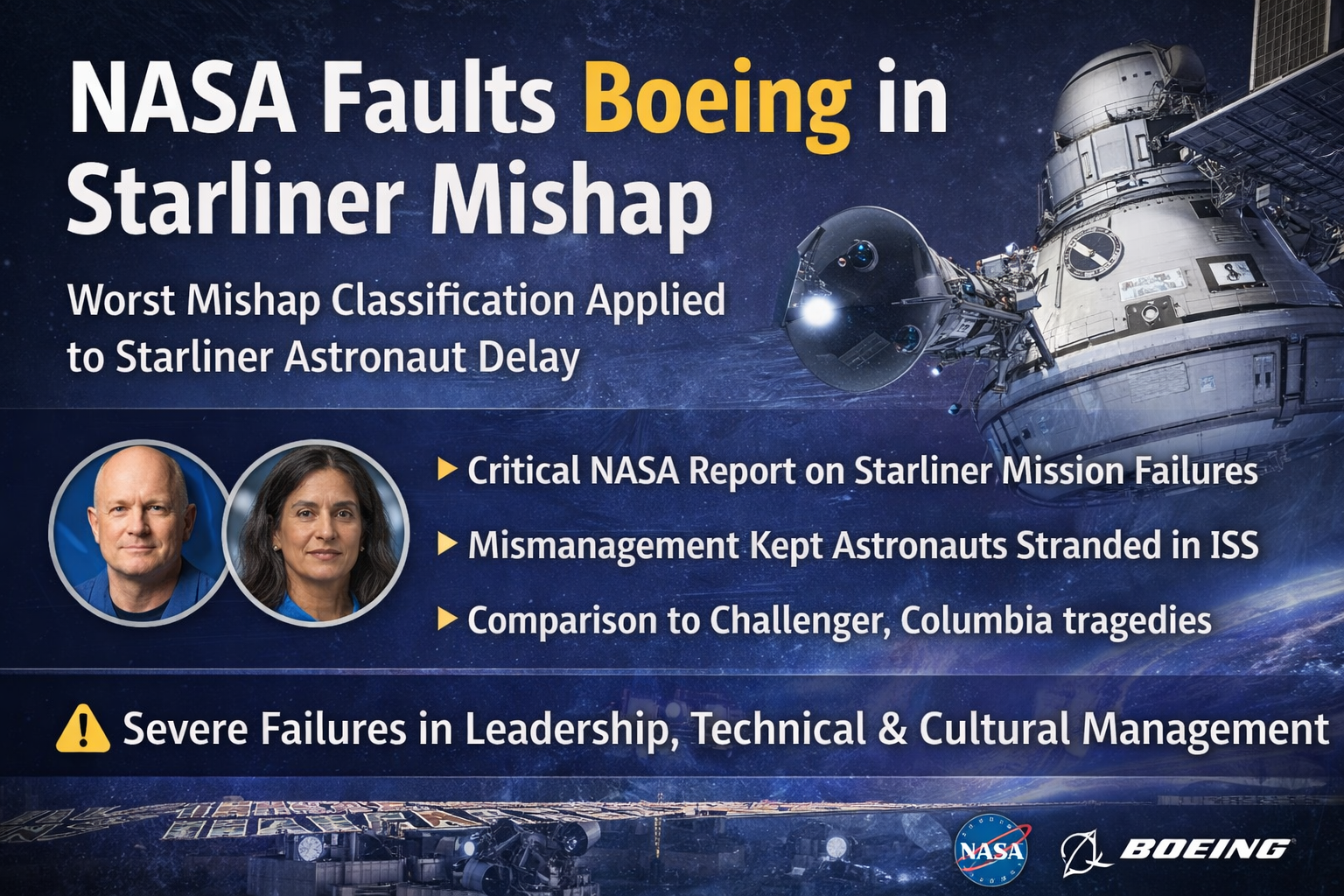
NASA documentation criticizes Boeing and leadership of the agency over Starliner failures that caused delay of the return of two astronauts — worst mishap classification ever.
Boeing Starliner Mission Experiences Grave NASA Report Results.
In a highly critical new evaluation published this week, NASA publicly chastised Boeing and its internal control of the mishandling of the 2024 Starliner crewed test flight, an incident that left two NASA astronauts significantly longer in the International Space Station (ISS) than expected and in a more dramatic way highlighted systemic problems in the management of agency of commercial partner flights.
The long-awaited report, created after months of independent research, is a derogatory view of leadership errors, technical malfunctions and a structural loss of touch between NASA and Boeing that endangered mission tasks and placed the crew in greater danger, although, ultimately, no lives were lost.
Classification NASA Worst Mishaps.
The center of the report is the retrospective designation of the Starliner mission by NASA as a Type A mishap the most severe designation of the agency. This designation makes the Starliner flight in 2024 comparable to some of the most notorious NASA failures – such as the Space Shuttle Challenger and Columbia disasters, the Apollo 1 fire – an event that caused loss of life or caused devastating damage.
Although Wilmore and Williams finally landed safely on Earth in March 2025, in a SpaceX Crew Dragon capsule, after almost nine months of being in orbit, the report by the agency makes it clear that the flight was not in line with accepted risk standards at several stages, technical failures were mixed with cultural and managerial failures.
Thrusters, Leaks, and More What Went Wrong.
The initial Starliner Crew Flight Test was initially planned to be an eight-to-14-day test flight in June 2024, but something went wrong as early as initially. Shortly after launch, there were leakages of helium and several problems with the reaction control system thrusters, which posed a risk to the spacecraft being able to safely maneuver during docking with the ISS.
NASA engineers had spent weeks on-ground diagnosis and ground tests on solutions, with live hot-fire tests on the thrusters as the capsule was still docked. Nevertheless, the agency leadership felt that it would be impermissibly dangerous to send the astronauts back to the same failing ship.
Rather, it was decided to keep the spacecraft in orbit and have both astronauts returned home in a mission by SpaceX – a decision that increased their stay in the space by almost 286 days; an extremely long period way beyond the originally scheduled time.
Communication and Leadership Failures.
The most notable thing about the report is probably the degree to which it holds the organizational culture and choice of leadership decisions – and not only hardware problems – accountable in the manner that the mission unfolded. Its new administrator, Jared Isaacman, who became head of the agency in December 2025 explicitly condemned Boeing and NASA administrators who permitted risks to run amok and a failure in communication that created mistrust.
The investigators discovered documentation of disorderly meetings, lack of clear lines of decision making and an environment where dissenting opinions were mostly discredited instead of being presented constructively. These circumstances, the report indicates, eroded the self-safety standards of the agency and obscured the responsibility between the contractor and the regulator.
Associate NASA Administrator Amit Kshatriya added that both Boeing and NASA actions endangered Wilmore and Williams and that the agency failed them, an unusual and uncharacteristic confession by the senior staff.
Industry Influence and History.
The issues with Starliner are in sharp comparison with other NASA commercial partner, SpaceX, which has flown regular crew rotations to and from the ISS since 2020 in its Crew Dragon capsule. The consistent performance of that company highlights the seriousness of the alarm regarding the distressed development of Boeing.
Even the Starliner program has encountered delays in nearly every phase of its creation, such as software problems and hardware delays in previous uncrewed demonstration flights. Although these were not as dramatic as the 2024 mishap, they highlighted recurring obstacles in the Boeing development pipeline.
The Implication of This on Future Missions.
NASA has expressed the desire to stay with Boeing in order to resolve the technical and cultural issues revealed, despite the harshness of the findings. Continued testing of modified thrusters and other systems is being conducted and NASA is scheduled to launch a cargo-only mission to the ISS in Starliner as early as April 2026 to further test corrective measures.
But no crew will be on board a Starliner spacecraft before NASA is satisfied that all the problems have been worked out, and the agency has indicated that it is willing to take a more critical look at its internal procedures and contractor controls.
The time in which this report was written is particularly consequential, with the larger human spaceflight efforts of NASA, such as the upcoming Artemis II mission to orbit the Moon, being dependent on solid quality assurance and safety operations. The engineering performance of the firm is also crucial outside of the Starliner program as Boeing is the prime contractor of the core stage of the Space Launch System.
NASA and Boeing executives have pledged to work collaboratively to implement all recommendations from the investigative report. Corrective actions are underway, including testing at ground facilities and redesign efforts aimed at improving the Starliner’s propulsion and control systems. But with NASA insisting on rigorous certification before any further crewed missions and with public confidence shaken, Boeing faces an uphill battle to restore both technical credibility and industry standing.