
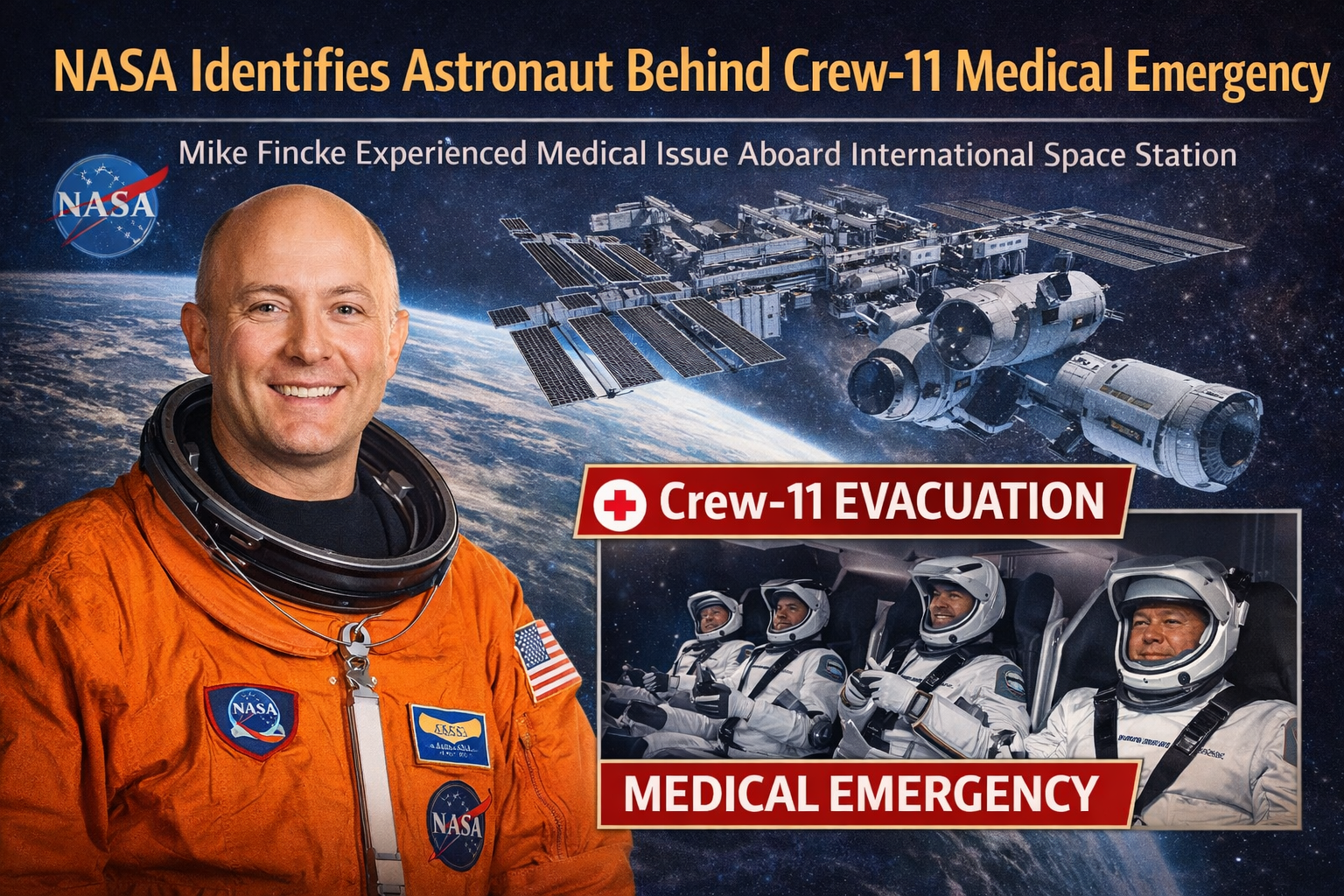
NASA has made a formal announcement that veteran astronaut Michael “Mike” Fincke is the crewmember whose in-flight medical event caused an extra measure of attention during the SpaceX Crew-11 mission on board the International Space Station. The announcement sheds some light on an incident that cast some doubt on the health precautions of astronauts and emergency readiness in space. Although NASA stressed the fact that the situation was managed based on existing safety protocols, the disclosure highlights the very nature of human spaceflight missions, which are risky at best, in a period when commercial flights have become ordinary.
The revelation came after a lot of concern with articles that indicated that a Crew-11 astronaut had a medical emergency worthy of emergency response. NASA confirmed that this was Fincke, a very senior astronaut and the former commander of the ISS. The agency concluded that the situation was controlled in time, and no accidents or incidents happened to the crew.
The Crew-11 Mission and Its Objectives
SpaceX Crew-11 was a NASA-led Commercial Crew Program launch that served as the key to ensuring that there is a consistent American presence in the ISS. The mission brought astronauts to the orbital laboratory to carry out scientific research, technology tests, and maintenance missions. The Crew-11 mission marked a continuation of NASA having to depend on SpaceX to provide its Crew Dragon spacecraft as a centerpiece of U.S. human spaceflight since it began its operational flights.
The Crew-11 mission was supposed to have a normal timetable with scientific experiments, Earth observation, and system upgrades in the station. Yet, the described medical incident presented us with a sudden dilemma, which illustrates the fragility of the balance between ordinary tasks and preparedness to deal with contingencies in space.
NASA authorities claimed that the problem was identified by the developed medical surveillance systems in the ISS. Astronauts have rigorous preflight health examinations, and medical assistance from Earth-based flight surgeons is 24-hour. The space station has the necessary medical facilities, and the crew undergoes training on how to deal with an emergency situation in a space station.
Mike Fincke did not venture into space on a short mission. As a longtime NASA astronaut, Fincke has spent considerable time in space on several missions. He has already worked on the International Space Station and has done spacewalks, which included building and repairing the station. Fincke was known around the NASA circles not only due to his technical skills but also due to his reliability, which made it obvious that he would have been selected to lead the Crew-11 crew.
In his lifetime, Fincke has spent hundreds of days in space. He has been an engineer, test pilot, mission planner, and trainer of astronauts. The experience he has earned him is one of the most experienced spacefarers in NASA, and his participation in Crew-11 was considered to be stabilizing the mission.
The fact that NASA confirmed Fincke was the astronaut who was affected by the medical event further puts the response of the agency into perspective. The authorities noted that the lives of the rest of the crew and station operations were not at risk. Still, safety measures demanded close attention and liaison with medical units on Earth.
NASA’s Response and Safety Protocols
NASA also highlighted the health of astronauts as one of its priorities and that there are multiple procedures to address an enormous number of possible medical emergencies. The ISS medical kit has medications, diagnostic devices, and emergency supplies that will be used in case evacuation is not possible immediately.
The reaction, in this case, seems to have been preemptive but not disastrous. NASA never described the incident as something life-threatening, and no mission-ending effects were reported. Still, the situation made people notice how fast space agencies have to respond in case the health of an astronaut is in danger. ISS evacuation cases are well-planned. Spacecrafts like the Crew Dragon by SpaceX spend missions in the station, acting as lifeboats that can take astronauts back to Earth in cases of emergency. These return vehicles have an essential part in the risk mitigation strategy of NASA. The capability to handle such an incident in a composed and efficient manner is an indication of the maturity of the NASA operation guidelines. A culture of readiness has been developed over decades of experience with the first missions to Mercury entering space, through the Shuttle era and on to commercial crew missions, where the welfare of astronauts is the primary concern.
Space is among the most physically demanding places that human beings can withstand. Microgravity has influences on muscle density, bone strength, cardiovascular, and immune response. Astronauts have to follow stringent physical workouts to overcome these effects, but unforeseen health problems may still occur.
NASA is undertaking continuous studies on the physiological effects of spaceflight on a long-term basis. The information obtained during missions to the ISS will shape future missions to deep space, such as missions to the Moon as part of the Artemis program and future missions to Mars.
Orbital medical incidents are very infrequent, but not unheard of. The present-day period is unique, with the growth of the number of launches and the growth of the role of commercial partners. The statistical probability of in-flight medical occurrences could tend to increase with increased astronaut travel to and from space, despite the fact that the overall safety may be increasing.
The Role of Commercial Partnerships
The Crew-11 mission was carried out with the help of a SpaceX Crew Dragon spacecraft as part of the NASA Commercial Crew Program. This alliance has helped the United States to recover its autonomous ability to launch human beings after the Space Shuttle was retired in 2011.
Commercial providers must possess high standards of NASA safety. The Crew Dragon ship has environmental systems, medical protocols, and back-home features. The success of the program has enabled NASA to invest more in deep-space exploration and leave the transportation of low-Earth orbit to the hands of the private industry. The management of the Crew-11 medical incident is an example of the integration these partnerships have. NASA flight surgeons, SpaceX engineers, and teams of mission control collaborate to make sure that each crew member is safe. The smooth response is a result of years of development and testing.
Editorial Perspective: Transparency and Public Trust
Space agencies must strike a delicate balance between protecting individual privacy and maintaining public accountability. In this case, identifying Mike Fincke—while clarifying that the situation was managed effectively—helps prevent speculation and misinformation.
It also humanizes the mission. Astronauts are often portrayed as near-infallible heroes, yet they are human beings operating in extreme conditions. Acknowledging medical events reminds the public of the real risks involved and the resilience required to undertake such missions.
Furthermore, the incident underscores the importance of robust reporting. Space journalism should avoid sensationalism while still addressing legitimate concerns. Clear, factual coverage ensures that audiences understand both the achievements and the realities of modern spaceflight.
The identification of Mike Fincke as the astronaut who experienced the medical event closes one chapter of speculation but opens a broader conversation about astronaut health, mission preparedness, and the evolving landscape of commercial spaceflight.