
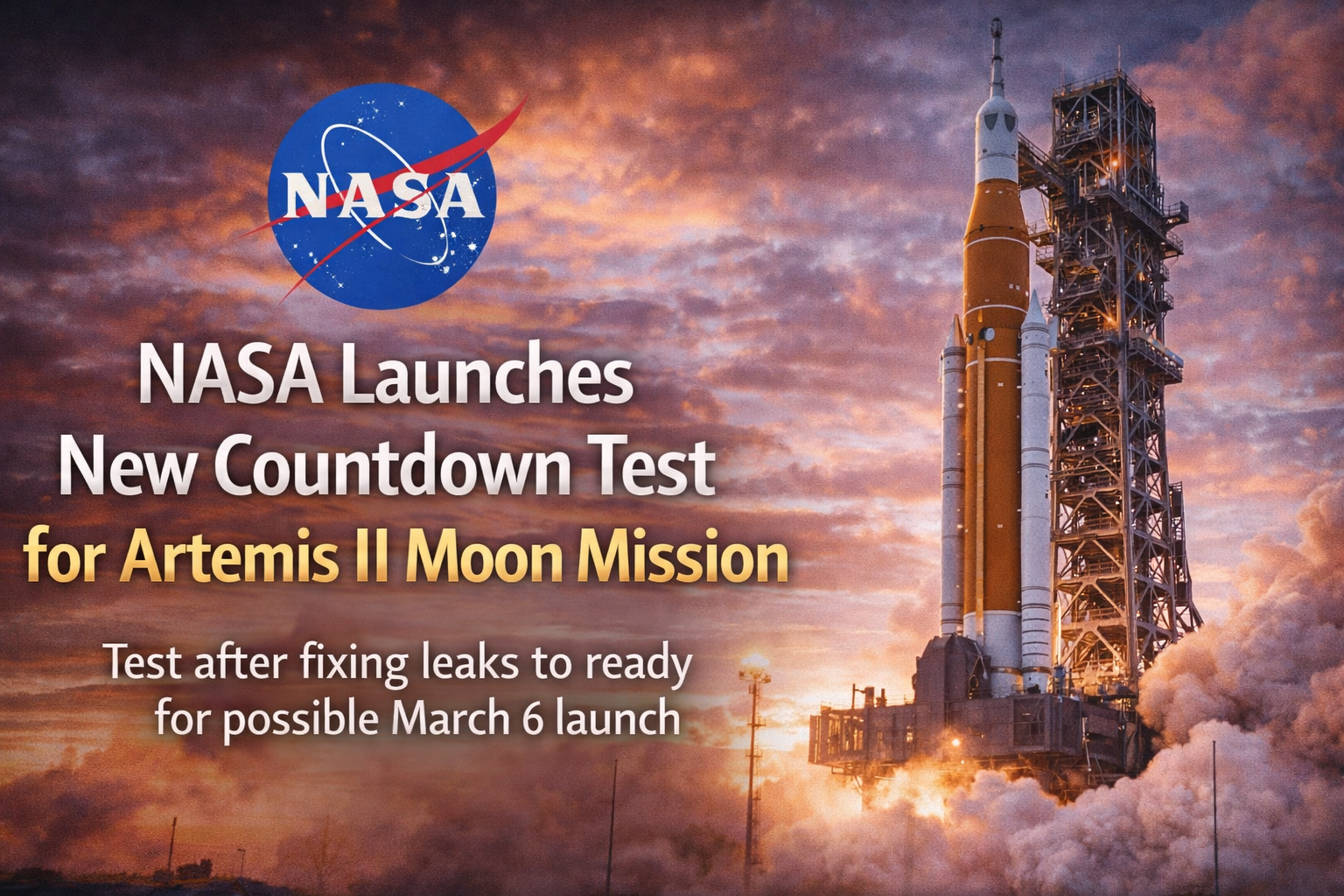
NASA has initiated a critical second practice launch countdown for its Artemis II moon mission after addressing fuel leaks that disrupted the spacecraft’s first full fueling test earlier this month. The two-day countdown test, taking place at NASA’s Kennedy Space Center, is designed to simulate key aspects of a real launch and determine whether the space agency can set a firm date for liftoff of the first crewed lunar mission in more than half a century.
The countdown test began Tuesday and is expected to culminate Thursday with an attempt to fully tank the Space Launch System (SLS) with more than 700,000 gallons (approximately 2.65 million liters) of super-cold liquid hydrogen and liquid oxygen propellant. This rehearsal — known as a “wet dress rehearsal” — is a crucial pre-launch step in which the rocket is fueled and the ground and launch control teams practice procedures they would carry out on launch day. A successful, leak-free fueling is required before NASA will announce a target date for the actual launch.
The earliest opportunity for Artemis II to lift off is March 6, 2026, with additional launch windows possible through March 11 if this countdown test and subsequent evaluations go smoothly. NASA officials had previously considered an earlier launch date but determined the extra time and data were necessary to ensure mission readiness and safety.
Recurring Hydrogen Fuel Leak Issue
Trouble with cryogenic hydrogen leaks during fueling isn’t new to NASA. Similar problems emerged during the uncrewed Artemis I flight test three years ago and led to multiple delays before that rocket successfully launched. During the first Artemis II wet dress rehearsal earlier this month, engineers detected higher-than-acceptable hydrogen leakage at the tail service mast umbilical (TSMU) — the interface where fuel lines connect between the rocket and ground systems. That discovery halted fueling and forced NASA to call off the practice countdown before reaching its primary objectives.
Liquid hydrogen is exceptionally cold — at around minus 423 °F (approximately −253 °C) — and its molecules are the smallest of any element, making it prone to seeping through even tiny imperfections in seals and connectors. Because of this, ensuring leak-free fuel transfer on a rocket as large as SLS is among the most challenging technical aspects of pre-launch operations.
To address the problem, launch teams replaced a pair of seals and a clogged filter in the ground support equipment at the pad before re-starting the countdown. If this second rehearsal runs without significant leaks or equipment faults, NASA will proceed to analyze the data and determine whether the SLS rocket is ready for a planned crewed mission.
What This Test Is and Why It Matters
A wet dress rehearsal stretches beyond simple fueling. Controllers and flight teams run through the full countdown sequence as though they were preparing for a real launch. The objective is to validate that all systems — from ground communications networks to propellant loading and launch pad mechanics — can carry out pre-launch and launch-mode procedures effectively. In previous Artemis programs, this rehearsal has exposed issues ranging from camera failures in cold conditions to leaks and communication dropouts, all of which had to be resolved before a flight could proceed.
This latest test will also include rehearsing abort scenarios and draining the tanks if mission controllers decide to “scrub” the launch for safety reasons. The ability to recycle the countdown — pausing and restarting without rolling the rocket back to the assembly building — is a major milestone for the Artemis team and could speed up decision-making in future operations.
The four astronauts assigned to Artemis II — NASA’s Reid Wiseman, Victor Glover, Christina Koch, and Jeremy Hansen of the Canadian Space Agency — are not physically on pad during this rehearsal. Instead, they are monitoring remotely while continuing their final preparations. The mission, if it proceeds as planned, will send the crew on a 10-day trip around the Moon and back to Earth, marking the first time humans have traveled beyond low-Earth orbit since 1972’s Apollo 17.
Delays and Schedule Implications
The Artemis II mission has already experienced multiple delays. Originally targeted for earlier dates, the flight was adjusted repeatedly to address technical issues with the Orion spacecraft’s heat shield and life support systems, among other concerns. The decision to delay until March after the initial hydrogen leak was identified underscores the complex interplay of engineering challenges and safety priorities.
One notable complication is that hydrogen fuel must be replenished continually during long countdowns because it boils off as it warms, even fractionally. This phenomenon increases the potential for leaks, especially in interface points like the TSMU where ground support and rocket hardware meet. In a press briefing, NASA officials explained that controlling boil-off and maintaining secure seals throughout fueling is one of the most demanding aspects of this part of the launch campaign.
The delay until March also allows NASA to consider alternate launch dates within a broader window in early spring. If this latest wet dress rehearsal meets engineering expectations, teams will use data from this test to firm up a date — likely one of several available between March 6 and March 11 — for Artemis II to make history.
Broader Context for the Artemis Program
The Artemis program represents NASA’s long-term commitment to sustainable lunar exploration and the eventual return of astronauts to the lunar surface. Artemis II is strictly a flybys mission, intended to test the integrated performance of the SLS rocket and the Orion spacecraft with humans on board. Success here is a prerequisite for Artemis III, currently planned as the mission that would land astronauts near the Moon’s South Pole and begin the next era of lunar exploration.
The program’s history of recurring fuel-leak issues highlights both the complexity and ambition of the endeavor. Resolving these issues now, during dress rehearsals, is far preferable to confronting them during a real launch attempt. NASA’s engineers and mission managers have emphasized that meeting safety thresholds — especially regarding cryogenic fueling integrity — is non-negotiable, even if it means adjusting launch schedules.
In the coming days, NASA will monitor the results of this latest countdown test very closely. If no significant leaks re-emerge and all major systems perform as expected, the agency will be poised to announce a targeted launch date from among the March windows available. Failure to fix the leaks would necessitate further repairs and possibly additional dress rehearsals, potentially pushing the launch further into spring.