
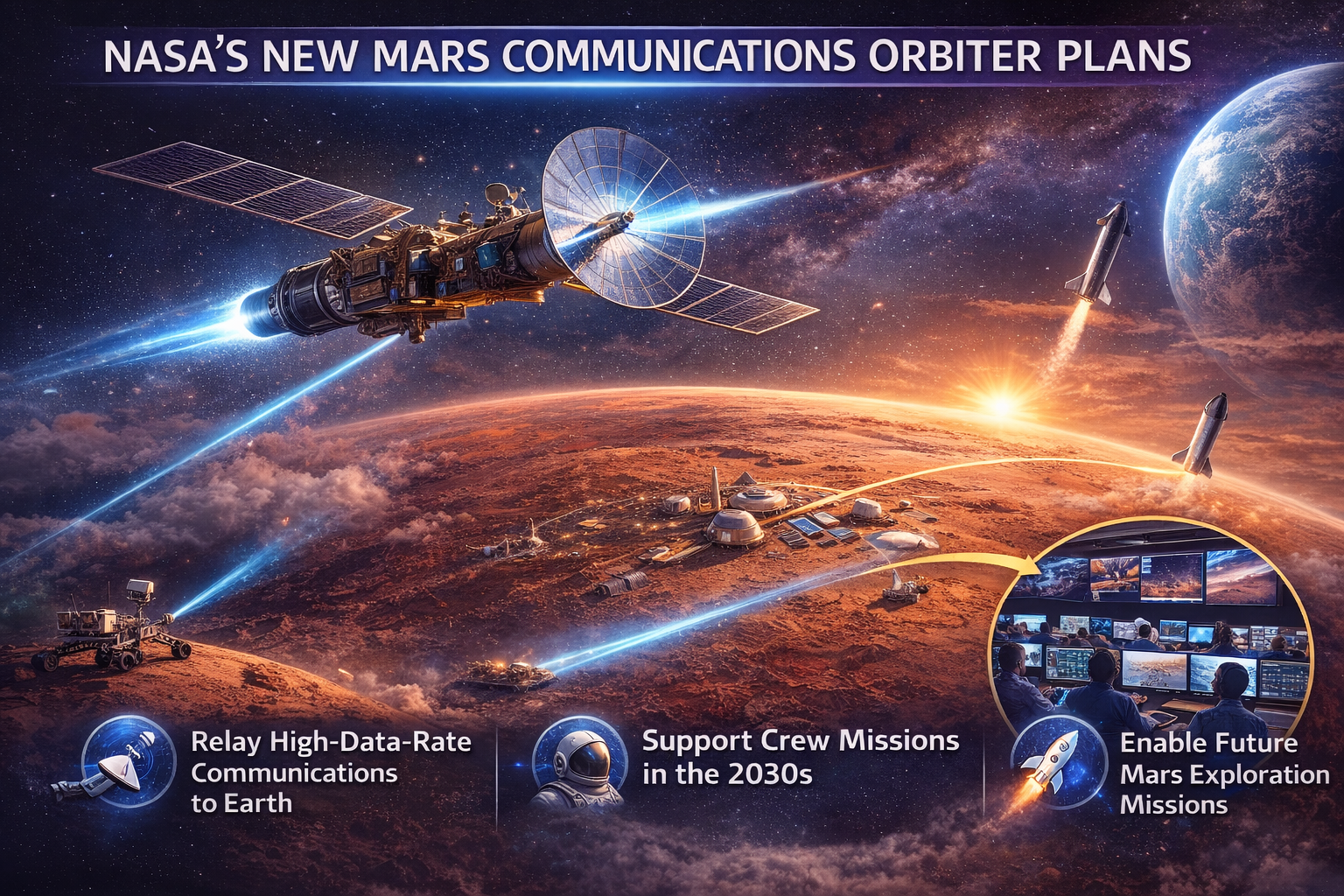
NASA has unveiled its intentions of a new Mars communications orbiter, a key mission, which is expected to enhance long-term exploration of the Red Planet by enhancing the communication capabilities between Mars and Earth. This announcement is an important move in the U.S. space agency plan to stay on Mars and it enhances communications, a vital factor in future missions, particularly as the extent and magnitude of exploration programs continue to grow.
The Mars communications orbiter, which is scheduled to be launched in the early 2030s, will be a relay platform and will offer strong and uninterrupted communication channels between Mars and Earth. The mission will help cope with the escalating demands of the escalating data generated by the robotic and human missions to Mars. With the agency undertaking more ambitious missions, including the possibility of the agency venturing into manned missions to Mars, the necessity to have robust and high capacity communication systems has never been more urgent.
Improving Communication Infrastructure for Mars Exploration
Currently, messages between Mars and the earth are managed by a few spacecrafts which orbit Mars, rovers and surface landers on Mars. The existing system is however constrained by bandwidth and delays that are a result of distance between the two planets. Signals travel at speed equal to that of light, but the distance between earth and Mars averages 225 million kilometers (140 million miles) and thus communications take up to 20 minutes in each way. These delays are a real challenge to the real time decision making of NASA as it seeks to undertake more complex missions to the Mars, particularly concerning operations of human exploration.
The Mars communications orbiter is new and is meant to make the transmission of data more efficient and quicker. The orbiter will provide a fast high data-rate connection between Mars and Earth, reducing the present transmission delays due to the use of advanced relay technology. This advancement in infrastructure is essential not only to provide a hassle-free operation of the rovers and landers that are already on the ground, but also to help plan and implement the missions of manned flights to Mars.
The plan by NASA would make this orbiter coordinate with the existing and future spacecrafts to cover the surface of Mars more effectively across the globe. It will also help to coordinate multi-spacecraft missions that will be at the core of future exploration plans. The role of the orbiter will become invaluable in ensuring strong communication connection of the increasing number of missions and the necessity of constant and effective contact.
A Critical Tool for Crewed Missions to Mars
The ultimate aim of NASA is to bring people to Mars in the 2030s and in the course of this endeavor, the agency has realized that it will be important to enhance infrastructure in the Red Planet. The orbiter should also be important in navigational support of crewed missions in addition to being a communications hub. By its presence at Mars, the orbiter will not only offer communication services, it will help to conduct accurate landing of the missions, as well as aid the mission planning.
The future Mars missions will be heavily dependent on the superior navigation systems of the orbiter, where the precision of landing is essential. NASA has already invented technologies such as the Mars Entry, Descent, and Landing (EDL) Systems which have been tested successfully on previous Mars rovers, such as Perseverance and Curiosity. NASA will also enhance its capability to maneuver spacecrafts through complicated landing procedures with the added communication and navigation support of the Mars communications orbiter thereby ensuring safety and accuracy of landing on the difficult surface of Mars.
The fact that the orbiter will help in providing prompt updates to the earth based control teams will also greatly decrease the delays during decision making during execution of the mission. To ensure the safety and success of the mission, real-time or close to real-time communication will therefore be essential considering the nature of the exploration of Mars, particularly when the missions are crewed.
Supporting a Sustainable Human Presence on Mars
The orbiter will play a major role in ensuring that NASA achieves its long-term aim of human exploration on the planet Mars. To establish sustainable presence in Mars, it is not sufficient to merely construct the infrastructure that will help it to sustain the lives of human beings, but also to have efficient communication systems. The communications orbiter will form a pillar in the assurance of the astronauts on Mars being well in touch with the mission control on earth particularly during the times when they are isolated at a distance.
The fact that the orbiter can support high-definition video and data transmission is one of the expected advantages of the orbiter. Since the human missions to Mars are expected to last long durations i.e. many months or even years, the orbiter will enable NASA to transmit scientific data, reports on health and well-being, and daily communications to Earth without any fear of communication blackouts and constraints. This will be useful in maintaining the relations between astronauts, their families, medical teams, and research partners on the ground and this is vital to the psychological health of astronauts during extended space travel.
The spacecraft will also have the capacity of receiving and sending data of several landers and rovers exploring Mars at the same time, therefore, eliminating bottlenecks that would otherwise defer data collection and distribution of scientific results. Moreover, its capacity to relay huge amounts of information might highly hasten the rate of the discoveries made on Mars, where the orbiter would serve as a high-speed pipeline containing the scientific research on Mars relayed back to the earth.
Technical Details and Mission Design
Even though some of the details on how the spacecraft will be designed are yet to be fully drawn, NASA has mentioned some of the main features of the mission. The orbiter will also have the state-of-the-art relay communication payloads in order to improve the data transmission rates and bandwidth. It will probably incorporate the latest technologies in radio frequency (RF) communication, it may use higher frequency bands like the Ka-band or laser communications that have proven to be used successfully on past spacecraft missions. The technologies will assist in stretching the limits of data speeds, and minimizing the time lag of communication that is a characteristic of the old radio systems.
Orbiter-wise the communications orbiter is likely to be in a highly elliptical orbit with Mars giving the communications orbiter the best views of the surface and ensuring that it can relay signals even when the atmosphere or the terrain of Mars would normally block view. The mission design will also take into account Mars’ dust storms, which can significantly impact signal clarity and reliability.
NASA is planning for the orbiter to be launched alongside other Mars exploration efforts, including potential landers, rovers, and future crewed missions. Coordinating with other spacecraft, the communications orbiter will ensure that all these missions can share data and relay information in real-time or near-real-time, further enhancing the efficiency and productivity of Mars exploration as a whole.