
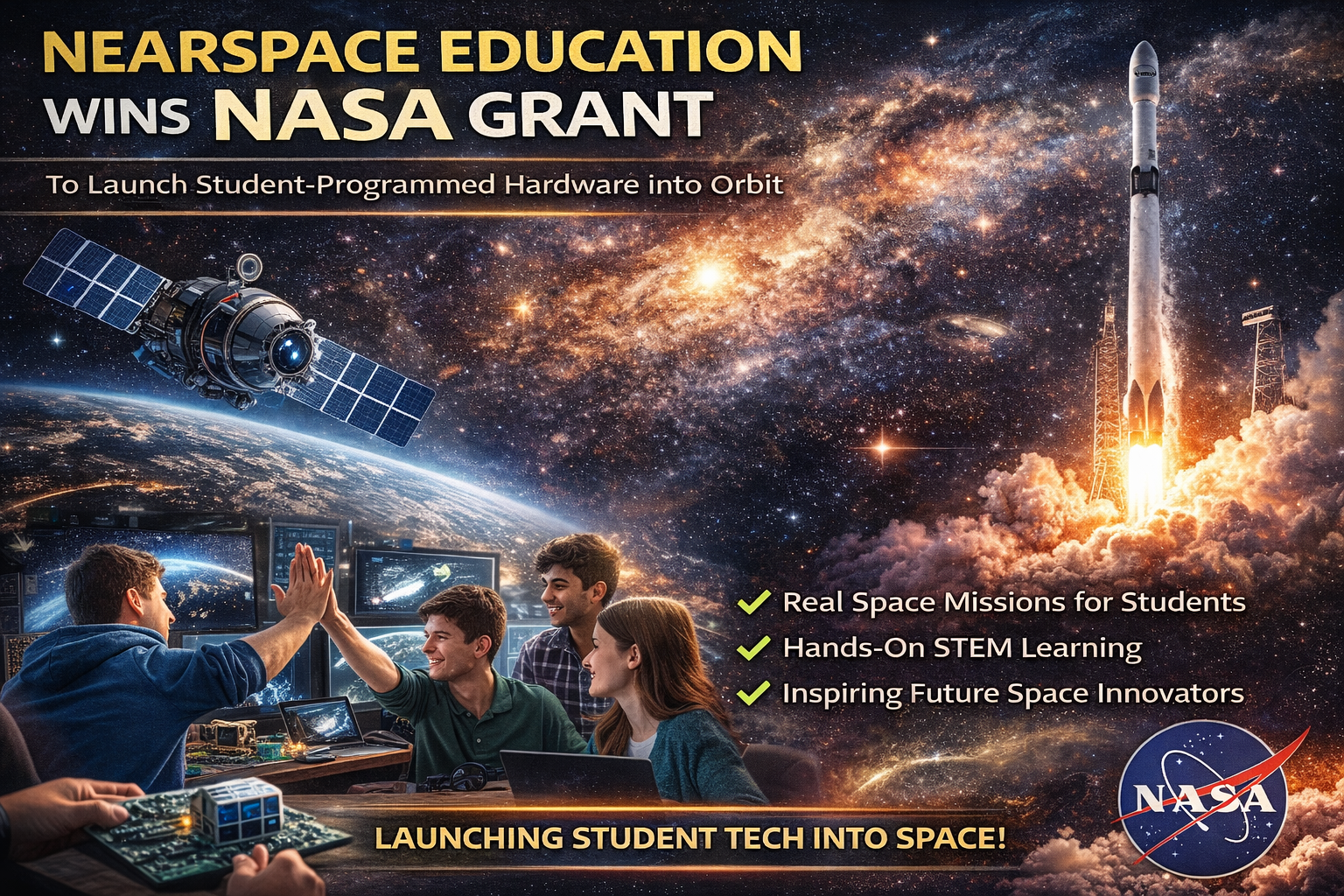
In an exciting development for educational space programs, NearSpace Education, an organization dedicated to teaching science, technology, engineering, and mathematics (STEM) through hands-on space exploration experiences, has been awarded a prestigious NASA grant to send student-programmed hardware into orbit. This groundbreaking initiative is expected to give students an unprecedented opportunity to engage with space science and technology at the highest level.
A Leap Forward for STEM Education
The partnership with NASA is a landmark change in the history of educational space programs in the United States and Indiana in particular. NearSpace Education will acquire with the assistance of this statewide grant the ability to design, assemble, and program their own experimental hardware, and launch it to space through commercial rockets. The project itself will engage students in practical space exploration allowing us to develop the next generation of engineers and scientists, and other creative professionals.
The project is an extension of the NearSpace Education mission of giving students in grades K-12 a practical learning experience that motivates them to become space exploration and aerospace technology professionals in their lives. NearSpace Education since its inception has been focused on the development of experiential learning experiences to expose students to the potentials of space exploration. The educational concept of the organization is aimed to give the students a broad outlook of the issues and rewards of space research, as well as, to inculcate critical problem solving and collaboration skills.
The Role of NASA in the Project
The grant that NearSpace Education received belongs to NASA STEM Engagement Program that aids in the development of innovative educational projects in the United States. The necessity to engage young students in space-related projects by NASA has not been new since the challenge of having a talented workforce in aerospace industries has been on the rise. This new venture will enable the students to make their contributions in the new space missions as they apply their expertise in engineering, physics and programming in developing technology that will be utilized in space. Not only will the implementation of student-created hardware serve as an illustration of the applied relevance of the classroom knowledge, but will also instill trust in the new generation of STEM professionals.
This project belongs to the wider campaign of NASA to establish the public-private collaboration that supports the development of STEM education. The space agency is aware that their future achievements in the space exploration will rely on the innovation and creativity of young minds and therefore it is important to give students an opportunity to work in the real world space technology. Through the engagement of students in space hardware and orbital missions, NASA hopes to create curiosity and motivate students to explore more in the STEM disciplines.
The Student-Programmed Hardware
The hardware that will be sent to space and programmed by the students will be aimed at testing certain technologies and gathering information on the diversity of space-related issues. The projects may be communications experiments through to environmental monitoring and hardware stress tests. This hardware will be launched into space on commercial rockets, including SpaceX Falcon 9 or Blue Origin New Shepard and then released into low Earth orbit to be experimented with.
The pertinent point about this project is that students will not merely witness the launch of a satellite or a test; they will be a part of the whole process, starting with the design to writing codes to processing data. Such practical engagement in a space mission project will provide students with invaluable experience in project management, collaboration, and technical problem-solving, which are the key skills in the modern rapidly changing job market.
The autonomy of the hardware to be programmed by students is one of the most thrilling details of the project. The devices will be made to gather information and take it back to earth without having to physically interact with the device in the course of the mission.
Long-Term Impact on Students
There is no possible way to overestimate the fact that this project can make other young students feel inspired and build their own future. Students who have a hand in the design, programming, and analysis of space-bound hardware will learn more about space science and state-of-the-art technology. A sentimental moment that many students may have with the experience of their own hardware being launched into space may be a rise to inspiration and a direct link to the realm of space exploration.
There will also be the aspect of teamwork and communication skills that the students will learn in the middle of the technical skills, since it is a team effort to create and implement their ideas. Teamwork, sharing of expertise and dealing with complicated situations will prove invaluable to students in any career they do in future.
The project of NearSpace Education is in line with national initiatives to resolve the skills gap of STEM fields. As the space exploration continues to gain prominence in the global economy, there is an increasing demand of not only technically competent but also endowed with problem-solving attitude workforce that is able to address the demands of future space missions. This kind of project and others would guarantee that students are not just learning theory but also being exposed to the practical side of space exploration.
The Growing Role of Commercial Space in Education
The commercial space industry is rapidly expanding, and as a result, this has created more chances of students being engaged in space missions. SpaceX, Blue Origin and Virgin Galactic are all private enterprises that have achieved a lot towards making space more approachable, and that includes conducting research in space. This is a trend that is exposing a new opportunity to students who can now be exposed to space technology and be able to experience it practically in a manner that was not before thought possible.
The venture of NearSpace Education in collaboration with NASA and its role in commercial missions to the space is one of the instances when the educational system could be receiving a boost through the expanding commercial space market. Through its partnerships with the private space firms and its NASA partnerships, NearSpace Education is also enabling it to build a talent-piping system that will prove vital to the future of space exploration.
A Bright Future for Space Education
Looking ahead, NearSpace Education hopes that this project will serve as a model for other educational organizations and school districts across the country. The success of this program could inspire other states and regions to replicate similar initiatives, expanding the opportunities available for students to get involved in space education and research.
Furthermore, as more hardware designed by students is launched into space, the data gathered will be used to inform future research and development in space technology. Students will not only have the chance to contribute to the success of space missions but also make a lasting impact on the advancement of space science.
With space exploration increasingly becoming a commercial and international enterprise, there is a growing recognition of the need to engage young minds in the challenges and opportunities presented by space. As the boundaries of space exploration continue to expand, programs like NearSpace Education’s provide the necessary foundation for the next generation of space scientists, engineers, and innovators.