
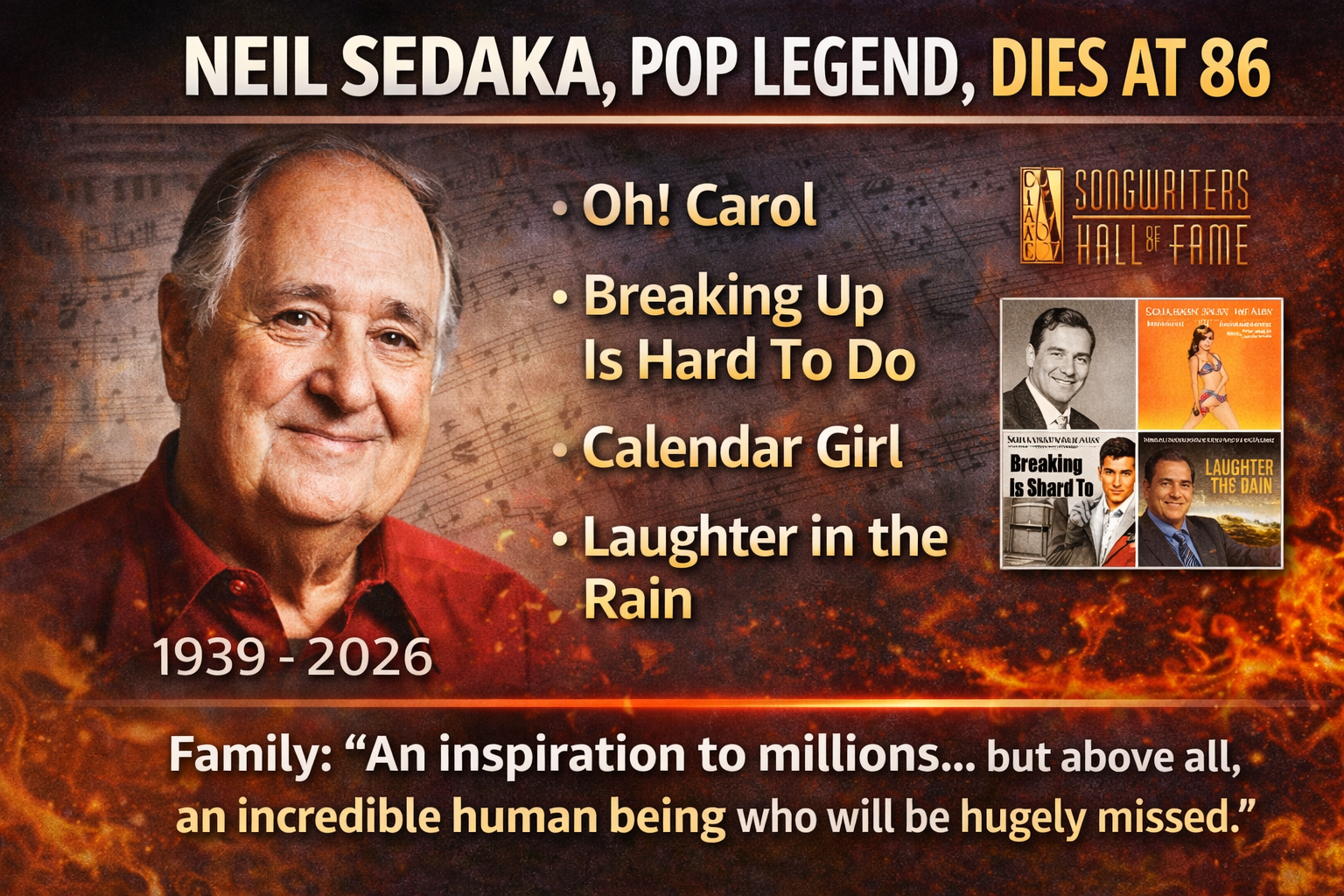
Neil Sedaka, one of the most persistent and successful artists of the 20th century pop music, died at the age of 86. The most famous Brooklyn-born singer, pianist, and composer was known to have contributed a wonderful list of pop classics that served to shape the early years of rock and roll and subsequently spearheaded a major comeback in the 1970s.
On February 27, 2026, Sedaka passed away, and his family acknowledged it with a heartfelt statement that did not just remember his career, but also all the personal impact that he had on his closest friends. The family said that he was a true rock and roll legend, an inspiration to millions of people, yet above all, an incredible human being who will be hugely missed.
Two Generations of Musical Life
Neil Sedaka was born on March 13, 1939, in Brooklyn, New York, and his musical career started with an early exposure to classical music. Neil took piano studies in the Preparatory Division of Juilliard when he was a child. However, his aspirations soon changed to popular music. In the late fifties, he was a key figure in what later came to be known as the Brill Building era of songcraft – a busy center of American songwriting where the composers and lyricists worked on the soundtrack to the culture of the post-war youth.
Along with old friend Howard Greenfield, Sedaka composed and sang a series of hits with a freshness of innocence and vitality of early rock and roll. His breakthrough hits – such as Oh! Carol, Calendar Girl, Happy Birthday Sweet Sixteen, and Breaking Up Is Hard to Do became radio and jukebox hits nationwide.
The voice of Sedaka, a bright and expressive tenor, and his masterful use of the piano were the elements that made his songs easily recognized. By the mid-1960s, not only had he written numerous hits of his own, in the Top 10, but also composed songs that would also reach the charts by other artists, including Connie Francis, and her hits, Stupid Cupid and Where the Boys Are.
From Stardom to Reinvention
Similar to most American artists of his time, Sedaka experienced a career downturn as the British Invasion and pop musicals of the Beatles era altered the landscape. Instead of becoming unidentified, he made this time fly by and kept on writing and creating a way of returning to the awareness of people.
His persistence would be spectacularly rewarded in the 1970s. The music industry backing in the form of music ally, Elton John, who signed him to his Rocket Record Company, enabled him to enter a career revival. Both ” Sedaka, “Laughter in the Rain” and Bad Blood topped the charts on Billboard, and this proved that he was still relevant in a changing industry.
His melodic instinct and emotional narration did not just stop with his recordings: the 1975 hit of the Captain and Tennille, Love Will Keep Us Together, which Sedaka co-wrote, won the Grammy in the category of Record of the Year and became one of the defining songs of the 1970s.
Legacy Beyond the Charts
Throughout a lifelong career of over 60 years, Sedaka authored or co-authored a substantial number of songs (exceeding 500) that have been interpreted by a remarkably diverse list of performers, including Elvis Presley, The Monkees and Frank Sinatra, to name but a few. In 1983, he was inducted into the Songwriters Hall of Fame. He received a star on the Hollywood Walk of Fame, which acknowledged his work as well as his undeniably powerful legacy to popular music.
Sedaka was a performer who was tireless even in the later years as his presence in the pop charts declined. Even in his 80s, he made regular tours and was still reaching audiences across the world, a tribute to his undiminished enthusiasm for live music.
He too experimented with a range of musical forms, whether he was interpreting classical music or Yiddish folk songs in keeping with his cultural roots, he was creatively restless and continued to experiment long after his fame with pop.
Personal Life and Reflections
In 1962, Sedaka was married to Leba Strassberg; the family had two children, and he also kept his close ones during his lifetime. Even his daughter Dara recorded a duet with him, Should’ve Never Let You Go which was a hit in 1980.
Although the circumstances of his death remain unclear, the sheer number of tributes posted by fans and other musicians testifies to the power of his music. To the listeners who have experienced his hits during their early years, and to the younger generation that is rediscovering his music, Sedaka has become integrated into the musical culture of more than one generation.
My Perspective
Being a veteran in the field of covering the music industry for decades, the death of Neil Sedaka is not only the death of a popular entertainer, but of a link between the generations of American music. There are hardly any songwriters who have been able to connect the pre-Beatles pop scene and the subsequent pop-rock scene with as much elegance and flexibility.
Sedaka was not merely a hitmaker; he was a narrator whose songs are imprinted in our minds. His skill to create an eternal hook, combined with lyrics that tended to represent love, heartbreak and joy, which touched upon universal experiences, made his songs have a perennial quality that few of his contemporaries could have.
Sedaka was resilient in a business where reinvention is usually the exception and not the norm. The experience of growing up a teenage sensation and becoming an experienced artist, as well as the setbacks and payoffs of life in music, is a story of his persistence on the stage until much later in life, which is a testament to a rare commitment to his profession.
The legacy of Neil Sedaka will live on through the music, which has been the soundtrack to thousands of individual memories, and in the thousands of musicians who took inspiration from the prolific output of the composer. I am saddened by his fans all over the world at his loss, yet full of melody, heart and grace.