
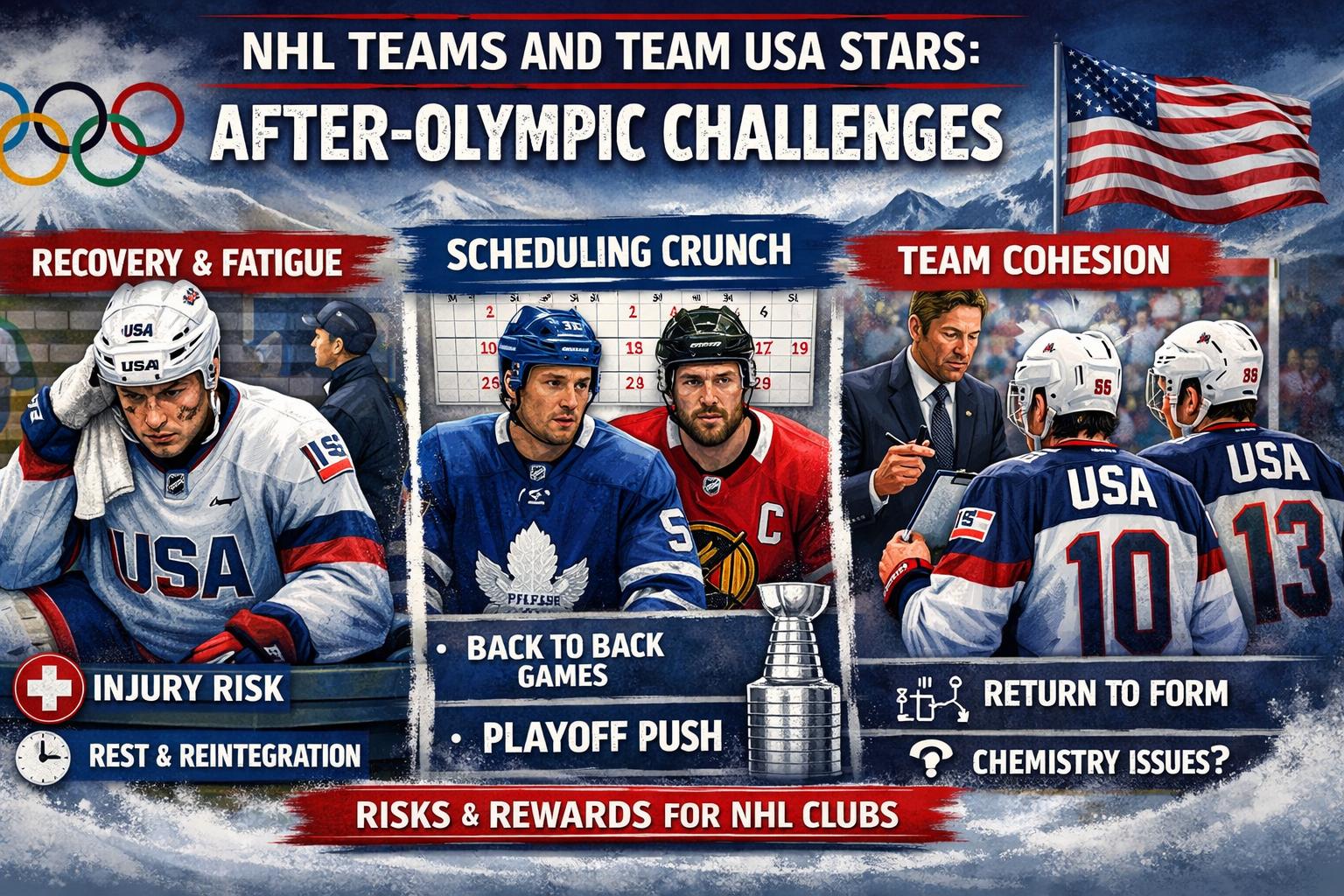
By the time the Winter Olympics are over in 2026, NHL clubs whose players are on Team USA will be facing a difficult post-Olympics timetable, having to cope with recovery and reintegration, as well as the health of their star talent. Although participation in the Olympics is a source of pride to both the players and the franchises, it is usually accompanied by a tight deadline and thus the team has to strategically decide on how to bring the athletes back to the field.
Olympic Success and Impact of the players.
The Team USA produced effective results in the Olympic tournament with various NHL superstars recording important goals, assists, and management. Players who have competed internationally are not only receiving the mental and emotional advantages of playing on behalf of their country, but also the physical conditions of extra games, travel and stress.
As a balancing act in the case of NHL teams, it is a double effect of pride and the risk of fatigue. The medical staffs and coaches should balance the willingness of the players with the risk of injuries or poor performance in the short-term post-Olympic program.
Recovery Timelines
Although the conditions of every player are not similar, annual medical programs that are unique to each team are usually adopted by the NHL after participating in Olympics. This may involve rest time, conditioning time, and slow reintegration into full team practice. The teams that have multiple players in the Olympics, especially those who made it to later stages in the tournament, might be forced to stagger their arrivals so as not to overstretch the squad.
Veteran stars which can be playing many minutes during international matches might need extra observation in order to perform at their best. Younger players might physical recovery faster but might require time to readjust psychologically and find back in-game rhythm in their NHL system.
Scheduling Challenges
The tight schedule of NHL during and around the Olympics makes the life of teams harder. Games that have been deferred or postponed because of the Olympic competition place a backlog of matches that need to be played on commencement of the normal season. This creates periods of compressed play, which in most instances, necessitates teams to rotate their lines, time their minutes, and care about the health of players.
High-concentration teams containing Team USA stars have an additional challenge of guaranteeing chemistry and cohesion when they come back. Players can have missed critical team meetings, practice, or line changes which should be clarified as soon as possible to reduce the balance in the field.
Strategic Considerations
In the case of coaches, incorporation of returning Olympians is a matter that needs to be approached strategically. The players can be brought back into the field slowly, or in certain instances, they can be directly put into important games in case their talent is considered vital. It is important to balance between rest and game preparedness especially with teams positioning themselves in playoff in a highly competitive industry.
Another consideration that general managers should take is the implications of contract and cap. Popular Olympic athletes are likely to be burdened by large salaries, and their post-Olympic performance may influence contract or roster choices. The health and productivity of star players are of priority whether on the ice or off the ice.
Potential Risks and Rewards
Although old players bring in the energy and international experience of competition, it has its drawbacks. Exhaustion, minor injuries and mental fatigue may impact on performance and a possible decline in output may be experienced. This adjustment period may be used by opposing teams and teams that are coming back to challenge the stars in the initial post-Olympic games.
Competitiveness and confidence on the other hand can be sharpened through Olympic experience. Players who have experienced high morale and leadership back when they competed against the medal holders would instigate inspiration among the other team members. Teams within NHL, which are able to manage reintegration successfully, can get great advantage, as they can use their Olympic conditioning and high-pressure experience to work to their benefit.
Player and Fan Perspectives
They are the players who usually take the pride of playing in Team USA, and a lot of them may refer to this as one of their career highs. Fans also like to watch NHL talent in the international arena to celebrate national success and high competition. Nevertheless, both camps understand the effect on the NHL season – not only the number of missed games but also early exhaustion of the season, which may happen after the Olympics.
Players have been enthusiastic to bring international competition momentum to their respective NHL teams. It is the difficulty to maintain this momentum and combine it with the physical and mental needs of a hectic NHL schedule.
Looking Ahead
With the NHL teams moving through the post-Olympic seasons, the health and performance of the players will be of vital importance. The training staff and coaches will be required to keep a close eye on ice time, rest, and work load to prevent injuries and maximize performance. Multiple Olympic team teams will also be able to change the tactics and lineups to fit newcomers to the team.
The weeks after Olympics will be a challenge to the depth, flexibility and medical supervision in the organization. In the case of teams that have Team USA stars, any decision made during this time might subject the team to playoff results and overall performance.
Challenges are inevitable still but the experience acquired by the players in the international platform can be rewarding in case handled well. In the case of NHL franchises, the question of finding the right balance between excitement, national pride, and the requirements of the regular season will always be a thing that would determine the performance of teams in the second half of 2026.