
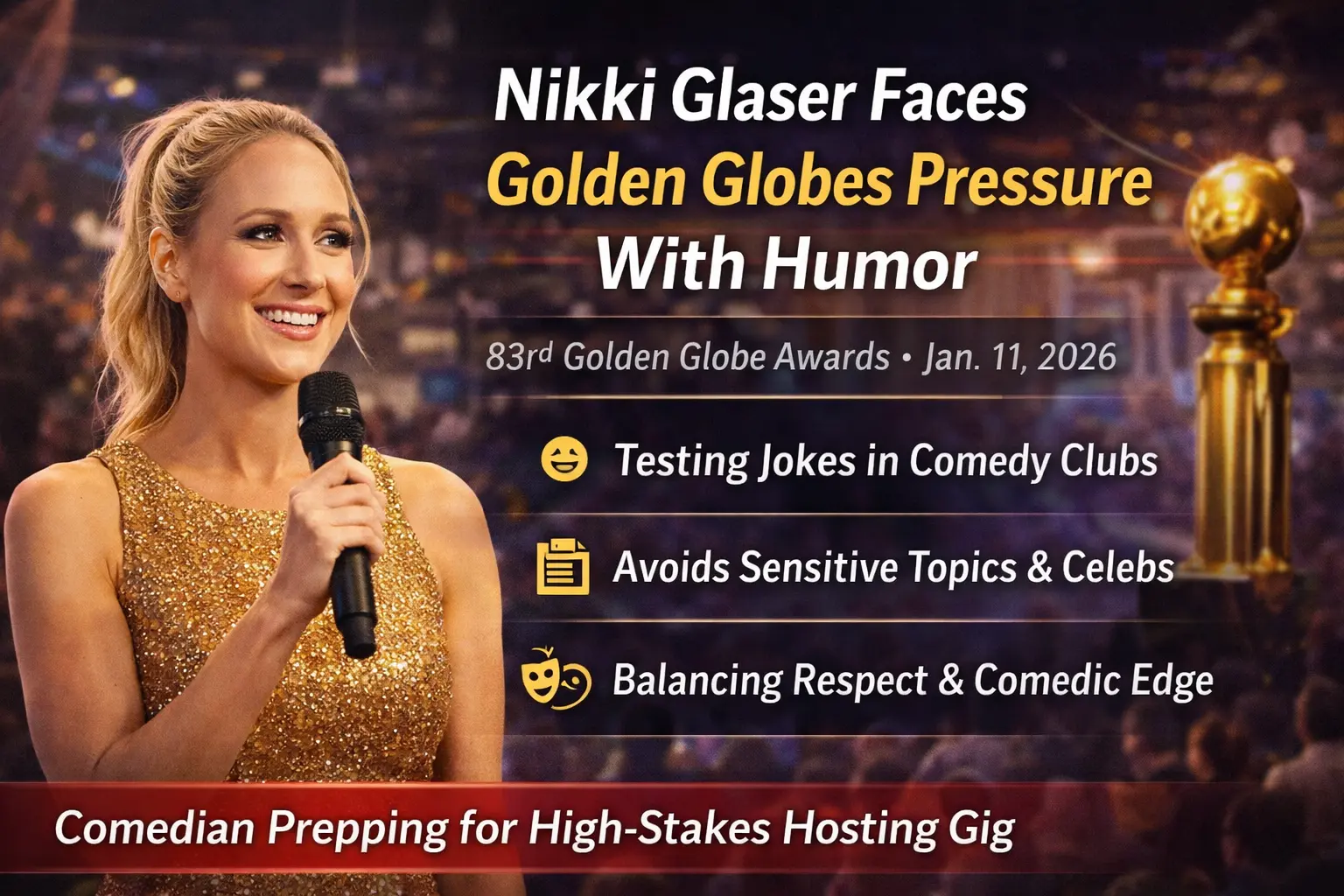
LOS ANGELES -With the 83rd Golden Globe Awards just days away (Jan. 11, 2026), comedian Nikki Glaser is making headlines not just for her return to the awards-show stage, but for the candid way she’s talking about the trial-by-fire experience that awaits her once the cameras start rolling.
During one of the recent interviews, it could not be made clearer by Glaser that there is extreme pressure that follows hosting the most discussed awards ceremony in Hollywood, particularly when the awards are going to be the second in a row. I am more or less screwed, I joked, which was not purely tongue-in-cheek in terms of what she is experiencing with this year’s show, due to the peculiarities.
Glaser is the first female to host the Golden Globes on her own merit last year, and critics and the viewers alike hailed her as having a keen sense of wit and bold humor. The victory solidified her fame outside the stand-up comedy industry – but also placed a lot of pressure on her that she has freely admitted to feeling obliged to achieve or even exceed this year.
Testing Material in Real Time
The most unique feature of the preparation that Glaser underwent is the approach of road-testing jokes that she did in Los Angeles comedy clubs. Trying it on smaller crowds, she will be able to test the reactions and perfect the monologue before presenting it to the entire world.
She has been taught a few lessons the hard way – the most important one being the fact that audiences are extremely defensive towards certain celebrities. Even the light jokes directed at Julia Roberts, which were usually addressed as the Sweetheart of America, failed miserably when they were tested, and such a joke will not go well at the Globes.
“I’m trying out my monologue… and just even any joke about Julia Roberts, they are not there for,” she said, revealing the delicate balance she’s striking between playful ribbing and audience expectations.
This kind of real-world feedback is vital in a fragmented cultural landscape where a joke that resonates with one group can fall flat with another, especially in a room full of Hollywood A-listers and millions of viewers at home.
The Art of Being Strategic and Respectful
Beyond club testing, Glaser has been intentional about what she chooses not to joke about. In an exclusive interview, she explained that certain topics like worn-out celebrity scandals or polarizing pop-culture moments feel “cheap” or forced, and she’s actively avoiding them.
Similarly, even when she tests material about award nominees like Leonardo DiCaprio, she finds herself holding back because of personal admiration, even joking that his presence makes joking about him “off-limits.”
She aims to create humor that feels authentic rather than cynical or mean-spirited. This strategy acknowledges the sophistication of the audience both in the room and watching at home.
Lessons From Other Comics (and a Joke That Got Nixed)
Glaser isn’t navigating this terrain alone. She’s collaborated informally with veteran comedians like Steve Martin and Judd Apatow, who have weighed in on possible jokes and direction. One joke Martin sent her was ultimately dropped, not because it was bad, but because both he and Glaser agreed it pushed too far for this particular show.
This mirrors her broader approach: many comedians thrive on shock value and boundary-pushing, but awards shows are unique; the host must entertain without derailing careers or souring nights for nominees.
Where other comics (like Ricky Gervais) leaned heavily into bitter jabs and yes-or-no cultural commentary during their hosting gigs, Glaser’s tone has been more calibrated, aiming for clever rather than confrontational.
What Worked — and What Didn’t — Last Year
A reflection on her 2025 monologue provides a template of how Glaser is planning to deal with 2026. Last year, when the overall performance received much applause, a few of the jokes drew a debate. Her little stunt at Selena Gomez and Benny Blanco had raised eyebrows – and even Glaser, after the fact, confessed that it was indeed quite mean, but she did not think that it was based on any ill intent.
Her direct mention of the scandal involving Sean “Diddy” Combs was another one that raised mixed responses both in the room and online. To some, it was a courageous, popular thing to do; to others, it was in bad taste.
It is obvious that Glaser is walking the thin line: she does not want to spoil the night of people, but she also has the sense of duty to fulfill the comedic expectations of the people at home.
The Influence of True To Life and Being Famous
The Golden Globe hosting has essentially changed the way that Glaser sees her role in the entertainment world. After her fame was largely built on her razor-sharp stand-up and her appearance as a roastee, she now finds herself in the limelight in a more mainstream setting.
She does not experience a lack of self-awareness, despite this high position, which appeals to a large number of fans. She often makes jokes about the fact that she has not seen all the nominated films and television programs, and it is an impossible task to stay in the current content flood. And yet, she does watch strategically – many times, on what will assist her in making jokes that are received by the audience.
Whether it is the preparation of a comedian or the emotional work that goes into comedy during a controversial cultural moment, the reflections of Glaser are more than merely a preparation routine of a comedian. She does not just race to be funny; she is also meticulously developing trust among celebrities and viewers.
Analysis by the Editor: How to Host awards shows in the present age
As an editorial, it is refreshing to see Nikki Glaser be so open about things, as it is a wonderful change of pace from the polished PR we are accustomed to, especially in the context of awards shows. Her transparent nature when it comes to taking jokes with the backlash of the audience and even questioning herself directly makes her more relatable in an age where audiences desire personalities that have real personality, rather than have scripts.
Her approach also shows sweeter tendencies in the current entertainment ecosystem: scattered audiences having distinct tastes in humor, heightened sensitivity of tone usage and the increasing influence of social media responses. Glaser is not merely a host of a show but has been maneuvering cultural fault lines that were not like this a decade ago.
Critics can complain that she is playing it too safe sometimes. However, in the environment of influential celebrities and with millions of audience watching online, strategic safety may become the most daring of all.