
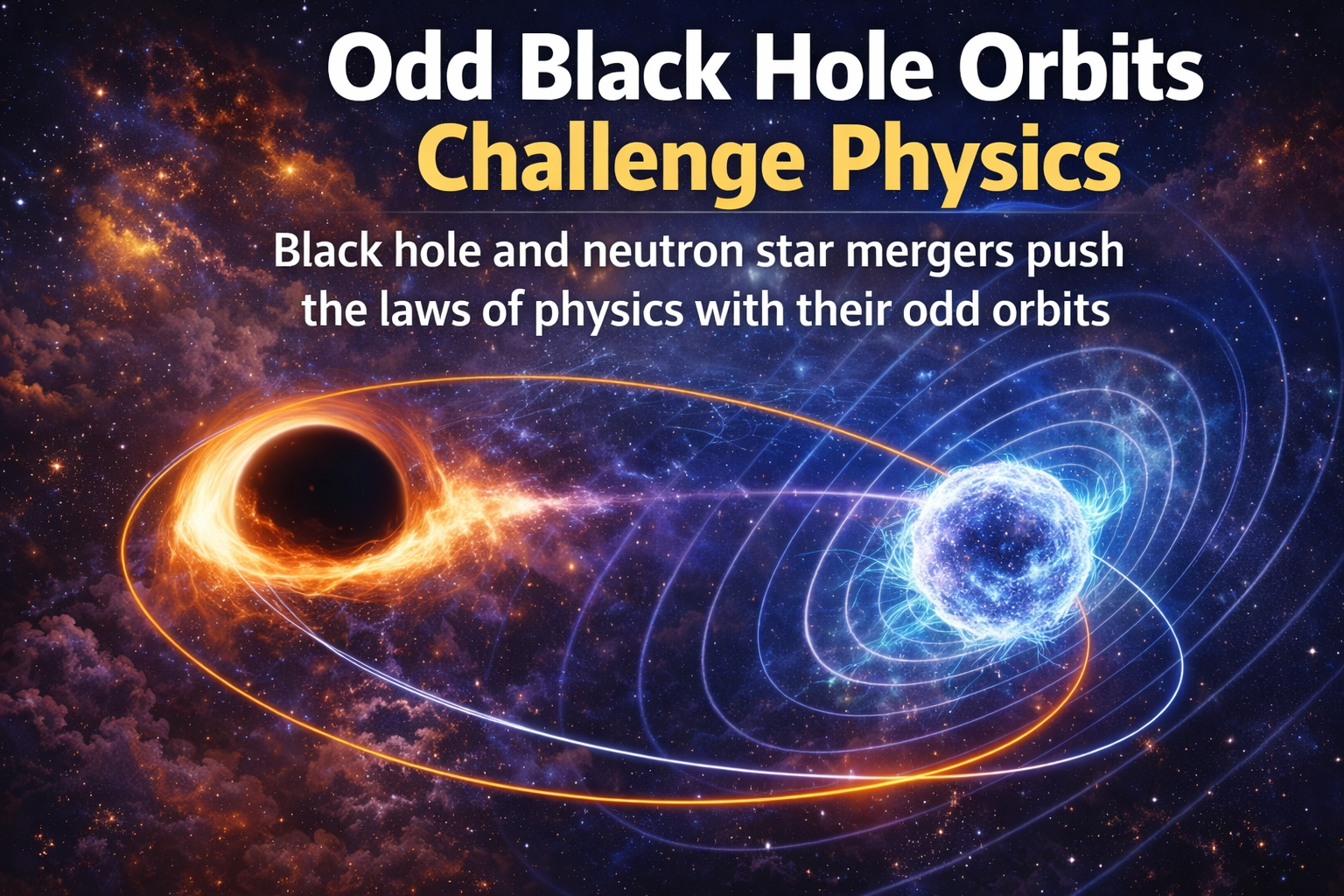
Astronomers studying some of the most extreme objects in the universe have discovered a surprising phenomenon that is forcing scientists to rethink long-standing ideas about cosmic collisions. Recent observations suggest that certain black hole–neutron star mergers occur in unusual oval-shaped orbits rather than the nearly perfect circular paths scientists previously expected.
This discovery is significant because such mergers produce powerful gravitational waves, ripples in space-time predicted by Albert Einstein’s theory of general relativity. When compact objects like black holes and neutron stars spiral together, they release enormous bursts of energy detectable across the universe.
However, new research indicates that the orbital motion leading up to these collisions may be far more complex than previously thought. Instead of gradually spiraling inward along smooth circular paths, some of these cosmic pairs appear to move in eccentric or elongated orbits, dramatically altering the nature of their final collision. The finding could reshape scientific understanding of how these systems form and evolve, while also offering a new way to test the fundamental laws of physics.
The Extreme Nature of Black Holes and Neutron Stars
Black holes and neutron stars are among the most extreme objects in the universe. Both are formed during the violent deaths of massive stars. A neutron star is created when a massive star collapses under gravity during a supernova explosion. The collapse compresses the star’s core so tightly that protons and electrons combine to form neutrons, producing an object only about 20 kilometers wide but with a mass greater than that of the Sun.
A black hole, on the other hand, forms when a star collapses so completely that gravity creates a region where nothing—not even light—can escape. At the center of a black hole lies a singularity, a point where density becomes infinite according to current theoretical models.
When these two types of objects form a binary system, they begin orbiting each other in a gravitational dance that can last millions or even billions of years. Over time, gravitational radiation gradually drains energy from the system, causing the objects to spiral closer together until they eventually collide. The moment of collision releases enormous energy in the form of gravitational waves.
The Discovery of Odd Orbital Paths
The discovery of eccentric or oval-shaped orbits emerged from detailed analysis of gravitational wave data collected by the LIGO-Virgo-KAGRA collaboration, an international network of detectors designed to observe ripples in space-time. Scientists studying one particular event, known as GW200105, found evidence that the black hole and neutron star were not orbiting each other in a perfectly circular pattern. Instead, the pair appeared to follow an elongated orbit shortly before merging. This discovery was surprising because most theoretical models predict that compact binary systems should lose orbital eccentricity over time. As gravitational waves carry away energy, the orbit should gradually become circular before the final merger. The fact that the system retained an eccentric orbit suggests that something unusual happened during its formation. Researchers say this observation represents the first robust evidence of a black hole–neutron star merger occurring in such an oval orbital path.
Why Scientists Expected Circular Orbits
For decades, astronomers believed that most compact binaries formed from pairs of massive stars born together in the same stellar system. In this scenario, the stars evolve side by side and eventually collapse into compact objects—such as neutron stars or black holes. Because the stars orbit each other for millions of years, their paths gradually become circular through gravitational interactions and radiation. By the time the objects merge, their orbits should be nearly perfectly circular. This expectation formed the basis for many gravitational wave detection models. Scientists assumed that signals produced by these mergers would reflect circular orbital motion. The discovery of eccentric orbits challenges this assumption.
Possible Origins of Eccentric Mergers
One possible explanation for these unusual orbital paths involves dynamical interactions in dense stellar environments. In regions such as globular clusters or galactic centers, stars and compact objects can pass extremely close to one another. These encounters sometimes lead to gravitational capture, forming binary systems that never existed before. When two compact objects capture each other through such interactions, their initial orbit can be highly elliptical. If the objects merge quickly after capture, the orbit may still be eccentric when gravitational waves become detectable. Another possibility involves three-body systems, where a third star or black hole perturbs the orbit of a binary pair. These interactions can stretch the orbit into an elongated shape and accelerate the merger process. Such scenarios would produce gravitational wave signals different from those expected from circular systems.
The Role of Gravitational Waves
The study of black hole and neutron star mergers relies heavily on gravitational wave astronomy, a relatively new field that emerged after the first direct detection of gravitational waves in 2015. These waves are distortions in space-time produced by accelerating massive objects. When two compact objects orbit each other, they create a pattern of ripples that travel across the universe at the speed of light. Detectors such as LIGO in the United States, Virgo in Italy, and KAGRA in Japan measure these signals using extremely sensitive laser interferometers. In recent years, the number of detected gravitational wave events has grown rapidly. Scientists recently expanded their catalog of detections to include more than 100 new events, providing a rich dataset for studying cosmic collisions. These observations allow researchers to measure the masses, spins, and orbital properties of merging objects.
Why Eccentric Orbits Matter
The discovery of eccentric mergers is important because it allows scientists to test the limits of Einstein’s theory of general relativity under extreme conditions. General relativity predicts how gravitational waves should behave when massive objects orbit each other. However, eccentric orbits produce more complex gravitational wave signals than circular ones. By analyzing these signals, researchers can compare observations with theoretical predictions and look for deviations from known physics. If scientists ever detect gravitational waves that do not match the predictions of general relativity, it could indicate the presence of new physical laws or previously unknown phenomena. For now, the newly observed systems still appear consistent with Einstein’s theory, but they provide a much more challenging test of its predictions.
Implications for Astrophysics
The discovery of eccentric black hole–neutron star mergers may also change how astronomers think about the life cycles of stars and compact objects. If many of these mergers form through chaotic interactions in dense star clusters rather than through long-lived binary systems, it would reshape theories about where gravitational wave sources originate. It could also influence predictions about how often such events occur across the universe. Scientists believe that future gravitational wave observatories will detect many more examples of these unusual systems. As detectors become more sensitive, researchers will be able to identify subtle details in gravitational wave signals that reveal the structure of binary orbits.