
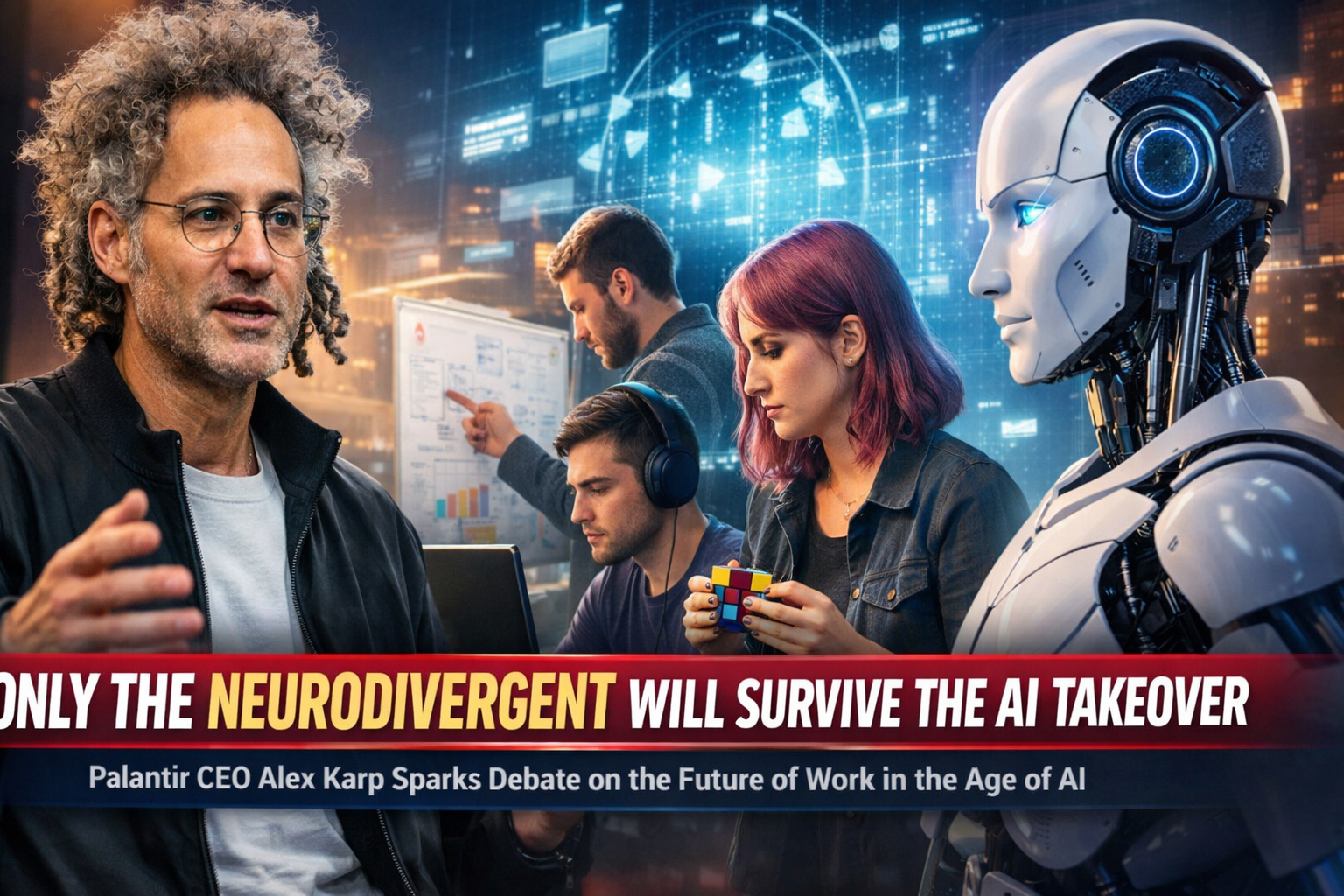
Palantir CEO claims neurodivergent individuals may thrive amid AI takeover, sparking debate on the future of work and human adaptability.
In a striking and controversial statement, Palantir Technologies CEO Alex Karp has suggested that in a future dominated by artificial intelligence, only neurodivergent individuals—those whose brains function differently than what is considered typical—will successfully adapt and thrive. Speaking at a recent industry forum, Karp argued that as AI increasingly automates traditional cognitive tasks, society will favor individuals with unique cognitive abilities that resist straightforward automation.
The remarks have sparked intense discussion among technologists, sociologists, and policymakers. Critics argue that such statements risk oversimplifying the relationship between humans and AI, while proponents suggest it highlights the emerging importance of diversity in thought and problem-solving in the age of automation.
The CEO’s Perspective on AI and Human Adaptation
Karp’s commentary revolves around the rapid integration of AI into industries, from finance and defense to healthcare and logistics. According to him, AI systems excel at predictable, rule-based tasks but struggle with novel problem-solving, creative thinking, and unconventional perspectives—areas where neurodivergent individuals often excel.
By this logic, the CEO suggests that the next wave of human productivity and innovation will depend less on traditional educational credentials and more on cognitive flexibility and atypical thinking patterns. Karp noted, “The AI takeover isn’t about machines replacing humans entirely. It’s about machines taking over what’s routine, and only those who can think differently will truly remain indispensable.”
Implications for the Workforce
Karp’s statement implies a paradigm shift in employability and skills training. Conventional talent development, focused on standard academic achievements and linear problem-solving, may be insufficient in an AI-driven economy. Instead, emphasizing neurodiversity, creativity, and adaptability may become critical for long-term career survival.
Corporate leaders are increasingly considering how to integrate neurodiverse talent into teams, not just for social responsibility but for operational advantage. Tech firms, including Palantir, are exploring programs to recruit employees with autism spectrum conditions, ADHD, or other cognitive differences, acknowledging their potential to outperform AI in complex, unpredictable scenarios.
Controversy and Criticism
Karp’s comments have not been universally well-received. Critics argue that framing neurodivergence as a survival mechanism risks stigmatizing those who are neurotypical while romanticizing cognitive differences. Legal scholars also note the need for caution to avoid creating employment biases or discriminatory hiring practices under the guise of AI readiness.
Additionally, sociologists caution against the simplistic narrative that neurodivergent individuals are inherently superior in an AI-dominated world. They emphasize that human adaptability is multifaceted, influenced by social support systems, education, and access to resources—not just neurocognitive traits.
Expert Analysis: Understanding the Statement
Cognitive Diversity and AI
While controversial, Karp’s statement taps into a broader discussion about cognitive diversity in the workplace. Studies in organizational behavior have shown that teams composed of individuals with varied cognitive approaches often outperform homogeneous groups, particularly in problem-solving and innovation tasks. AI, by contrast, operates within algorithmic constraints and can struggle with ambiguous, nuanced problems.
Preparing for the AI Economy
Industry analysts see a clear signal in Karp’s words: companies must rethink talent strategies. This includes:
- Emphasizing cognitive diversity as a strategic advantage
- Designing training programs to foster creativity and unconventional thinking
- Integrating humans and AI in ways that leverage complementary strengths
This approach could help ensure that human workers remain relevant, not through resistance to AI, but through collaboration with intelligent systems.
The Societal Dimension
Karp’s vision also raises broader societal questions. If AI continues to replace routine intellectual and administrative tasks, educational systems, workplace policies, and social safety nets may need dramatic reform. Preparing all individuals—neurotypical and neurodivergent alike—for a future economy dominated by AI becomes a moral and practical imperative.
Moreover, fostering neurodiversity must extend beyond tokenism. Experts advocate for inclusive environments, tailored support structures, and recognition of different work styles to ensure equitable participation in an AI-integrated workforce.
While framing the future in terms of neurodivergence versus neurotypicality is simplistic, it underscores the urgent need to value cognitive diversity, creativity, and adaptability in a world where AI will dominate repetitive, predictable tasks.
As a news editor, I view this as an opportunity to spark conversation about how human ingenuity complements AI, rather than framing it as an existential competition. Organizations, governments, and educational institutions should proactively prepare for a future where human strengths evolve alongside technological advancement, ensuring that all individuals can thrive.
Alex Karp’s statement that only neurodivergent individuals will survive the AI takeover has ignited debate across tech, education, and policy sectors. While controversial, it highlights the growing importance of cognitive diversity, creativity, and adaptive thinking in an AI-driven future. Rather than a literal survival scenario, the remark can be interpreted as a call to action: society must rethink how it educates, employs, and supports human talent in a rapidly automating world.
The challenge ahead lies in harnessing human potential in harmony with AI, ensuring that technological progress benefits all segments of society. Embracing diversity—not just in cognitive style but across gender, culture, and experience—will be the key to thriving in the age of AI.