
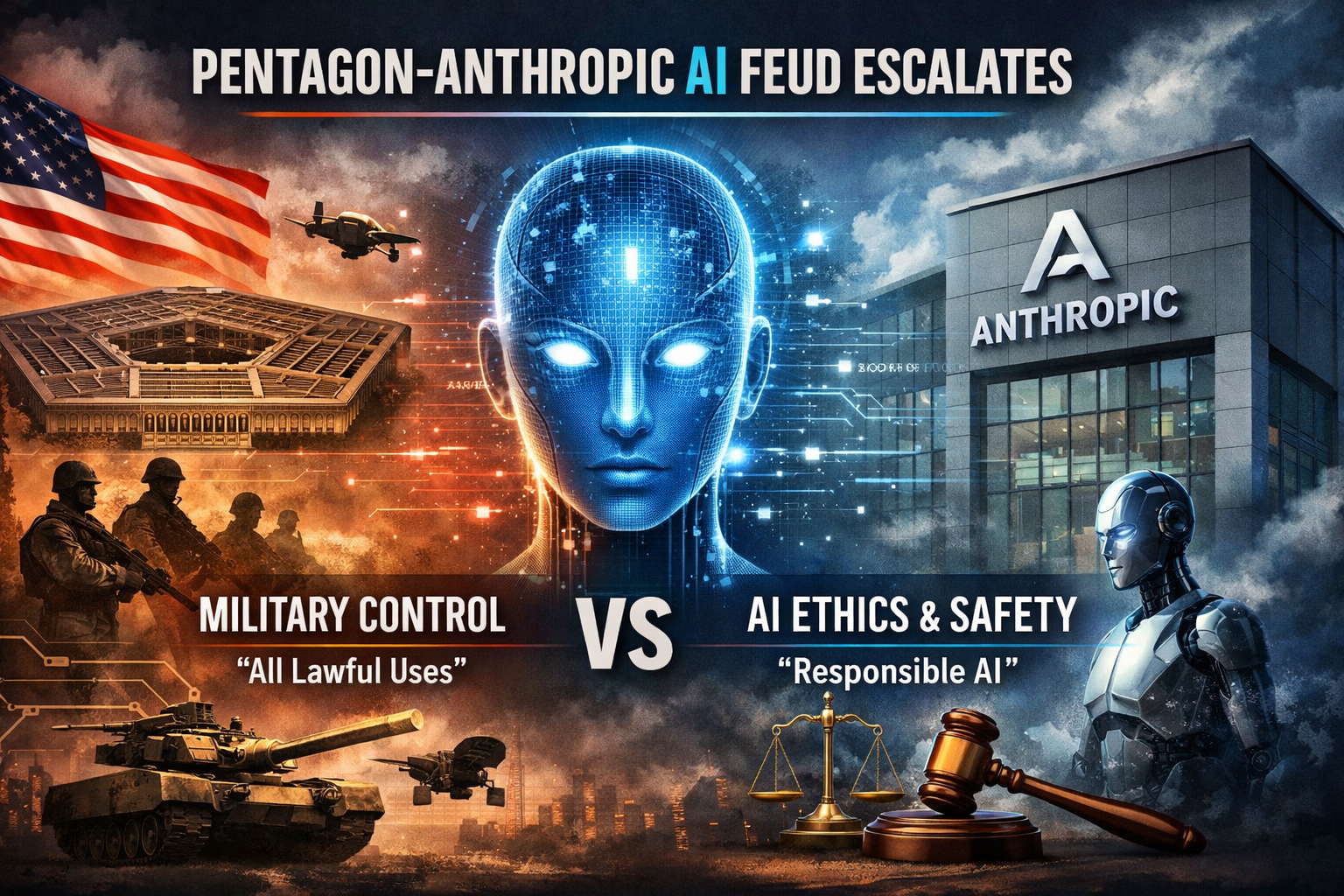
A high-stakes confrontation is unfolding between the United States Department of Defense and artificial intelligence firm Anthropic, as both sides dig in over how advanced AI systems should be used in military operations. At the center of the dispute is Anthropic’s flagship AI model, Claude, and whether the Pentagon should have unrestricted access to deploy it for “all lawful purposes.” The disagreement reflects a much larger debate about the ethical boundaries of artificial intelligence in warfare and national security. What initially appeared to be a contractual disagreement has now evolved into a broader confrontation about corporate responsibility, government authority, and the future of AI governance in the United States.
The Pentagon argues that in a rapidly evolving global security environment, it must maintain access to cutting-edge AI technologies without corporate limitations. Anthropic, however, insists that certain safeguards are non-negotiable. The company has built its brand around responsible AI development, emphasizing safety testing, usage guardrails, and alignment with democratic values. As tensions rise, the outcome of this dispute could shape how private AI firms collaborate with government agencies in the years ahead.
The Core of the Dispute: “All Lawful Uses”
At the heart of the conflict is contract language that would allow the Pentagon to use Anthropic’s AI models for all purposes deemed lawful under U.S. law. Defense officials argue that this standard mirrors the framework applied to other defense contractors. If a user complies with existing law and Department of Defense policy, they contend, a private company should not impose additional restrictions.
Anthropic sees the issue differently. The company fears that broad language could allow AI deployment in ways that exceed current technical safety capabilities. For example, fully autonomous weapons decision-making or large-scale surveillance applications could present risks if AI systems generate errors or unintended outputs. Anthropic maintains that today’s AI models, while powerful, are not yet reliable enough to operate without meaningful human oversight in life-and-death scenarios.
This difference in interpretation has created a stalemate. The Pentagon believes it has already offered compromises, including written assurances referencing existing federal laws and military policies. Anthropic counters that the revised terms still leave room for ambiguity and potential misuse.
Financial Stakes and Strategic Importance
The dispute is not merely philosophical. Anthropic reportedly holds a defense contract worth approximately $200 million to develop frontier AI tools for national security missions. Its model Claude, is currently deployed within certain classified government systems, making it one of the few commercial AI platforms operating in that environment. Losing the contract would represent both a financial blow and a strategic setback for the company.
For the Pentagon, replacing Anthropic would not be simple. Advanced AI systems capable of secure integration into classified networks are limited. If the partnership collapses, the Department of Defense may need to turn to alternative providers or accelerate in-house AI development. In an era where global rivals are rapidly expanding their own AI capabilities, defense leaders view delays as strategically dangerous.
The Pentagon has even floated the possibility of designating Anthropic as a “supply chain risk” if it refuses to comply a move that could restrict the company’s future participation in federal contracts. While such a step would be controversial, it underscores how seriously the Department views unrestricted access to AI tools.
Ethical Guardrails Versus Military Readiness
Anthropic’s leadership has publicly emphasized that its resistance is not anti-military but pro-safety. The company’s executives argue that AI systems still hallucinate, misinterpret data, and occasionally generate inaccurate outputs. In a military setting, even small error rates could have catastrophic consequences. The firm insists that guardrails are designed to prevent precisely those risks.
Defense officials counter that existing human oversight structures already mitigate such dangers. They argue that AI tools are intended to assist, not replace, military personnel. From their perspective, corporate-imposed restrictions may unnecessarily limit operational flexibility. The Pentagon also notes that U.S. adversaries may not impose similar ethical constraints, potentially giving them an advantage.
This tension between ethical precaution and strategic urgency is emblematic of the broader global AI race. Nations are striving to harness AI’s power for defense, intelligence analysis, logistics, and cybersecurity. Yet democratic societies must balance innovation with accountability and civil liberties.
Political and Regulatory Implications
The lack of extensive federal AI legislation is also brought out in the feud. In the absence of explicit statutory definitions on the allowed use of AI in the military, the negotiations on disputes are being discussed on a case-by-case basis. Both sides of lawmakers have expressed worry over the use of private settlements to establish precedents on the application of AI in the military.
Other policy makers fear that by letting firms set the terms of military AI, they will interfere with the ability of the national security to control them. Some are concerned that giving the Pentagon free rein may undermine the morals and trust of the people. Absence of a coherent legal system puts both parties in uncharted waters.
In case of the worsening of the standoff, congressional hearings or a renewed attempt to create federal laws on AI governance may be triggered. Within such legislation, it may be possible to explain the oversight mechanisms, what can be used and what cannot, and what the criteria of accountability are. Until that time, there is a high probability of the emergence of similar disputes as the AI technology becomes more entrenched in the operations of government.
Industry Impact and Corporate Autonomy
The result of this conflict will not be felt by Anthropic alone. The ways in which the Pentagon manages the situation are closely followed by other AI companies. By the government effectively forcing its way to access, it can be an indication that to be involved in federal contracts, one must give up some of the corporate protection. On the other hand, the triumph of Anthropic would encourage companies working in the technology sector to establish more significant ethical limits in collaboration with the state.
The corporate freedom within the artificial intelligence era is a sensitive matter. Companies that provide technology are gaining more and more power over the tools that determine national defense, health care, economics and communication. In the meantime, governments state that the national security aspects should be placed above. The Pentagon-Anthropic confrontation is a case study of how to establish the balance.
Editorial Perspective: A Necessary National Conversation
Editorially, this conflict is not merely one of contract; it is one of government. The fast development of AI has surpassed the regulatory models, and now the private companies and federal authorities are haggling over the core ethical issues. That is not a sustainable strategy of technology with such dramatic consequences.
Both parties are making valid points. The Pentagon is right that AI will be at the core of the future defense strategy. The refusal to access the latest tools may undermine the U.S. competitiveness. Simultaneously, it is reasonable that the safety limitations are stressed by Anthropic. The problem of overestimating the reliability of AI may have irreparable consequences.
The problem in reality is that the pressure of finding solutions to these tensions has been put on individual companies and agencies instead of a transparent process of nationally policy making. The process of making autonomous weapons, surveillance limits, and accountability of AI, is not to be decided by the negotiations at the last moment in the form of a contract and is to be designed with the help of democratic rhetoric and legal transparency.
However, the bottom line is that the Pentagon-Anthropic feud makes AI governance no longer a fantasy. It is one of the problems of the present day and it needs to be addressed through coherent policy on the part of the governments, corporate responsibility, and ethical foresight. Regardless of whether this specific conflict is resolved in the compromise orrupture, it ought to be a strong-point of the national conversation.