
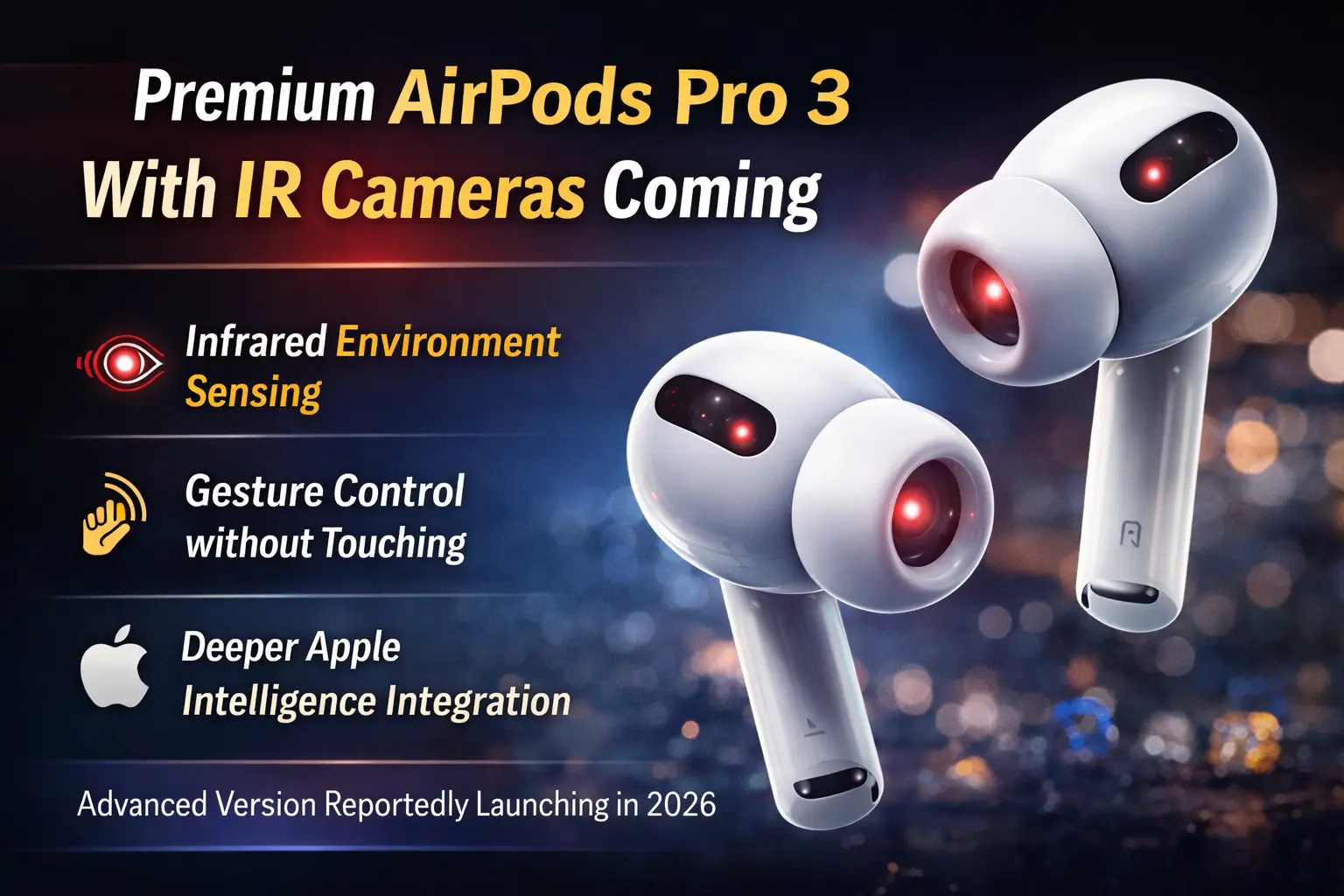
Apple is again ready to take its AirPods series to the next level. As per the recent news, the company has been developing a high-end and premium model of the AirPods Pro 3, which is anticipated to have infrared (IR) cameras, sophisticated sensors, and a profound Apple Intelligence application. This is considered a big step in the wearable roadmap of Apple because it has the potential to turn AirPods into just other wireless earbuds into smart devices capable of contextual awareness.
The standard AirPods Pro 3 that Apple has already launched already have improvements like the improvement of sound quality, increased Active Noise Cancellation, improved transparency mode, and smarter software features. But the future high-end model will be far beyond the standard one, as it is aimed at those users who desire the latest wearable devices and sophisticated AI-powered features.
The inside sources say that Apple might sell two editions of the AirPods Pro 3 regular product to the general audience and a more affordable and high-end-technical version to the tech-savvy and first-mover target audience. This two-layer approach would enable Apple to increase its presence and retain its premium brand image.
How IR Cameras Could Change the AirPods Experience
The most noticeable aspect of the high-end AirPods Pro 3 is that they have infrared cameras. The cameras are not aimed at making photos or capturing videos. Rather, they are supposed to be utilized in environment sensing, motion detection, and gesture recognition. The earbuds were able to monitor user movements, head position and what was going on around them more accurately with the help of IR technology.
This feature would see AirPods become much more interactive. An example here is that the earbuds can be able to readthe direction in which the user is gazing or the direction in which he is moving and react by providing contextual audio feedback. The application of such functionality is consistent with the larger vision of Apple to create more devices that have the ability to interpret user intent instead of reacting to manual instructions.
IR cameras would enable AirPods to become a wearable that can adjust to real-life scenarios more easily, to provide a more human-friendly and more organic approach to the user experience.
Visual Intelligence and Context-Aware Capabilities
Visual Intelligence may also be introduced to the AirPods line with the introduction of IR cameras. Visual Intelligence is a system in which devices are used to process the visual information in the real world and integrate it with audio information and contextual information to provide smarter information.
Premium AirPods Pro 3 can automatically turn the noise-cancelling levels up or down depending on the surrounding environment. The earbuds could be set to be more Active Noise Cancellation in a busy or noisy environment, and to be smooth transitioning to the transparency mode in quieter environments. This would occur dynamically without necessarily having to input the information manually.
Moreover, the context-related alerts, reminders, and suggestions might also be facilitated by Apple Intelligence. An example is that the earbuds could identify some environments or activities and deliver audio feedback accordingly. Through synergizing the visual consciousness with the audio processing, AirPods would not just be ordinary listening tools, but they would be intelligent assistants to complement daily routines.
Gesture Controls Without Physical Touch
High-end gesture control is the other significant update that is likely to be involved in the premium AirPods Pro 3. So far, AirPods have been interacted with by means of touch gestures and stem presses. In IR cameras, Apple could implement gesture-based controls that are hands-free and thus do not require touching.
Hand movements or slight gestures enable users to play or stop music, increase or increase/decrease its volume or receive and cut calls. This kind of interaction would come in handy, especially when it is difficult to touch the earbuds, like when working out, cooking, commuting or driving.
Gesture-based control is also well-suited to the overall concept of spatial computing and natural user interfaces, which is a strong interest of Apple. Apple can make its wearable products more usable by cutting down on the physical effort and making interactions more natural.
Apple Intelligence at the Core
The core of the high-end AirPods Pro 3 will be Apple Intelligence, the emerging AI and machine learning platform at Apple. The earbuds can adapt the experience more to the user with AI-driven processing that processes user behavior, preferences, and daily habits to provide an experience tailored to the user.
Language translation (in real-time), voice assistant (smarter), and adaptive noise cancellation might be made more responsive and realistic. Apple Intelligence can also be used to enhance the quality of calls through the improvement of voice clarity and the elimination of background noise in real time.
Through smart-on-device processing, AirPods would be able to make smart decisions in real-time without overly depending on cloud computing. This would enable quicker reactions, enhanced secrecy and an enhanced user experience.
Health and Lifestyle Possibilities
High-tech sensors and AI also allow the premium AirPods Pro 3 to have a bigger role in health and lifestyle tracking. Apple is currently working on the usage of wearables beyond fitness monitoring, and the AirPods may become a significant component of this system.
This may be used to identify posture, head motion or patterns of physical activity because of the presence of the IR cameras and motion sensors. AirPods may be used as a part of a more holistic health and wellness system when used in conjunction with other Apple products, such as the Apple Watch and iPhone.
This would add to the connected ecosystem of Apple, with several gadgets collaborating with each other to deliver real-time information and custom feedback.
Battery Life and Engineering Challenges
Adding cameras and advanced sensors to such a compact device is not without challenges. Battery life is expected to be one of the key concerns, as additional processing power will be required to support IR cameras and AI features.
Apple has a strong track record of optimizing power efficiency through custom chips and software improvements. The company will likely focus heavily on energy-efficient hardware and intelligent power management to ensure that battery life remains competitive.
Design constraints are another challenge. AirPods already have a compact form factor, and integrating IR cameras without compromising comfort or aesthetics will require precise engineering. However, Apple’s history of miniaturizing complex technology suggests that these challenges are not insurmountable.
Privacy and Data Security Considerations
The presence of cameras in earbuds naturally raises privacy concerns. Users may worry about how visual data is captured, processed, and stored. Apple is well known for its privacy-first approach, and this is expected to continue with the premium AirPods Pro 3.
Most data processing is likely to happen on-device, minimizing the need to transmit sensitive information externally. Clear privacy indicators, transparent policies, and strict data controls will be crucial in building user trust.Apple will need to clearly communicate how IR cameras function and reassure users that the technology is designed for sensing and interaction, not surveillance.
Pricing and Market Positioning
Given the advanced hardware and AI-driven features, the premium AirPods Pro 3 is expected to be priced higher than the standard model. While the regular AirPods Pro 3 caters to the mid-premium segment, the high-end variant will likely target users who are willing to pay extra for innovation and advanced functionality.
This two-tier pricing strategy aligns with Apple’s recent approach across product categories, offering users multiple options at different price points. It allows Apple to maintain its premium image while appealing to a broader audience.In a highly competitive wireless earbuds market, features like IR cameras, gesture controls, and Apple Intelligence integration could clearly differentiate the premium AirPods Pro 3 from rival offerings.
Expected Launch Timeline
According to current reports and supply-chain signals, the premium AirPods Pro 3 variant could launch sometime around 2026. Apple has not officially confirmed the product, but the volume of leaks suggests that development is at an advanced stage.
If launched, this model could mark a significant shift in how AirPods are positioned, moving from audio accessories to intelligent, AI-powered wearable companions that integrate deeply into Apple’s ecosystem.