
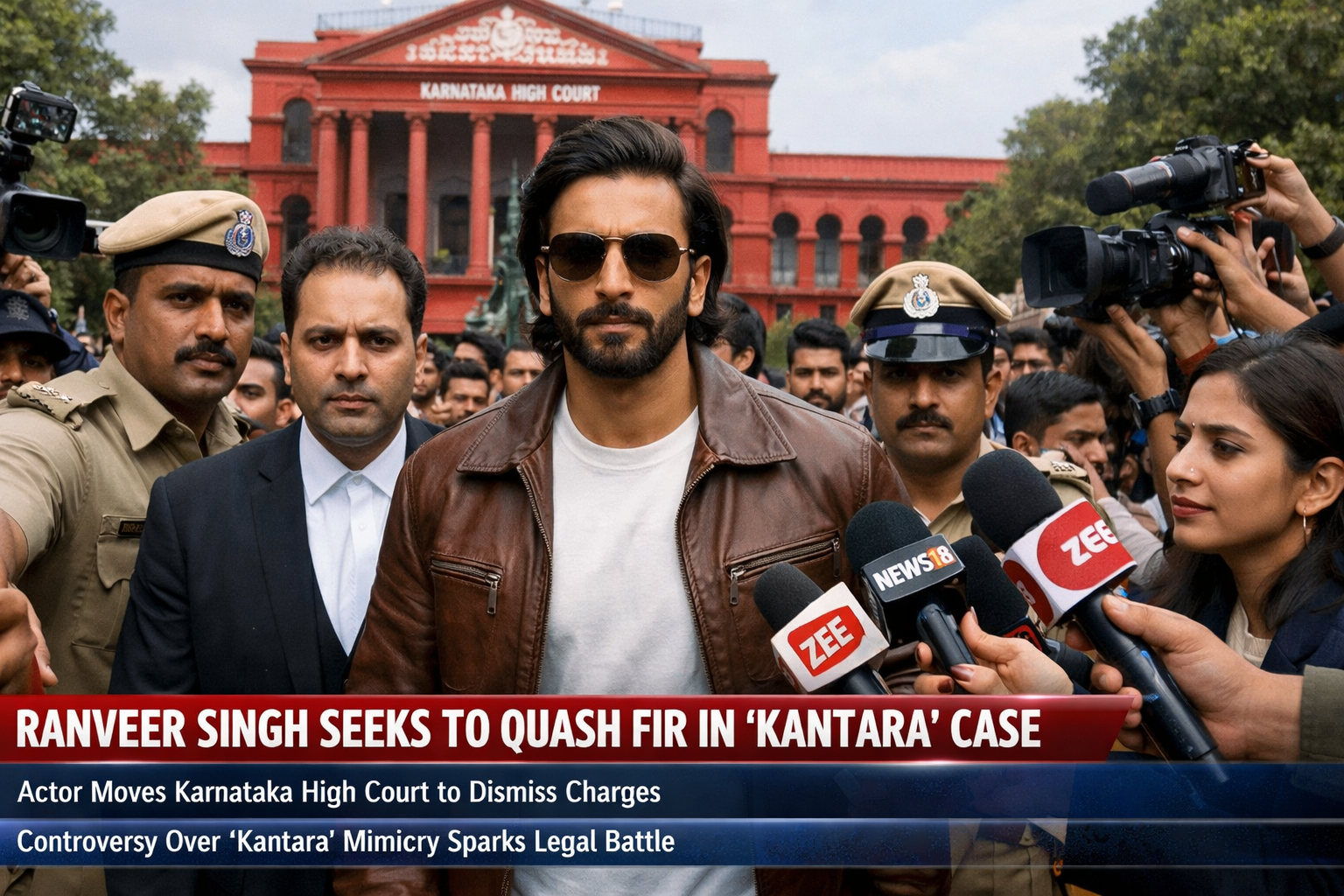
Bengaluru / Panaji -Bollywood superstar Ranveer Singh, who is always involved in high-energy acts and charismatic personas on and off camera, is currently engaged in a legal tussle that has become one of the most discussed issues in Indian cinema this year. Singh has gone to the Karnataka High Court to have the First Information Report (FIR) filed against him cancelled due to allegedly abusive words he uttered in imitating one of the characters in the blockbuster film Kantara: Chapter 1.
It was developed following a private complaint made by the advocate in Bengaluru who alleged that the act of Singh was deeply insulting to religious instinct and an insult to a holy deity among numerous people in high-profile event. The FIR was registered at the High Grounds Police Station in Bengaluru, and the Bollywood actor petitioned the court challenging the legality of the FIR and the order of the lower court to institute criminal proceedings by the police.
How the Controversy Began
The origin of the controversy can be traced to November 28, 2025, at the 56th International Film Festival of India (IFFI) in Goa, when Ranveer Singh was making comments about Kantara: Chapter 1, a movie that had already gained wide acclaim among critics and audiences because of its portrayal of traditional cultural practice in coastal Karnataka.
In one of his speeches, when standing on the stage, Singh clapped the performance of Kantara actor Rishab Shetty and imitated a character called Daiva, a spirit guardian that is worshiped in the local folklore. The parody contained quotes of the phrases of the deity in the movie, which was supposed to be a form of praise, but was interpreted as an offense and degrading towards some. The character, as it was verbally referred to by Singh as per the FIR, was a female ghost, which was, according to the complainant, offensive and incorrect.
Social media enhanced the response, and video footage of the speech spread widely and generated an outcry among people who believe that the mockery was against a sacred cultural and religious tradition. The complaint has clearly indicated that the Daiva tradition is manifested in the form of divine protection and justice, and that Singh has brought it out as a caricature, thus hurting the sentiments of the believers who have been deeply attached to it.
The Courtroom Battle in the High Court
As a reaction to the FIR, on February 23, 2026, Singh appealed before the Karnataka High Court in response to the FIR and the underlying magistrate’s order that resulted in its registration. It claims that the FIR was registered without due scrutiny of purpose and circumstances, and that the charges are not a cognizable offense in law that should result in a criminal investigation.
The sections mentioned in the FIR are:
- Section 196 – encouraging hatred or incompatibility based on religion.
- Section 299 — intentionally abides to offend religious emotions.
- Section 302 – the words spoken with a view to insulting religious feelings.
In the petition of Singh, it is stated that the provisions were misused because the remarks made by this actor were positive and as compliments to the work of a colleague and were certainly not meant to offend any faith or belief. His defense team also emphasized the fact that he had immediately gone ahead and made an unconditional public apology on social media to make it clear that what he was doing was in no way to mock the belief system, but he was merely admiring the acting of Shetty. The petition also claims that the criminal proceedings should not be continued since it would be an abuse of the legal process.
The case was set to be heard in a bench led by Justice M. Nagaprasanna, and the second hearing is set for February 24, 2026. It is also notable that the High Court did not grant expedited or special treatment simply because the petitioner is a celebrity, and it is important to note that the law execution is executed evenly regardless of the stature of the person.
Industry Response and Reaction by the Public
The case has brought heated debate, especially concerning freedom of expression, freedom of artwork and the level of cultural sensitivity. The fans of Ranveer Singh believe that the reaction is completely out of proportion and that the imitation in the form of a comedic one made with no intention of causing any harm to anyone should not be criminalized, particularly when the actor himself is knowledgeable of cultural traditions. It has been noted by many that when faced with the general feeling of people, Singh publicly admitted that he had made the error and apologised.
On the other hand, critics add that government representatives should be careful when handling cultural artifacts and religious activities, particularly in heterogeneous societies where there are varying interpretations of things. They argue that popular celebrities should have a role to ensure that their activities have extensive social consequences.
Also in the film industry, there has been a general avoidance of making a splash within the industry itself, with most others noting that creative expression must be safeguarded but also be respectful. Multiple observers of the industry interpret the episode as a sign of how fast cultural scandals can go out of control in the era of social media and immediate customer response.
Legal and Cultural Context
The legal system in India has laws that take into consideration the religious sentiments and set sanctions for any form that deliberately offends or encourages the creation of disharmony on a religious basis. The Bharatiya Nyaya Sanhita (BNS) that regulates contemporary criminal processes is aimed at creating a balance between the freedom of speech and social harmony. According to the observations of the legal experts, the key issue in the case of Singh will revolve around intent and context and not necessarily on the content of the remarks.
In past cases related to the same controversy, the courts have considered the presence of a knowing and malicious intent on the part of the accused to insult or make a mistake in normally communicating or expressing. The forthcoming hearings in the Karnataka High Court would probably question the very definition of hurt religious feelings, as well as whether a speech given by the crowd in praise can be regarded as such.
Editorial View: A Reflection of the Freedom in the Arts and the opinion of the people.
As an editorial, the Ranveer Singh case is a very interesting – and, as a caution, fascinating – crossroads of culture, law, and influence of celebrity.
On the one hand, creative expression and performance art are indispensable factors in the cinema that tend to draw on a variety of traditions to narrate interesting stories. Mimicry, specifically, is an old type of homage or witty tribute in the entertainment industry. The statements of Ranveer Singh, who, in accordance with published reports and in explanation to himself, is grounded in admiration of the performance of another actor, are certainly not based on disparagement of a belief system.
Nevertheless, celebrities should be aware of the fact that the cultural backgrounds and symbolic values are different by a wide margin in different regions and societies. This might not appear as offensive in one context, but may be incredibly snubbing in another, particularly in the plural Indian social context. The exaggerated voice of the celebrities may accidentally steer the reaction of the masses into the emotional and legal seas. In this respect, the FIR, severe as it is, is indicative of deeper concern in the society, not only a technicality of the law.
After all, the courts will be forced to strike a compromise between artistic freedom and anti-hate and anti-disrespect measures. The case can establish valuable precedents regarding the extent to which the creative expression of personalities by the majority can go in a multicultural environment, and whether the responsibility of the law should be cooled by apologies and explanations. Most importantly, it helps artists as well as audiences to remember that art and culture do not exist in a vacuum, but are influenced by perceptions, respect, and standards of public discussion that are constantly changing.