
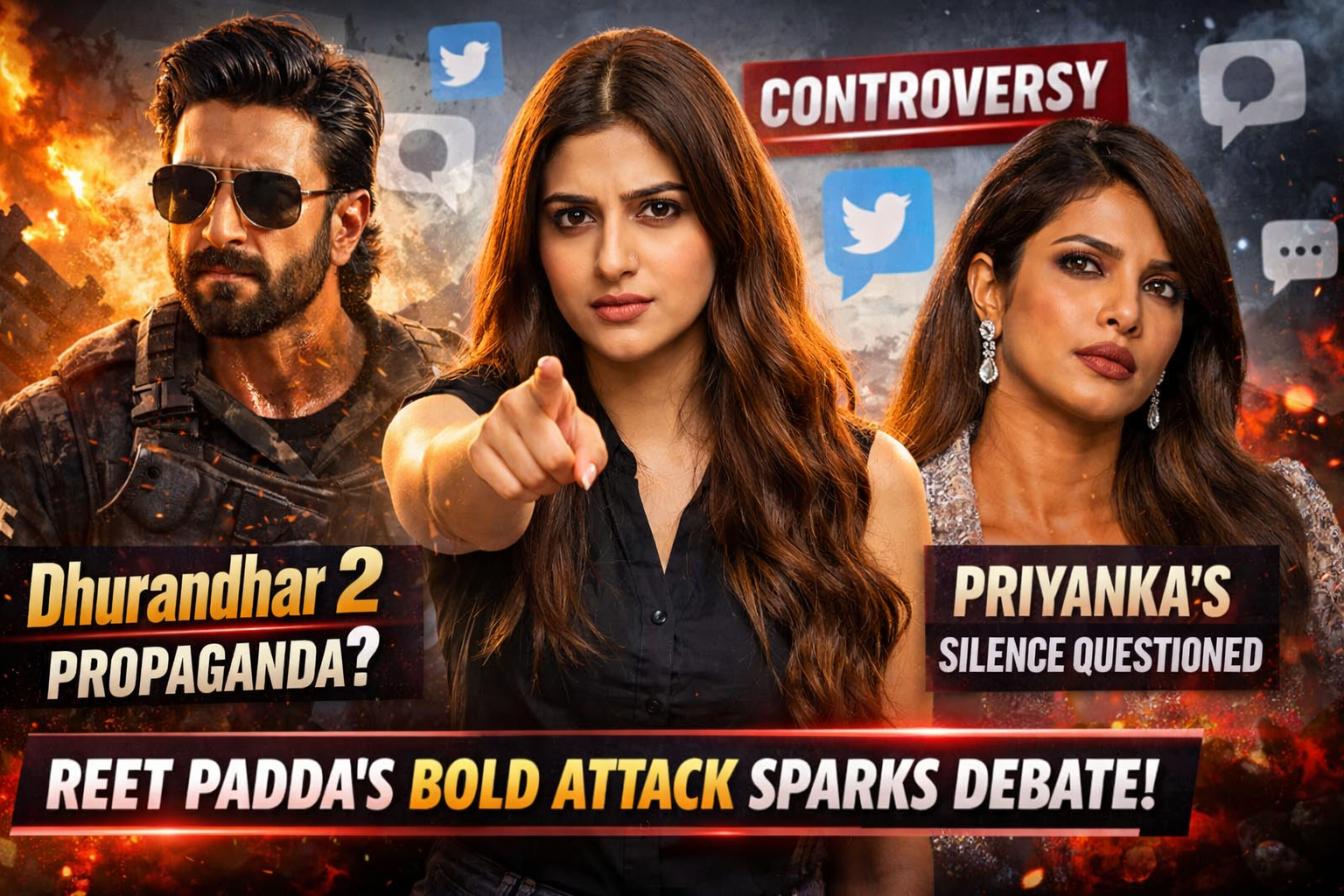
A new scandal has arisen in Bollywood, and this time it is not a plot of a movie or a tussle at the box office, but it is a boldly phrased post on social media. The case of Reet Padda, the sister of upcoming actor Aneet Padda, and her utterances criticizing the blockbuster movie Dhurandhar: The Revenge by Ranveer Singh, and her outspokenness against Priyanka Chopra, whose utterances she termed as silence on global political matters, has caused much controversy.
The scandal arrives as Dhurandhar: The Revenge is taking off commercially with over 1100 crore at the worldwide box office in the days of its release, a fact which solidifies its status as one of the largest hits of the year. However, the skyrocketing popularity of the film has been matched by increased questioning regarding the political undertones of it, which is currently being put into the limelight by Reet Padda.
The Storm That Came With the Viral Post
The comments made by Reet Padda came after an online debate, where she was not shy in making comments. In an elaborate and frank post, she has termed Dhurandhar: The Revenge as propaganda, and claimed that the movie propagates a government-friendly version of the events, and that it glosses over the political reality of the issue.
Her criticism was not limited to one movie. She made likenesses to other politically charged films, encouraging to believe that there was a larger trend towards exaggerating certain films in Bollywood, with others having a harder time being heard. Her response, with its sharp, non-apologetic and sarcastic tone, rapidly attracted attention and went viral on the platforms.
The most notable thing was not the fact that she criticized the movie, but also that she was ready to face the mainstream discourses in the industry. It was an outspoken stand of Reet in a time when neutrality was the trend of the insider.
Making a Call Out: Priyanka Chopra: The Silence Debate
The least controversial, possibly, was her indirect criticism of Priyanka Chopra. Reet has wondered why the actor is not talking about an illegal war, as she is calling it, since she believes that it is the duty of influential people around the world to voice their opinions on matters of high importance.
She alluded to the instances when celebrities could shine in global prominence, like during international award shows. When they do not, she uses this as a prerequisite that they have neglected their moral duty.
This remark has split the opinion of the people. Some members of the social media community agreed with her demand to hold them accountable, but some believed that asking actors to take up political positions is unjust and unrealistic.
A Movie Which is already Media scrutinized
Surprisingly, the criticism by Reet Padda is not in a vacuum. Before this controversy, Dhurandhar: The Revenge had elicited debates among critics in regard to its blatant political message.
It is a high-octane spy movie that incorporates action and nationalism. Although it has been commended because of its scale and performances, a number of critics have remarked that it has very strong ideological undertones. Other reviews called it a hyper nationalistic spectacle or a story that is more on the propaganda side.
This commercial and ideological dichotomy is not new to Bollywood. Nationalistic films tend to be a box office hit and at the same time become the subject of political discussion.
Social Media Response: Differentiated Audience
The internet, which is no surprise, has likewise been divided into two camps.
Those who support Reet Padda also state that she is somehow growing uneasy about the politicization of the cinema. According to them, movies must entertain, and not support particular stories, and they think that people in power should be willing to be criticized.
Conversely, those against her saying believe it is excessive. Some say that the film is always subjective, and calling the movie propaganda means infringing on the freedom of expression. Others have come to the defense of Ranveer Singh by arguing that it does not necessarily mean that actors dictate the ideological orientation of a movie.
In the meantime, the Priyanka Chopra call-out has ignited a broader discussion on the subject of celebrity activism, namely, what activism is supposed to be, what activism is not supposed to be, and what activism is meant to mimic.
The Greater Issue: Do Celebrities Have a Role to Play?
The core of this controversy is another question: Should celebrities be required to participate in political and social matters?
Over the past few years, the international population has continued to demand that notable personalities should employ their platforms in advocacy. Silence is usually viewed as comity, especially on issues such as climate change and human rights. Nevertheless, such an expectation is not unproblematic.
Celebrities are in the business of celebrity that is highly intertwined with politics and economic order. The consequences of speaking out can be career-related, particularly in such business sectors as Bollywood, where censorship and the market meet popular opinion.
The statements of Reet Padda are not related to a single film or a single actor, of course: they refer to the changing role of the celebrities in the hyper-connected, politically conscious world.
Editorial Vantage: An Essential Interruption or an Inappropriate Criticism?
This is a controversial issue that is not only expected but also very important from an editorial perspective.
Although the comments of Reet Padda are controversial, they represent a more general trend towards change in the consciousness of the audience. The current viewers are more critical, politically minded, and less passive consumers. Her intervention, in that sense, catalyzes the significant discourses on the topic of representation, narrative framing, and accountability.
However, oversimplification is also a possibility. When the film is declared propaganda without in any way recognizing the artistic/commercial context, the more complicated storytelling can be simplified down to polarizing judgments. Cinema, anyway, exists in grey shades.
On the same note, the assumption that all celebrities need to speak publicly on all matters may not be realistic. Advocacy must preferably be both informed and authentic, rather than being performative and forceful.
The ultimate point that this episode makes is a conflict between art and ideology, influence and responsibility, expression and expectation.