
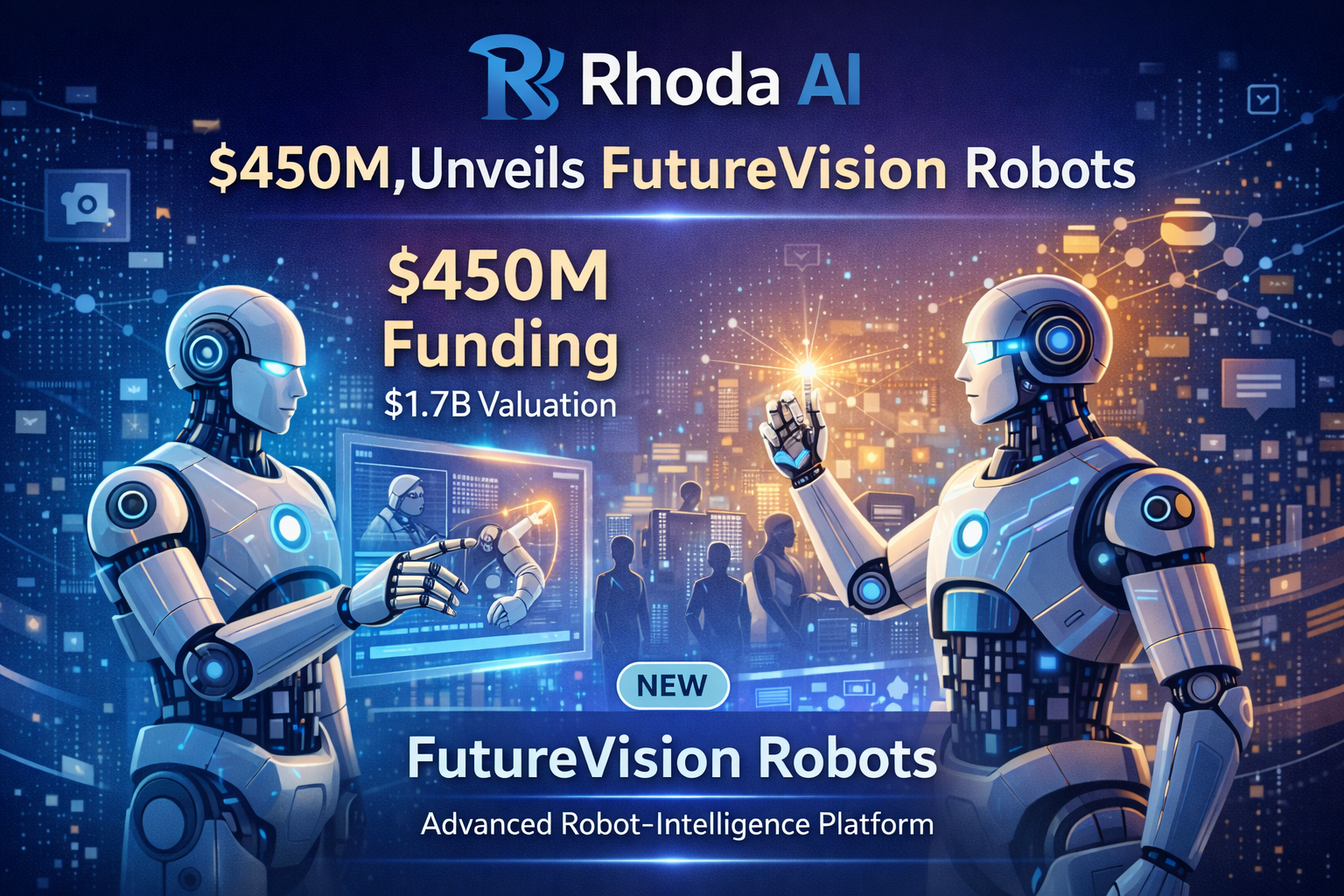
The artificial intelligence industry in the world is growing at an alarming rate, and there are new companies that are emerging and pushing the limits of what machines can achieve. Rhoda AI, a robotics and AI-based startup, is one of the most recent ones; it recently released the news that it raised 450 million in a Series A fundraiser, valuing the enterprise at around 1.7 billion. The company also launched its new technology platform FutureVision on the same day as the finance announcement, which is designed to dramatically transform the way robots perceive and relate to the physical world.
The statement emphasizes the increased attention of investors and technology firms to AI-based robotics. Although traditional robots have worked in factories over the decades, they tend to perform poorly in environments that cannot be predicted. Rhoda AI asserts that the new platform can address this issue, as robots will be able to learn from large volumes of information and respond intelligently during dynamic scenarios.
The Funding Round and Investors
The 450 million dollar investment is one of the biggest early-stage investments in the robotics industry in recent years. It received the support of many big investors such as venture capital firms, global investment groups, and technology-oriented funds. These investors, to a great extent, perceive great opportunities in AI-driven robotics, especially as production, logistics, and other supply chain activities keep growing more automated.
The big investment is also an indication that there is a lot of confidence in the vision and technology of Rhoda AI. The valuation of the company is 1.7 billion dollars, which makes the company one of the fastest-growing startups in the AI robotics industry. The amount of funding that was obtained by a company that only recently became publicly traded shows just how much the investors think that robotics will become a major focus in the upcoming phase of technological revolution. The capital will be mainly utilized in further research and development, employment of engineers and scientists, and the faster implementation of the FutureVision platform in industries.
Introducing the FutureVision Platform
The main point of the announcement made by Rhoda AI is its new platform called FutureVision the company refers to as a next-generation robot intelligence system. FutureVision is not based on premeditated instructions as traditional robotic software would be, but on the analysis of a mass of video data to learn more about the way the physical world works.
The platform relies on artificial intelligence models that track the movements of objects, human behavior with the environment, and the real-life development of various situations. Through the examination of these patterns, the system develops a more enhanced insight into physics, movement, and conduct.
It is a method that helps robots to predict what may occur next in a scenario. As an illustration, a robot may notice when an object is falling, anticipate the motion of the people around, or alter its behavior whenever the conditions abruptly change. This predictive power allows the robots to work in difficult environments in a safer and more efficient manner.
How the Technology Works
FutureVision operates in a cyclical process of observing, predicting and taking action. The system takes visual data from cameras and sensors first, which are displayed as it tries to grasp the environment of the robot. After that, it forecasts what will occur in the near future with the help of AI models that are trained on millions of videos.
According to these forecasts, the system translates its knowledge into physical movement control instructions that drive the motors and behaviors of the robot. This happens a lot of times in a second, and it enables the robots to change according to the new situations instantly and become more intelligent helpers that can manage unpredictable situations. Futuristic robots, which run on FutureVision, are capable of modifying their action and carrying on with their work even after something odd happens.
Potential Applications Across Industries
Rhoda AI believes its technology can transform several industries where automation is already growing. Manufacturing is one of the most obvious areas. Many factories use robotic arms for repetitive tasks, but these machines usually require highly controlled environments. With advanced intelligence, robots could operate more flexibly and work alongside human employees.
Logistics and warehouse operations are another major opportunity. Companies that manage large distribution centers rely heavily on automated systems to move goods. However, unexpected situations such as misplaced packages or obstacles can disrupt operations. AI-driven robots could handle these disruptions more efficiently.
Other potential applications include retail operations, agriculture, healthcare logistics, and even construction. As robots become more adaptable and intelligent, their ability to perform a wider range of tasks could dramatically expand.
Challenges Facing AI Robotics
Despite the excitement around Rhoda AI’s announcement, significant challenges remain in the robotics industry. Building robots that operate safely in unpredictable environments is extremely difficult. Unlike software applications, robots interact directly with the physical world, which introduces safety risks and engineering complexity.
Regulatory standards also play an important role. Companies deploying robots must ensure that their systems meet strict safety guidelines, particularly when machines operate near humans. Achieving certification and building trust with customers can take years of testing and refinement.
Cost is another barrier. Advanced robotics systems require expensive hardware, sensors, and computing power. For many businesses, the benefits of automation must clearly outweigh the cost of implementation. These factors mean that even promising technologies like FutureVision will need extensive real-world testing before large-scale adoption becomes possible.
Market Competition in Robotics
Rhoda AI is entering a competitive market where many technology companies are racing to build more intelligent robots. Several startups and major corporations are investing heavily in humanoid robots, industrial automation, and AI-powered robotics platforms. Companies such as Tesla, Figure AI, and other robotics startups are exploring similar ideas about combining advanced artificial intelligence with physical machines. These efforts aim to create robots that can perform a wide range of tasks instead of being limited to a single function.
Rhoda AI’s strategy appears to focus on providing a software platform rather than building complete robots. By licensing FutureVision to robot manufacturers and industrial partners, the company hopes to become the intelligence layer that powers many different machines.
This approach could allow Rhoda AI to scale faster by integrating its technology into existing robotic systems rather than developing new hardware from scratch.
Editor’s Perspective: A Promising but Challenging Path
From an editorial standpoint, Rhoda AI’s announcement reflects a broader shift in how the robotics industry is evolving. For many years, robotics development focused primarily on hardware engineering. Today, artificial intelligence has become the driving force behind the next generation of robotic systems.
The idea of training robots using large amounts of video data is particularly interesting. It mirrors the way modern AI models learn language or recognize images. If this concept works effectively in robotics, it could significantly reduce the time and cost required to train machines for real-world tasks.
However, there is still a gap between technological promises and practical deployment. Robotics startups often face long development timelines because real-world environments are far more complex than controlled testing conditions. A robot that works well in a laboratory may behave very differently in a busy warehouse or factory. Another factor to consider is scalability. Even if FutureVision proves successful in pilot programs, deploying the technology across thousands of machines in multiple industries will require extensive engineering support, customer training, and maintenance systems.
Looking Ahead
Rhoda AI’s funding round and the launch of FutureVision represent an important step forward in the integration of artificial intelligence and robotics. With strong financial backing and an ambitious technological vision, the company is positioning itself as a major player in the emerging field of intelligent automation.
In the coming years, the most important indicators of success will include real-world pilot programs, partnerships with major robotics manufacturers, and measurable improvements in efficiency and safety. If Rhoda AI can demonstrate that its platform allows robots to operate reliably in complex environments, the company could help accelerate the adoption of robotics across industries worldwide. While challenges remain, the combination of AI and robotics is likely to shape the future of work, manufacturing, and automation in the decades ahead.