
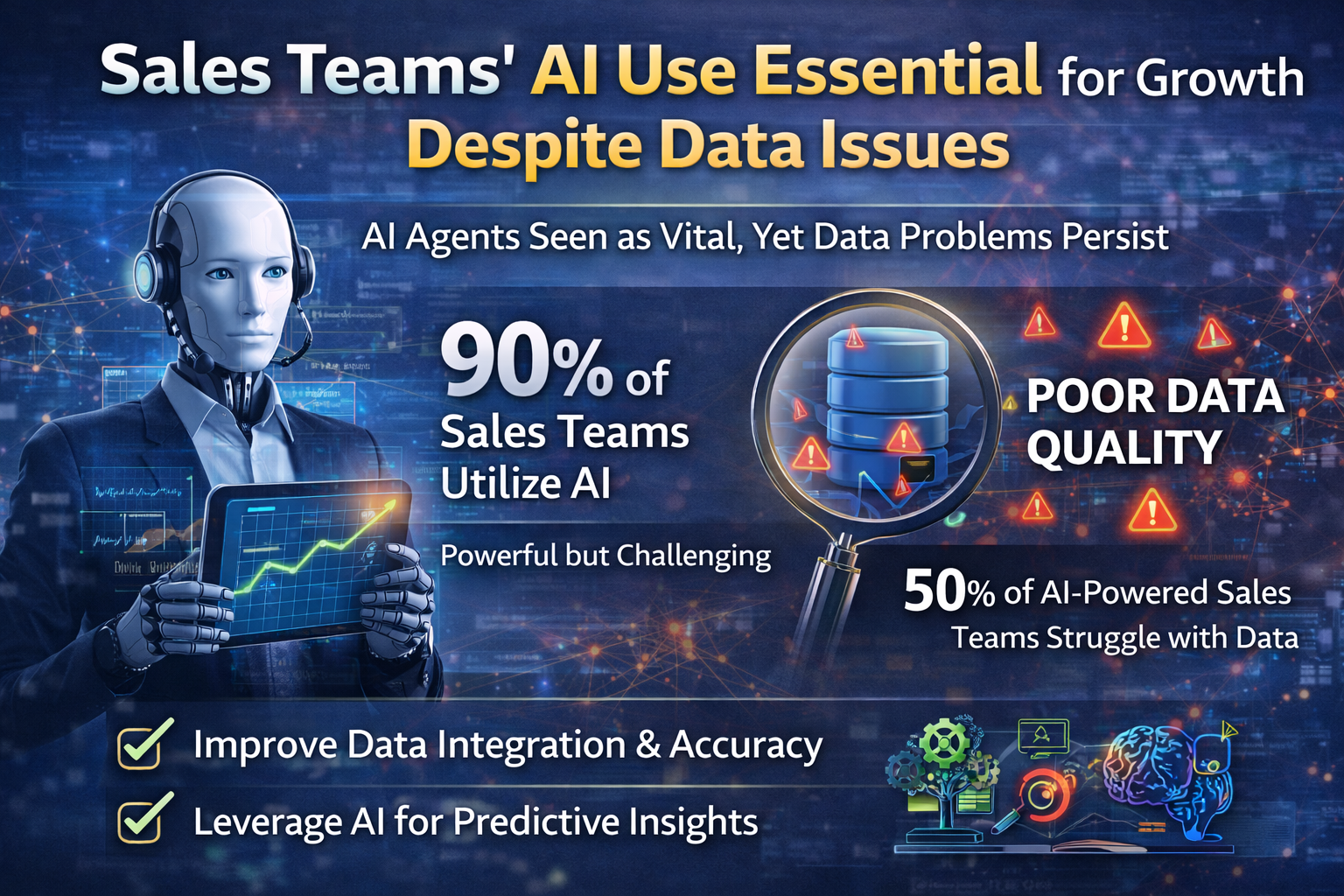
Artificial intelligence (AI) is quickly becoming a favorite among sales teams in the industries to enhance their performance, optimize their workflows, and, most significantly, increase the rate of revenue growth. Recent reports show that in the world of sales, about 90% of the sales teams have incorporated AI agents in their operations. These AI-powered tools have become necessary in managing numerous facets of the sales process, such as lead generation and customer engagement, data analysis and predictive modeling. Still, even though AI agents are turning out to be key drivers of sales success, there remains an unforeseen challenge, namely, sales teams continue to grapple with the same underlying issue of data that is hampering the full capabilities of these sophisticated technologies.
The use of AI has already demonstrated its value in different roles among sales teams. It has the ability of automating routine duties such as data entry and allowing the human agents to concentrate on high-level activities such as relationship building and strategy. Moreover, AI can offer predictive analytics to allow sales teams to make better decisions, suggest the best engagement strategies, and personalize communications on a large scale. In spite of these benefits, most organizations are discovering that the application of AI is frequently hampered by low-quality or sporadic data.
The Data Issue: A Flaw to AI Performance
Even though AI agents are revolutionizing the sales operations, they can only be as effective as the data they are being fed on. The inability to find clean, consistent, and up to date data is one of the main challenges that sales teams have to deal with nowadays. It has been shown that almost 50 percent of companies that use AI in sales are facing this identical data problem. Industry experts believe that AI tools rely on quality information to provide significant results, and any irregular or inaccurate data may produce wrong predictions and make poor decisions.
To really benefit sales strategies, AI needs to have access to data that is not only all-encompassing but also structured to allow AI models to come up with correct conclusions. The sales teams might be workings with multiple types of data like CRM systems, emails, social media communications, and third-party databases, which do not necessarily interoperate. This fractured landscape renders it hard to establish coherent dataset that can be utilized to its maximum by AI. Furthermore, old information may cause lost opportunities and poor sales plans.
The adoption of AI by many businesses has been in the hope that they will enjoy a competitive advantage over their competitors, but when the quality of data underpinning the AI is of a poor quality, the effectiveness of the AI will be minimal. It is even more problematic since AI-driven tools are taking center stage in decision-making. In the absence of clean and accurate data, the sales teams can find themselves in a scenario where they are putting money in the AI technology, which is, instead of becoming a source of growth, exacerbating their data issues.
An Increasing Data Hygiene Requirement
Since AI is now a key element in sales strategy, it is essential to address data quality. Sales teams interested in reaping the most out of AI have developed an interest in data hygiene. It is no longer a luxury to ensure that the data that is being inputted into the AI systems is up-to-date, consistent and accurate. Companies are becoming conscious of the fact that it is not sufficient to invest in AI, but they should also give a significant emphasis on data management practices that can facilitate AI-based results.
Sales leaders have been approaching the data issue in a number of ways. Enhancing the connection of different sources of data is one of the initial steps. Making the differences in datasets converge into one centralized system allows businesses to provide AI agents with a better overview of customer behavior, sales performance, and market trends. The other important aspect of the data challenge solution is that they need to adopt a better practice in data governance and data cleaning. Errors can be avoided with the help of regular audits, validation processes, data quality checks, and provide AI agents with reliable and actionable information.
Other firms are spending on data experts dedicated who can monitor the integrity of the data utilized in AI. With specialists who pay attention to the cleanliness of data, companies will be able to make sure that their AI tools are working with the best input and will provide more accurate predictions, more successful engagement tactics, and eventually, more sales.
AI’s Impact on Sales Growth
Despite the data challenges, AI agents remain a powerful tool for driving sales growth. Sales teams that have overcome or mitigated these data issues have seen remarkable results. AI-driven tools have been credited with improving sales productivity by automating tedious tasks, providing real-time insights, and identifying cross-sell and upsell opportunities. Sales teams also benefit from AI’s ability to personalize outreach at scale. Using predictive models, AI can determine the best time to contact a lead, the most effective messaging for each customer, and even suggest follow-up actions that are most likely to lead to a successful conversion.
As AI continues to evolve, its impact on sales teams will only grow. Over time, AI agents are likely to become even more sophisticated, able to predict customer behavior with higher accuracy and recommend sales strategies with precision. Companies that have addressed their data issues and are leveraging AI tools effectively will gain a significant competitive advantage in an increasingly crowded market. In this sense, AI is not just an enhancement to sales operations; it is becoming a necessity for staying relevant in the modern business landscape.
The Role of AI in the Future of Sales
The broader implications of AI’s role in sales are significant, extending beyond productivity boosts and cost savings. AI is reshaping the way sales teams interact with customers, enabling a more customer-centric approach to sales. By harnessing the power of AI, sales teams are becoming better equipped to engage customers at the right time, with the right message, and through the right channel. In turn, this deeper understanding of customer needs and preferences fosters long-term loyalty and strengthens brand relationships.
As AI continues to grow in importance, sales teams that effectively leverage these tools while addressing data challenges will be best positioned to succeed. Overcoming data fragmentation, cleaning up outdated information, and investing in robust data management practices will be critical to realizing the full potential of AI. Sales teams that fail to tackle these data issues may find their AI investments yielding limited results, or worse, worsening the data problem as inaccurate predictions lead to misguided decisions.