
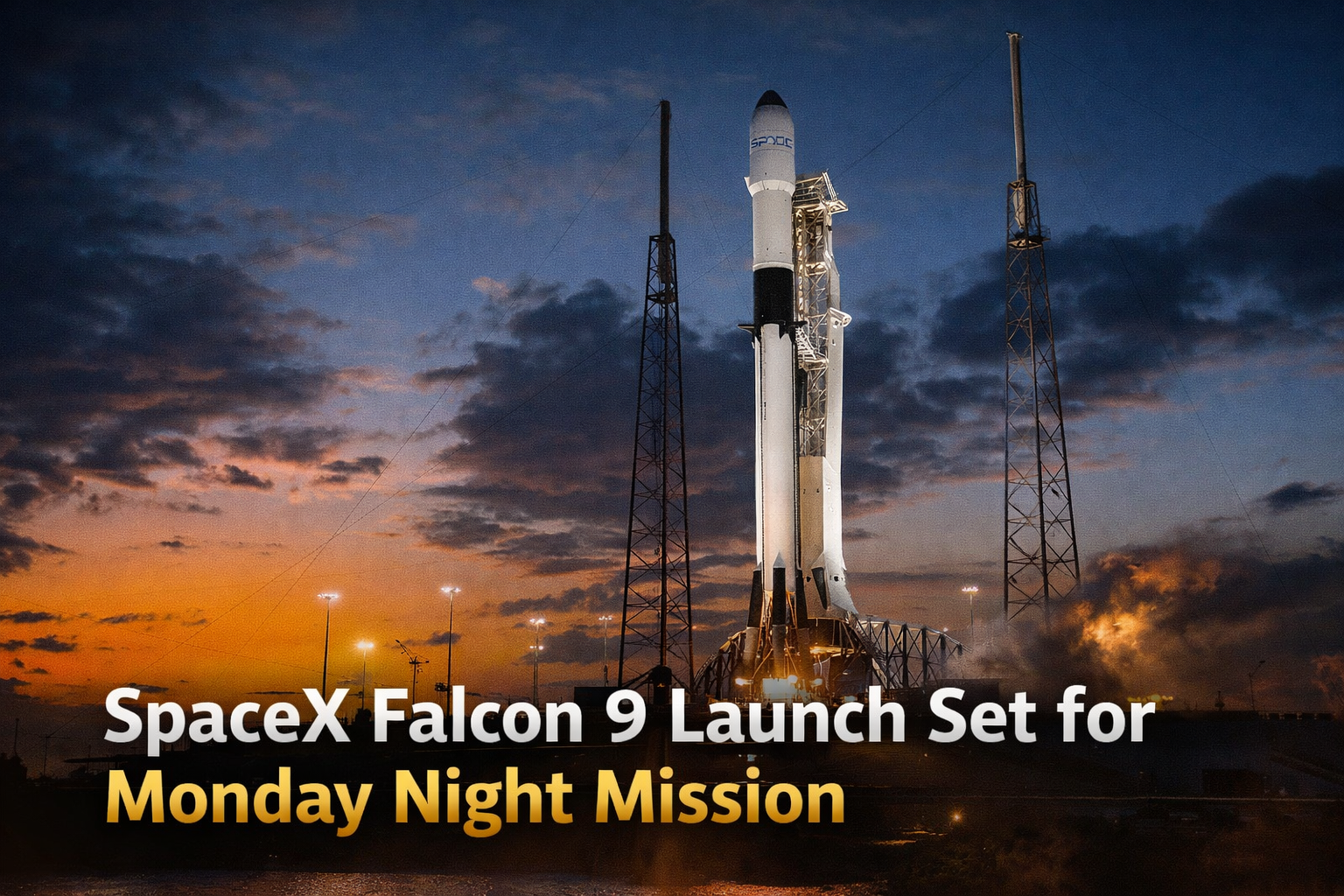
Space exploration continues to move at a rapid pace as private aerospace companies expand their role in orbit. SpaceX, the California-based space technology firm founded by Elon Musk, is preparing another significant rocket launch from Florida’s Cape Canaveral Space Force Station. The upcoming mission, scheduled for Monday night, will send a payload of satellites into low Earth orbit aboard a Falcon 9 rocket, further strengthening the company’s ambitious satellite infrastructure in space.
This launch highlights the continued momentum of commercial spaceflight in the United States. Over the last several years, SpaceX has transformed how rockets are built, launched, and reused. The Falcon 9 system has become the most frequently launched orbital rocket in the world, capable of transporting satellites, cargo, and astronauts to orbit while recovering its booster for reuse. The Monday night launch represents another step in this ongoing technological revolution.
Details of the Monday Night Launch
The rocket launch is planned from Space Launch Complex-40 at Cape Canaveral Space Force Station in Florida. The mission will use a two-stage Falcon 9 rocket, one of SpaceX’s most reliable launch vehicles. The Falcon 9 will carry a group of satellites designed for operations in low Earth orbit, a region of space roughly 160 to 2,000 kilometers above the Earth’s surface.
Low Earth orbit has become a critical zone for modern communications and technology. Satellites operating in this orbital band provide services ranging from broadband internet to weather forecasting, Earth observation, navigation, and national security monitoring. In recent years, SpaceX has focused heavily on deploying satellites that expand its global space-based internet network.
Falcon 9 rockets typically launch vertically and reach orbit in approximately nine minutes. After liftoff, the rocket’s first stage separates from the upper stage and begins a controlled return to Earth. SpaceX has perfected the technique of landing the booster on a drone ship stationed in the Atlantic Ocean, allowing the hardware to be reused in future launches.
The reuse capability dramatically reduces the cost of access to space. Each recovered booster can fly multiple times, sometimes exceeding ten missions. This technological innovation has allowed SpaceX to dramatically increase the frequency of launches.
Expanding the Satellite Network
The satellites on this mission are expected to contribute to a growing constellation designed to deliver global connectivity and communications services. SpaceX’s satellite network has expanded rapidly over the past few years, with thousands of spacecraft already operating in orbit.
As of early 2026, the network is approaching approximately 9,500 active satellites. These spacecraft operate together as a “mega-constellation,” forming a web of orbital nodes that can transmit internet signals across the planet.
This network plays a critical role in expanding internet access in remote and underserved areas. In regions where traditional infrastructure such as fiber-optic cables or cell towers is difficult to build, satellite-based internet can provide high-speed connectivity.
Beyond residential internet access, the satellites also support other services. Airlines are increasingly using satellite connectivity to provide in-flight Wi-Fi, while telecommunications companies are exploring ways to connect smartphones directly to satellites for emergency coverage in remote locations.
Falcon 9: A Workhorse of Modern Spaceflight
The Falcon 9 rocket has become a cornerstone of modern aerospace engineering. Designed by SpaceX, the two-stage rocket stands roughly 70 meters tall and is powered by nine Merlin engines in its first stage.
The rocket is capable of carrying more than 22 metric tons of payload into low Earth orbit, depending on mission requirements. One of its most notable features is the ability to land and reuse its first stage. The booster descends using grid fins and landing legs before touching down either on a drone ship at sea or at a landing zone on land.
This innovation has fundamentally changed the economics of spaceflight. Traditionally, rockets were single-use systems, meaning they were destroyed after each launch. By recovering and reusing boosters, SpaceX has reduced launch costs and increased the pace of missions.
Recent Falcon 9 missions have demonstrated the remarkable durability of the rocket’s boosters. Some boosters have flown more than a dozen times, showcasing the potential for aircraft-like reusability in space operations.
The Importance of Cape Canaveral
Cape Canaveral, located on Florida’s eastern coast, has been one of the most important launch sites in the world since the early days of the space race. The region hosts multiple launch facilities used by NASA, the U.S. Space Force, and private companies.
Space Launch Complex-40, the pad used by SpaceX for many Falcon 9 missions, has become one of the busiest launch facilities in the United States. The location offers an ideal trajectory for rockets heading eastward over the Atlantic Ocean, reducing risk to populated areas.
The Cape Canaveral area also benefits from favorable weather conditions and a long history of aerospace infrastructure. Launch operations here are supported by the U.S. Space Force’s Eastern Range, which provides tracking, safety monitoring, and range control during rocket flights.
The continued activity at Cape Canaveral reflects the growing partnership between government agencies and private companies in advancing space exploration.
The Rapid Pace of SpaceX Launches
SpaceX has dramatically increased its launch cadence in recent years. The company now performs dozens of launches annually, delivering satellites, cargo missions, and crewed spacecraft.
In many cases, Falcon 9 launches occur only days apart. This rapid tempo demonstrates both the reliability of the rocket and the efficiency of the company’s launch operations.
A typical Falcon 9 mission involves several key phases. After liftoff, the rocket accelerates through the atmosphere and reaches space within minutes. The first stage then separates and returns to Earth while the second stage continues toward orbit. Satellites are typically deployed around 50 to 60 minutes after launch.
The recovered booster is then transported back to port, inspected, refurbished, and prepared for another flight.
Visibility and Public Interest
Rocket launches from Florida often attract widespread public attention. Residents and visitors along the East Coast frequently gather to watch the spectacle of a rocket climbing into the night sky.
Under clear conditions, launches from Cape Canaveral can be visible across multiple states. Observers often see a bright plume of exhaust illuminated by the rocket’s engines as it ascends above the horizon.
For many people, witnessing a rocket launch remains one of the most powerful reminders of humanity’s expanding presence in space.
The Future of Satellite Constellations
The Monday night mission represents just one launch in a broader effort to expand satellite networks in Earth orbit. SpaceX and other companies are racing to build large constellations that can support global communications.
These constellations promise major benefits, including improved internet access and new capabilities for navigation, climate monitoring, and disaster response. However, they also raise concerns about space traffic and orbital debris.
As more satellites are launched, scientists and regulators are working to develop better systems for tracking spacecraft and preventing collisions. Maintaining sustainable use of Earth orbit will become increasingly important as commercial space activity continues to grow.