
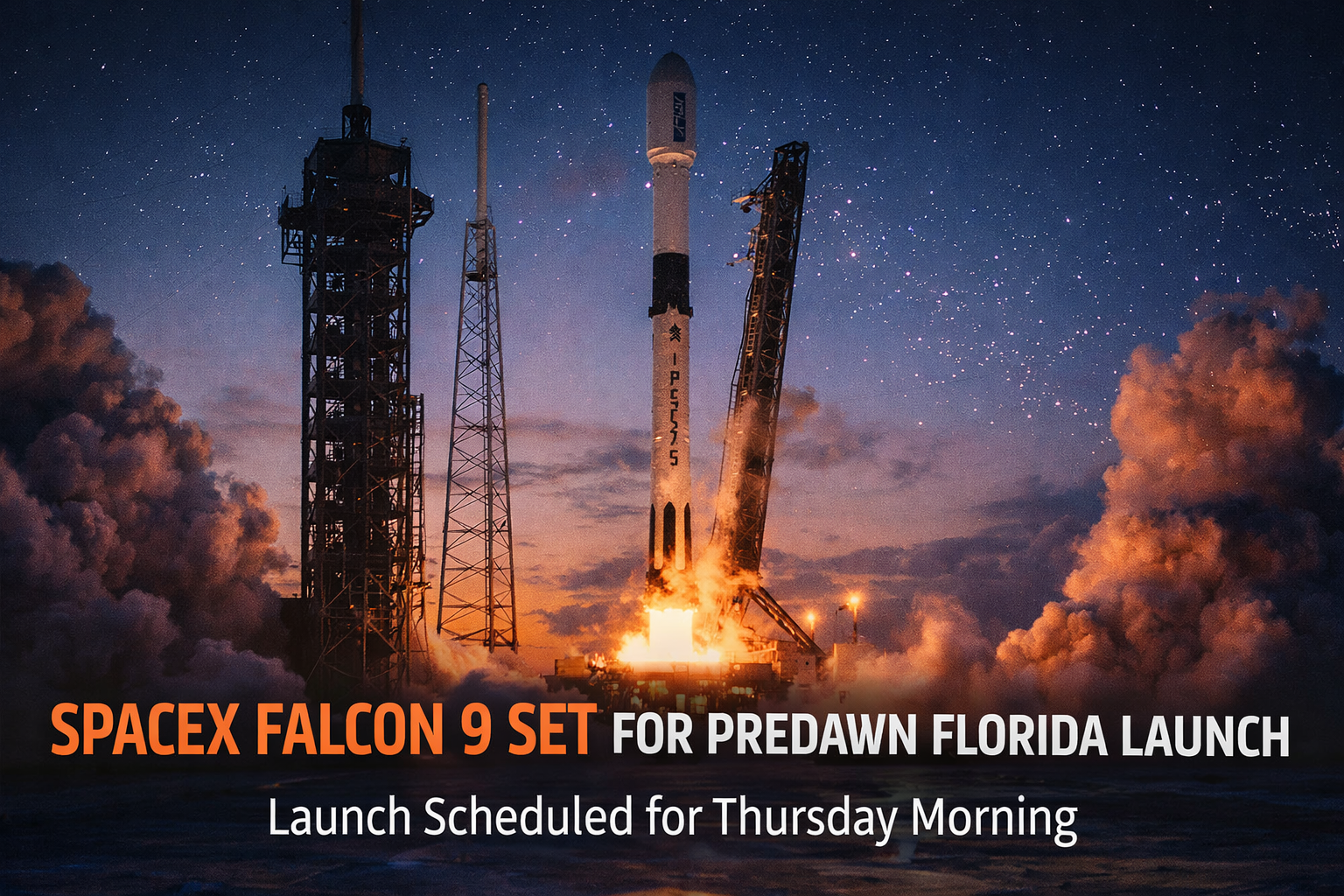
A new SpaceX Falcon 9 rocket launch is scheduled to light up the early morning skies over Florida, continuing the company’s relentless pace of missions in 2026. The launch, set for predawn hours on Thursday from Cape Canaveral Space Force Station, will carry another batch of Starlink internet satellites into low Earth orbit, further expanding SpaceX’s global broadband network.
The mission reflects SpaceX’s ongoing effort to deploy and maintain its rapidly growing satellite constellation while demonstrating the reliability and reusability of its Falcon 9 rocket system. With liftoff planned for the early morning window, the launch is expected to offer a striking visual display for observers across Florida’s Space Coast and potentially beyond.
Launch Details and Timing
According to launch schedules, the Falcon 9 mission is targeting a liftoff window beginning around 6:57 a.m. Eastern Time on March 18–19, 2026, depending on final countdown conditions. The rocket will launch from Space Launch Complex 40 (SLC-40) at Cape Canaveral, a site that has become one of SpaceX’s primary hubs for frequent orbital missions. This mission, identified as part of the Starlink Group 10-33 deployment, will carry approximately 29 Starlink V2 Mini satellites into low Earth orbit. Predawn launches are particularly significant because they often create visually dramatic effects in the sky. As sunlight reflects off the rocket’s exhaust plume at high altitude, observers may witness glowing trails or “space jellyfish” formations.
Mission Objectives
The primary goal of the mission is to deploy additional satellites for SpaceX’s Starlink broadband network, a global system designed to provide high-speed internet access to remote and underserved areas. Starlink has become one of SpaceX’s most important commercial ventures, with thousands of satellites already in orbit. Each new launch adds capacity to the network, improving coverage and performance for users worldwide. The satellites will be released into orbit shortly after liftoff, where they will gradually maneuver into their designated positions using onboard propulsion systems. Over time, these satellites form a coordinated network that communicates with ground stations and user terminals, enabling internet connectivity across vast regions of the Earth.
Falcon 9 Rocket and Reusability
The Falcon 9 rocket used for this mission is part of SpaceX’s reusable launch system, which has revolutionized the economics of spaceflight. The rocket’s first-stage booster, which has already flown on multiple missions, will separate from the upper stage shortly after liftoff and attempt a controlled landing on a drone ship stationed in the Atlantic Ocean. For this specific mission, the booster—identified as B1077—is expected to complete its 27th flight, highlighting the durability and reliability of SpaceX’s reusable technology. This reusability allows SpaceX to launch rockets at a much higher frequency than traditional aerospace systems, significantly reducing costs and turnaround times.
Flight Profile and Landing Sequence
After liftoff, the Falcon 9 rocket will follow a northeast trajectory over the Atlantic Ocean, minimizing risk to populated areas. Approximately two to three minutes into flight, the first stage will separate from the second stage. The second stage will continue carrying the Starlink satellites into orbit, while the first stage begins its descent. Roughly eight to nine minutes after liftoff, the booster will attempt a landing on the autonomous drone ship “Just Read the Instructions”, positioned in the Atlantic. This landing sequence is one of the most critical aspects of the mission. Successful recovery allows SpaceX to reuse the booster for future launches, further increasing efficiency.
Weather and Launch Conditions
As with all rocket launches, weather conditions play a crucial role in determining whether the mission proceeds as planned.
Launch teams monitor factors such as:
- Wind speed and direction
- Cloud cover
- Lightning risk
- Temperature and atmospheric pressure
Even minor deviations from acceptable conditions can lead to a delay or scrub, particularly for missions involving precise orbital insertions. Florida’s coastal weather can be unpredictable, especially during early morning hours, making last-minute changes a possibility.
Viewing Opportunities
Predawn launches often provide some of the most visually stunning rocket displays. Observers along Florida’s east coast—and potentially across parts of the southeastern United States—may be able to see the rocket’s ascent. Because the launch occurs before sunrise, sunlight can illuminate the rocket’s exhaust plume at high altitude, creating bright, glowing trails in the sky.
These visual effects have become a hallmark of SpaceX launches, drawing crowds of spectators and photographers to the Space Coast.
SpaceX’s Rapid Launch Cadence
The upcoming mission is part of an increasingly busy launch schedule for SpaceX. The company has already conducted dozens of launches in 2026, maintaining a rapid cadence that includes missions from both Florida and California. Recent launches have demonstrated SpaceX’s ability to perform back-to-back missions within days, deploying multiple batches of Starlink satellites in quick succession. This pace reflects the company’s long-term strategy of building and maintaining a massive satellite constellation while also supporting commercial and government payloads.
The Broader Context of Starlink
Starlink represents one of the most ambitious satellite projects ever undertaken. The constellation aims to provide global broadband coverage, particularly in areas where traditional internet infrastructure is limited or unavailable. With thousands of satellites already in orbit and more planned, the network continues to expand rapidly. This growth has raised both opportunities and challenges. While Starlink has improved connectivity in remote regions, it has also sparked discussions about space traffic management, orbital debris, and the impact of large satellite constellations on astronomical observations.
From an editorial standpoint, this launch is another example of how SpaceX has fundamentally changed the space industry. The company’s ability to conduct frequent, reliable launches using reusable rockets has set a new standard for commercial spaceflight. What once required years of preparation can now be accomplished in a matter of weeks—or even days. However, this rapid pace also raises important questions. As the number of satellites in orbit continues to grow, concerns about space congestion and long-term sustainability become increasingly relevant. Managing orbital traffic and minimizing debris will be critical challenges in the coming years. At the same time, SpaceX’s achievements demonstrate the potential of private industry to drive innovation and expand access to space.
Conclusion
The upcoming SpaceX Falcon 9 launch from Cape Canaveral represents another step forward in the company’s mission to expand its Starlink satellite network and maintain a high launch cadence. Scheduled for the predawn hours, the mission will deliver a new batch of satellites into orbit while showcasing the reliability of reusable rocket technology. For spectators, the launch offers a chance to witness one of the most visually striking events in modern spaceflight. For the space industry, it underscores the growing importance of rapid, cost-effective access to orbit. As SpaceX continues to push the boundaries of what is possible, each launch adds not only satellites to the sky but also momentum to the future of commercial space exploration.