
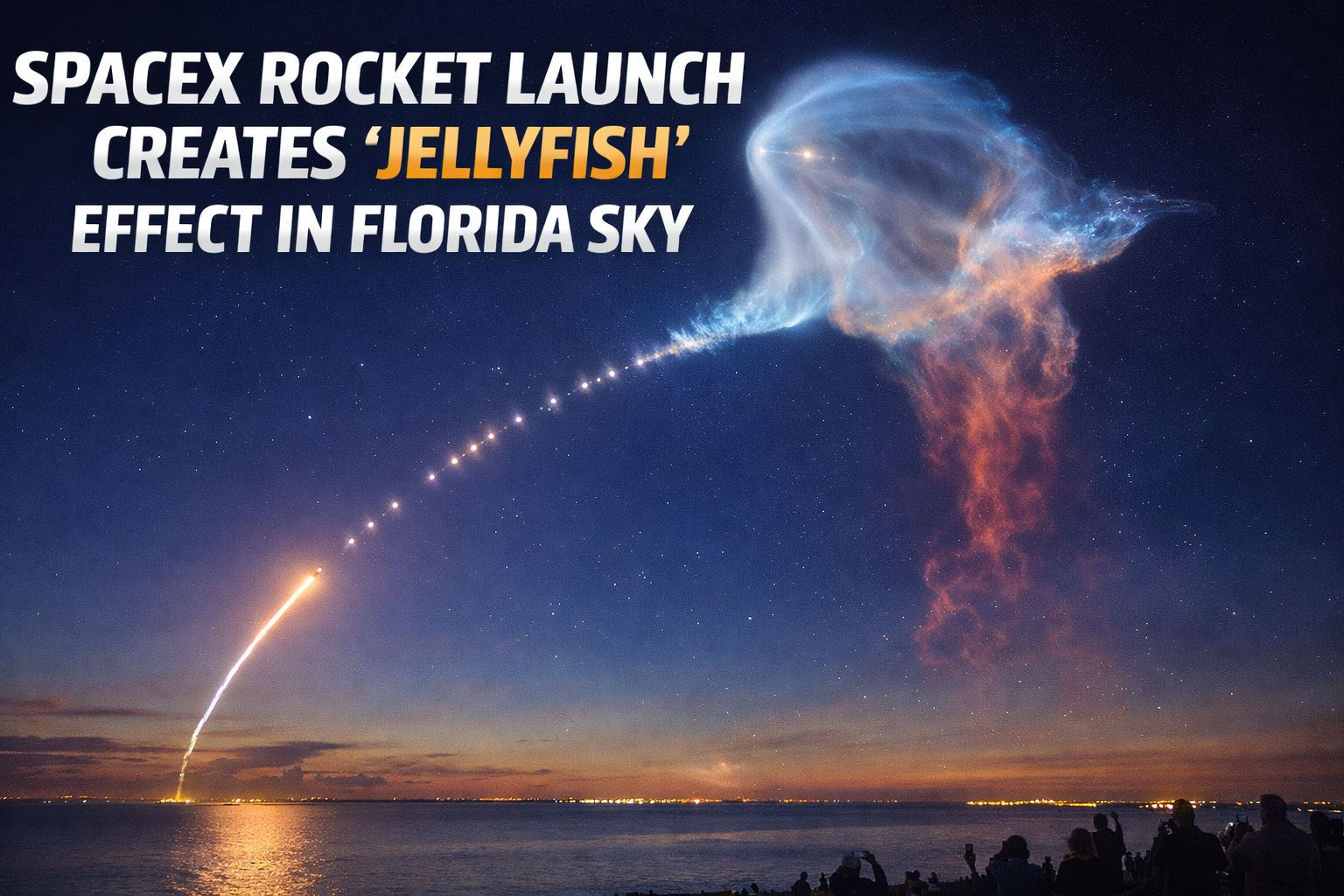
Early on the morning of Wednesday, March 4, 2026, space enthusiasts and early risers across Florida witnessed a rare and striking celestial spectacle as a SpaceX Falcon 9 rocket lifted off from Space Launch Complex 40 at Cape Canaveral Space Force Station. As the rocket ascended into the pre-sunrise sky, its high-altitude exhaust plume was illuminated by sunlight that was not yet visible from the ground, producing a surreal, glowing display likened by observers to a “jellyfish” floating in the sky. The visual phenomenon quickly spread across social media, captivating photographers, amateur astronomers, and casual onlookers who captured the extraordinary moment in images and video.
SpaceX achieved a launch at 5:52 a.m. Eastern Standard Time, which was the next in its continuing initiatives to launch more satellites into the low-Earth orbit (LEO) to provide more broadband internet. These are the new satellites in Starlink 10-40 mission which will enhance global connectivity capacity by expanding network capacity and enhancing performance to users in underserved areas around the globe. SpaceX has launched almost 11,400 satellites, of which about 9,800 are already in orbit and this makes SpaceX the largest commercial satellite internet service provider.
What Created the ‘Jellyfish’ in the Sky
The remarkable “jellyfish” effect seen across much of Florida and beyond was not caused by The spectacular jellyfish effect that appeared in most of Florida and beyond was not due to unusual rockets and neither was it an indicator of non-function. Rather it was caused by solar light shining on the exhaust plume of the rocket high in the atmosphere, and this kind of phenomenon only takes place in highly specific light conditions, especially when a rocket is fired off at twilight time, around a sunrise or sunset. As the rocket moves up a long way into the atmosphere, many miles (more than 100 kilometers) up in the air, the rocket exhaust spreads out in all directions within a very short time as the pressure in the air is very low. As the sun gets hit by this growing cloud and the ground remains dark, the plume may assume a glow like colour, which to the observers appears to be a translucent and bulbous formation in the sky.
This, according to meteorologists and space photographers, is a space jellyfish phenomenon, which is directly similar to such a phenomenon as noctilucent cloud effects, the clouds or plumes which are created visible at twilight due to illumination by the sun even when the observer on the ground is still dark. The rocket had not yet reached the altitudes where its exhaust plume would be illuminated directly by the sun when it happened on Wednesday, but at that time the sun was more than an hour below the horizon, and the result was a dreamy effect which was not lost in a few minutes as the rocket shot toward space.
Those who were watching told that they saw the formation drifting over the early morning sky between Tampa Bay and the Space Coast points. The Gulf Coast was experiencing clear skies in certain areas and this enabled photographers in Pinellas County and other parts of Tampa Bay to have a clear shot of the sea-jelly-like appearance floating low on the horizon immediately after takeoff. Many people have termed the glow as being surreal as it was accompanied by hues of blue and orange in the areas that sunlight intersected the thinner plume extending high in the air.
The Starlink Mission Itself
In addition to the visual show, the mission achieved the objectives of SpaceX to develop the Starlink program. A total of 29 Starlink satellites were launched into their low-Earth orbit by the Falcon 9 rocket. The satellites are meant to offer high-speed and low-latency internet to users in every part of the world especially those parts that lack strong ground-based infrastructures. Starlink is now a part of the modern telecommunication sphere, and it is applied by rural internet connectivity, emergency internet in catastrophe zones, etc.
This was also a milestone to the spaceX technology of reusable rockets. The Falcon 9 booster (the first stage) was named Booster B1080 and was the 25th flight of this spacecraft to be launched into space and make a controlled landing on the autonomous SpaceX drone ship (A Shortfall of Gravitas) in the Atlantic Ocean.
SpaceX conducted its 28th launch of 2026 with this mission alone, adding to a history of more than 600 launches overall. Of those 28 missions this year, 23 have been devoted to building out the Starlink constellation, highlighting SpaceX’s emphasis on expanding this critical infrastructure at an unprecedented pace.
Growing Phenomenon in Rocket Launches
While the “jellyfish” visual is eye-catching and memorable, it is not unique to this mission. Rocket launches that occur near sunrise or sunset often produce similar effects, as the interplay of sunlight with exhaust plumes at high altitude can create glowing formations in the sky that are visible from hundreds of miles away. These effects have been documented in numerous past launches, leading observers and astrophotographers to anticipate them when timing and atmospheric conditions align.
For example, similar phenomena have been observed during both SpaceX and other launch providers’ missions, where high-altitude plumes were lit by sunlight against darker skies, creating cloudlike or “space jellyfish” signatures that drift across the heavens. Although the colors and shapes can vary depending on atmospheric conditions and lighting angles, the underlying physics remains consistent: the rare combination of twilight illumination and thin upper atmospheric air allows rocket exhaust to scatter light in ways that exceed everyday sky patterns.
These displays captivate not just space enthusiasts but also casual observers who might otherwise have little interest in space launches. The dramatic visuals can bridge the gap between technical aerospace operations and public imagination, reminding people that rocket launches, beyond their scientific and commercial significance, can be shared experiences under the night or dawn sky.
The Broader Context of SpaceX’s Launch Strategy
SpaceX’s rapid launch tempo is driven in large part by the ambitious scale of its Starlink program. The company aims to field a megaconstellation tens of thousands of satellites strong, an endeavor that has already transformed expectations for global internet coverage. With nearly 8.5 minutes passing between liftoff and the Falcon 9 booster’s landing on its drone ship in the Atlantic, the mission exemplified SpaceX’s operational proficiency and the maturity of its reusable launch systems.
SpaceX’s frequent and regular launches highlight a broader trend in spaceflight: the commercialization and commodification of access to orbit. Whereas space launches were once rare events reserved for governmental programs, companies like SpaceX now conduct dozens of missions annually, often for commercial customers, scientific payloads, and critical infrastructure like broadband satellite networks. The result is more frequent opportunities for the public to witness spaceflight in action, sometimes producing spectacular atmospheric effects like the “jellyfish” plume that defined the March 4 mission.