
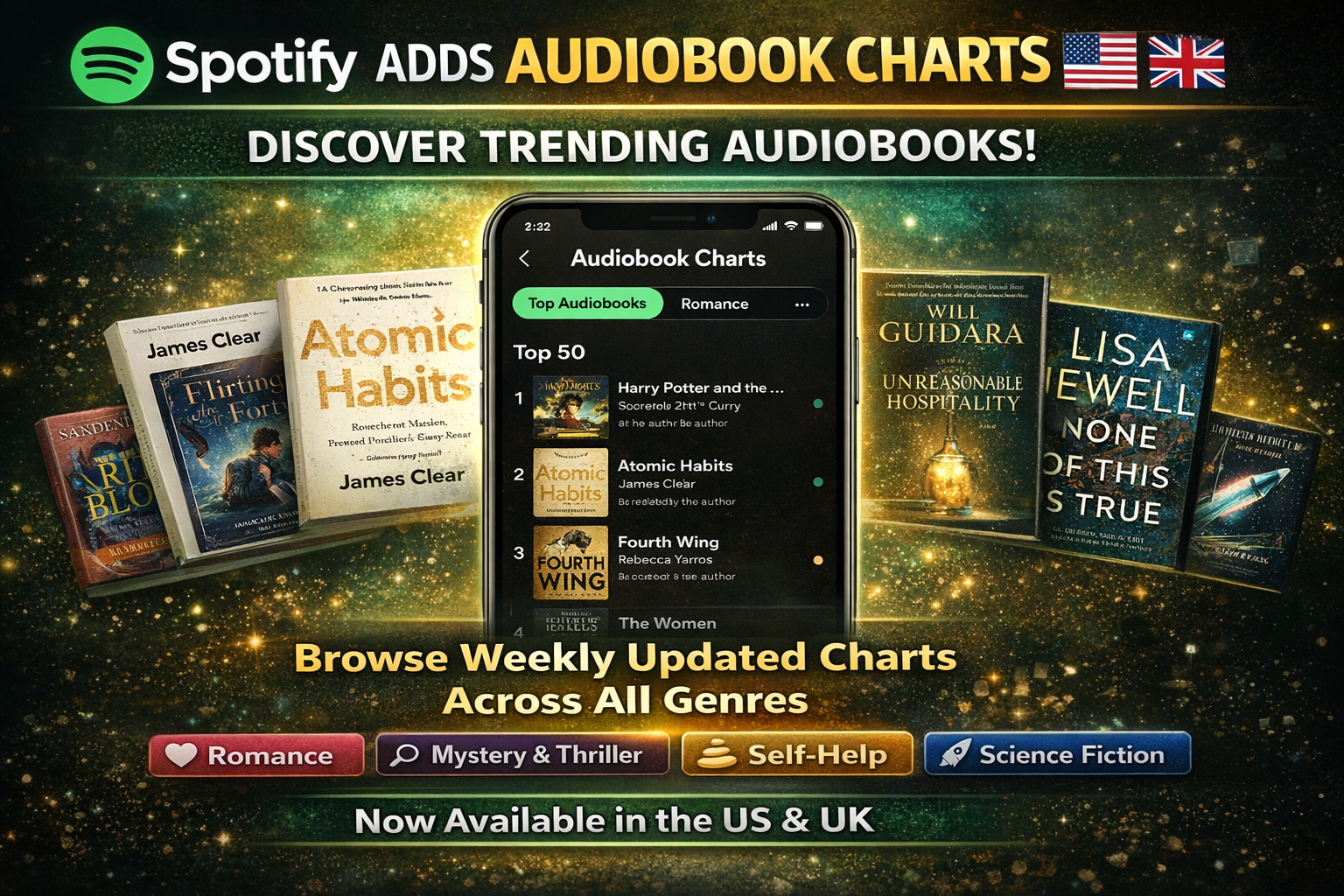
Another significant move in the expansion of that is the introduction of Audiobook Charts in the United States and the United Kingdom, which was officially announced by Spotify. It will also provide the new customer with an easy interface to find popular and trending audiobooks on the application. Spotify is trying to replicate the signal of success that it has had with music and podcast rankings by bringing a chart-based discovery model to audiobooks.
The functionality indicates the larger vision of Spotify to be a one-stop audio service. The company has progressively diversified into audiobooks in recent years, and this new move is an indication that audiobooks are no longer an experiment but a part of its growth strategy.
How the Audiobook Charts Work
The new Audiobook Charts offer users weekly updated charts of the ranking based on listening data and listener activity. The charts will feature a general ranking of the best Audiobooks, and also genre rankings of romance, mystery, thriller, self-help, and science fiction. These lists can be found in the audiobook section of the app, which is updated on a regular basis to show the most popular listener trends.
Unlike other conventional bestseller lists, which can be based on sales a lot, Spotify rankings are based on actual listenership on the platform. This implies that the charts will indicate what users are truly listening to and not necessarily what is being bought. This provides a better reflection of real-time audience interest and engagement in theory.
Improving User Discovery
Discoverability has always been one of the biggest problems in the audiobook industry. Having hundreds of thousands of titles, there are many users who are confused about what to listen to next. The goal of the chart system of Spotify is to streamline this process by promoting what other listeners are popular at the moment.
To the general listeners, this offers them a simple access point into the audiobook world. Users do not have to go through as many titles and can get a quick idea of what is trending and what genres are getting popular by visiting the site. This strategy resembles the way the listeners of music usually find new songs according to the Top 50 or viral lists.
Spotify minimizes the friction involved in the discovery of long-form material by drawing upon data-driven rankings. The fragmented attention of this age might mean that the availability of audiobooks would considerably affect the total time of listening.
Impact on Authors and Publishers
Authors and publishers also have a significant implication of the introduction of charts. The visibility of audiobooks is a key factor to achieving success, and a high ranking on Spotify charts may turn into more streams and wider awareness.
Independent authors can have new opportunities with this system. In the event that the sole method to propel a title is engagement, then niche or genre-specific works can be exposed just as mainstream bestsellers are. In the meantime, publishers have an additional performance indicator that can be measured in real-time. Charts are usually culturally charged. In music, the chart positioning can boost the reputation of the artist and create a role in the media coverage. Assuming the audiobook charts grow to have the same value, it may transform the marketing patterns and competitive forces within the publishing industry.
Spotify’s Competitive Position
The entry of Spotify into the audiobook discovery market is amid the rivalry the company has with the already existing players, namely, Audible and Apple Books. Although these platforms have always prevailed in the audiobook market, Spotify has the advantage of having a huge number of current users and an integrated ecosystem. Spotify promotes cross-format usage since audiobooks are played in the same context as music and podcasts. Visiting the app to play music, a user can now consider audiobooks and not download another platform. This convenience has the potential to change the habits of the listeners and upset the traditional audiobook provider.
In addition, Spotify has an advantageous technological advantage because of its proficiency in recommendation algorithms. The firm has been working to perfect the personalisation of music and podcasts. The discovery of audiobooks should be more dynamic and user-friendly by applying similar insights of data to audiobooks.
Editorial Perspective: Why This Matters
As an editorial matter, the introduction of Audiobook Charts at Spotify is not just a feature addition, but it is the beginning of the maturation of streaming-based audiobook consumption. Traditionally, audiobooks have been linked to purchase-based models. The strategy of Spotify brings them closer to streaming culture, where the interaction and popularity can be seen immediately.
A wider tendency towards the disclosure of consumption data is also strengthened by the introduction of charts. The users nowadays require knowing what other people are listening to, watching or reading. Rankings generate the feeling of community involvement and cultural zeitgeist. In case audiobook charts can take off, it can affect reading behavior in the same manner that music charts affect listening behavior.
Nevertheless, it will be determined by the effectiveness of implementing this feature by Spotify into the daily routine. Charts should be simple to read, updated frequently, and indicative of various preferences. The discovery promise can be diluted if they are overtaken by a few blockbuster titles. Conversely, when Spotify balances very mainstream and a variety of genres, the functionality might democratize the exposure of audiobooks.
The Future of Audiobook Streaming
Spotify’s move suggests that audiobooks are no longer peripheral to digital audio platforms. As streaming continues to evolve, the boundaries between music, podcasts, and books are becoming increasingly fluid. Users are growing comfortable consuming long-form content through the same interface where they stream songs.
The Audiobook Charts are a logical next step in this evolution. They bring familiarity, structure, and competitiveness to a space that has often felt fragmented. For listeners, it means easier discovery. For creators, it means new visibility pathways. And for the industry, it signals a potential shift toward streaming-driven popularity metrics.If Spotify successfully leverages its global audience and data analytics capabilities, Audiobook Charts could become a defining feature of the next phase of digital publishing.