
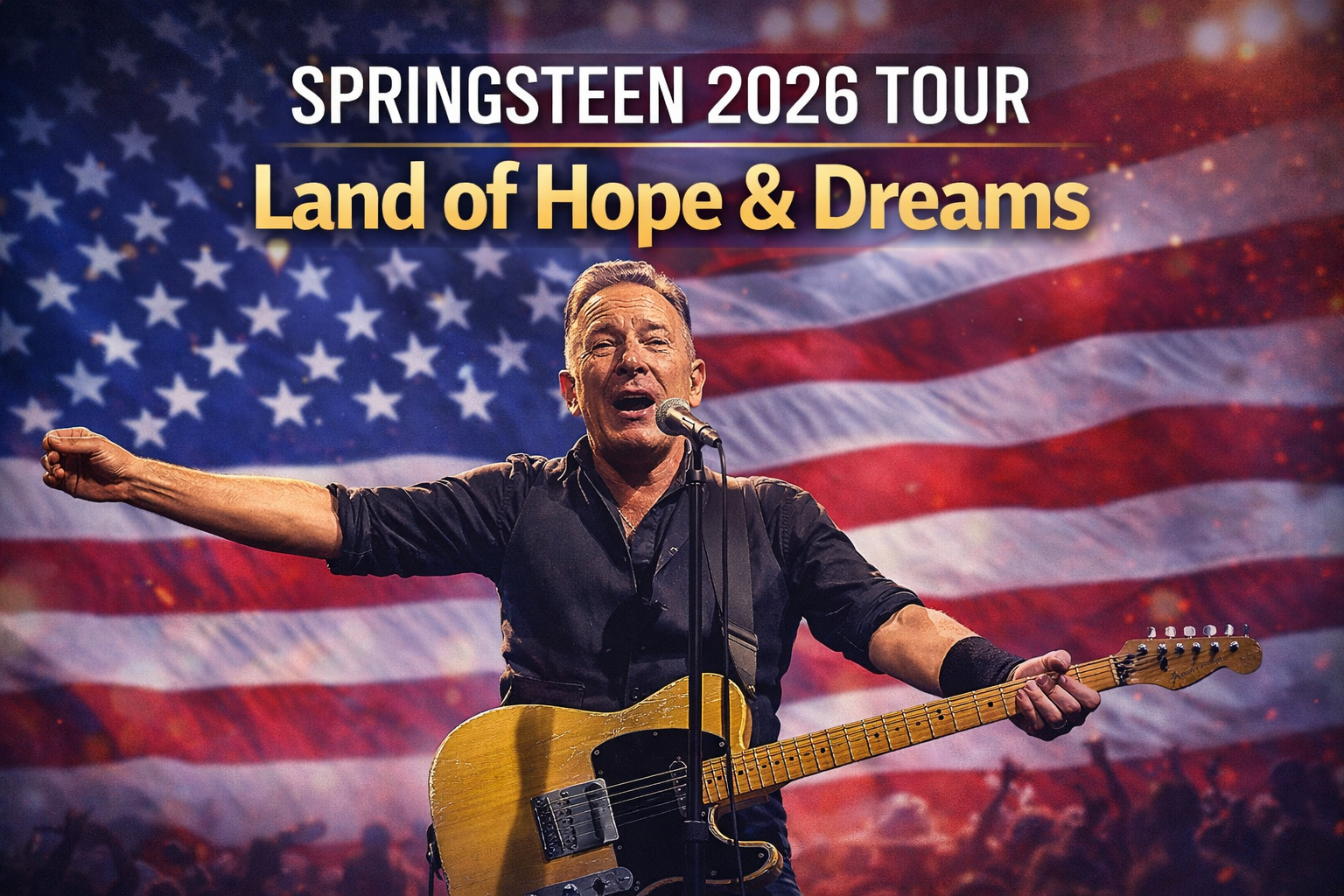
The Boss, Bruce Springsteen, is officially going back to the stages in the United States in spring 2026. The long-awaited Land of Hope and Dreams American Tour will tour 20 cities between March 31 and May 27, starting with Minneapolis, Minnesota and ending with an epic outdoor concert at Nationals Park in Washington, D.C., during May. Currently in the last stage: announced on February 17, 2026, the tour will be Springsteen’s first full US tour in five years, and a continuation of a successful European and Canadian leg of the same Land of Hope and Dreams tour in 2025.
A Tour with a Message
Most artists allow their music to speak on its own, but this tour, dubbed Land of Hope and Dreams, was framed not only as a rock and roll party but a sociopolitical statement. The trek was self-described by Springsteen as a cry of protest in the defense of American democracy, American freedom, our American Constitution, and our sacred American dream, a sharp reaction to the ever-polarizing politics in the United States.
This is a general theme of democratic strength, and not mere propaganda. It is reminiscent of his recent single, “Streets of Minneapolis,” in January of 2026. The latter protest song was written in the wake of the lethal shootings of civilians by federal immigration officers in Minneapolis as a tribute to communities in the area affected by the immigration enforcement efforts.
On the musical side, the tour is based on the long-standing tradition of Springsteen, who is able to combine energetic rock music with serious lyrical subjects. This run is unique, though in the extent to which it has been overtly political, with Springsteen making no secret of his shows being an effort to promote solidarity during difficult times instead of merely entertaining.
Tour Cities and Highlights
The Boss will be able to perform in iconic venues in front of fans in various parts of the country. The trip plan consists of eight major cities that contain arena and stadium visits, including:
- Minneapolis, MN -Target Center (Tour opener)
- Inglewood, CA- Kia Forum (two nights).
- San Francisco, CA- Chase Center.
- Phoenix, AZ -Mortgage Matchup Center (April 16 show included)
- Chicago, IL – United Center
- New York, NY, Madison Square Garden (several nights).
- Philadelphia, PA -Xfinity Mobile Arena.
- Washington, D.C., Nationals Park (Tour closer).
Such a wide geographic appearance, from the West Coast to the Northeast and the capital of the country, is a testament to the lasting popularity of Springsteen and his cultural penetration.
The E Street Band and Production
The highlight of the tour is the use of the E Street Band, the support band that Springsteen has had going back. Other stalwarts in the band, including Roy Bittan (piano), Nils Lofgren (guitar), Patti Scialfa (guitar, vocals), Garry Tallent (bass) and Stevie Van Zandt (guitar) and Max Weinberg (drums) continue to make the band chemistry a key Springsteen live album. Other musicians such as Soozie Tyrell and Jake Clemons further enrich the sound and horn sections, and support choirs give it a rich and dynamic concert feel.
The shows of Springsteen are traditionally associated with marathonic sets lasting three hours or more, which combine the usual hits such as Born to Run, Dancing in the Dark or The Promised Land with more in-depth cuts and social commentaries. By history, the audience should be prepared to see a night of strong musicianship, sing-alongs among the fans and tears.
A Cultural Moment
Although the history of Springsteen touring is vast, having toured for decades, the current tour comes at a time when most people believe that the role of rock music in the public discourse is changing. Instead of avoiding being controversial, it seems like Springsteen is leaning into controversy, with his stage serving as a platform to intensify the conversation about freedom, justice and national identity.
This is what has been brought to the fore by critics in the major outlets about the tour. People are calling him heroic on his way to solving intricate problems by using music; however, others are asking whether political activism can best be exercised in a rock tour. This response, however, highlights a larger fact: Springsteen has a bigger impact on culture than on music, a role that very few rock musicians of his age and profile have had a similar influence on.
The selection of Phoenix and other cities where recent debates of immigration policy have taken place further entrenches the tour in regards to modern issues. Not only are audience and commentators listening to setlists, but also to the intersections of venues and dates with the larger narratives of community identity, policy, and civic activity.
Ticketing and Fan Response
Most shows were available to purchase tickets on February 20 and 21 and had no presale, unlike in other areas of the industry, where it is usual to have early access and tiered sales. Conversations among fans indicate that they are very excited and a little bit frustrated with the issue of ticket purchasing, which is a sign of the popularity of Springsteen even after several decades of his career.
The social media discussion reveals that the fans are excited to travel to various cities- some of them will be attending their fourth or fifth Springsteen concert, and others are upset because they are not getting a chance to buy tickets through the presale. This type of intensity is not merely a form of nostalgia, but a feeling that Springsteen still has something artistically and emotionally interesting to share.
Final Thoughts: A Tour for Its Time
Being an old-school listener of music and culture, I regard the 2026 Land of Hope and Dreams tour as a field of more than concerts; it is an artistic endeavor based on context. Springsteen is addressing issues that have a great echo in a divided political context, economic pressures, and introspection. You may agree or disagree with his message. Still, there is no refuting the importance of a 76-year-old rock icon taking up his megaphone to initiate a conversation and revitalize crowds in a country that is struggling to find its identity and sense of purpose.
This tour might reinvent the way that legacy musicians approach modern-day matters not only in the form of songs but even in the way their art is framed. It is a radical decision, yet in a career that is characterized by risk, heartland rock masculinity, and narrative, it is distinctly Springsteen.
The only way to know is how these shows will be remembered: as classic rock concert shows or as cultural landmarks or both. However, according to historical examples, they will be discussed even after the last chord stops.