
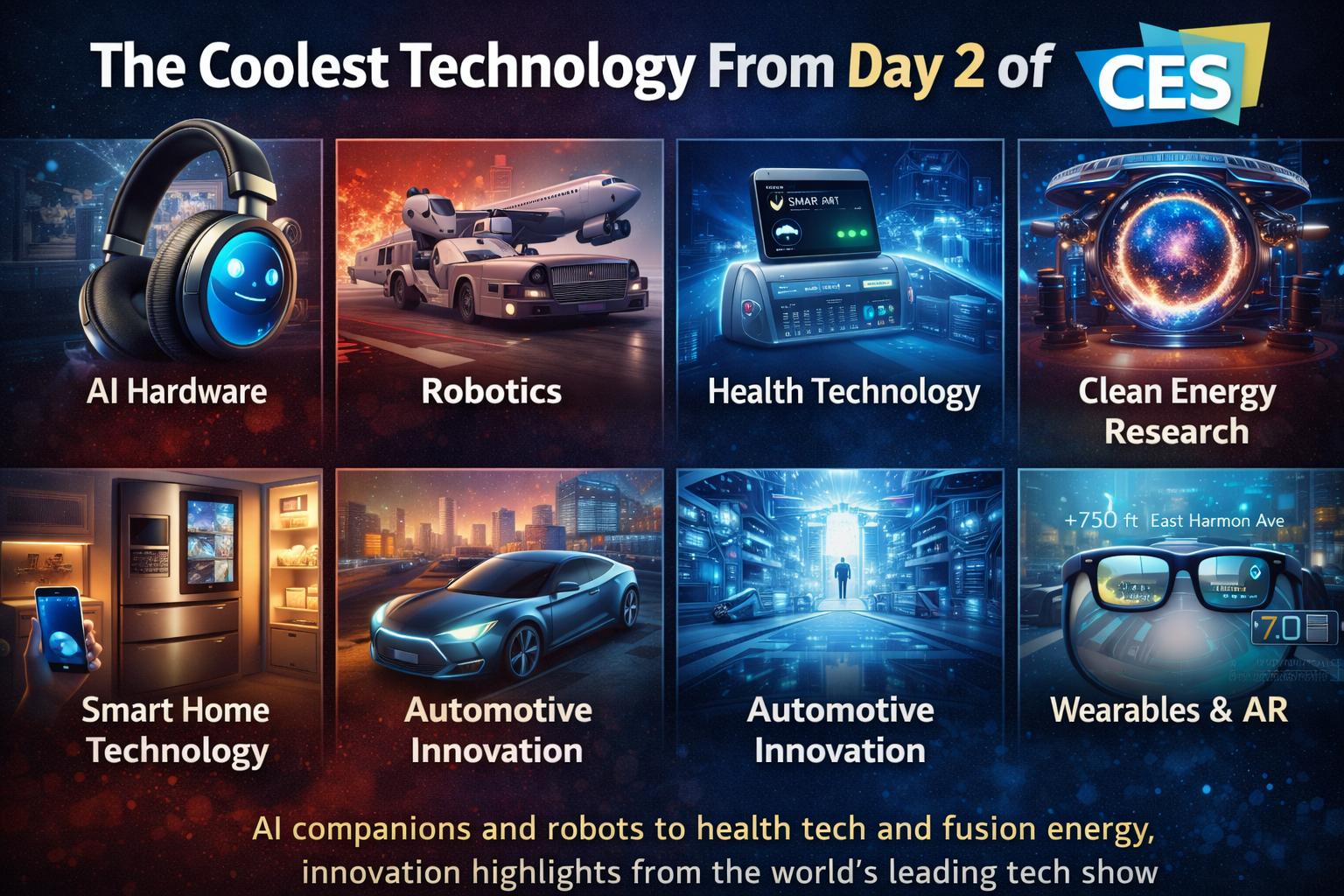
The recent Consumer Electronics Show (CES 2026) presented a broad selection of futuristic technologies that helped to strengthen the image of the event as the most influential consumer technology event in the world. Ranging all the way to AI-driven personal gadgets and autonomous robots to high-tech health care tracking solutions and recent developments in the field of clean energy research, businesses utilized the second day of the show to showcase how the new technologies are making the transition between the concept and the reality of their application.
Although flashy prototypes continued to be a feature on the exhibition floor, many of the unveiled innovations on Day 2 were oriented towards real-life applications, marking a transition towards technology that would fit well in real life.
AI Hardware Moves Into the Spotlight
AI remained the order of the day in CES 2026, but Day 2 saw a distinct change: AI is not just a program anymore; it is now being integrated into the physical world.
Razer, the producer of gaming hardware, presented experimental AI-based products, which combine digital intelligence with material design. One of the prototypes is a pair of over-ear headsets that has an integrated AI which serves as a gaming accessory as well as a chat robot. Another idea unveiled a small desktop AI friend who visually communicates with the user, provides contextual feedback and real-time help.
These devices represent a larger pattern throughout CES, in which firms are considering how AI can serve as an omnipresent personalized assistant and not a device that can be invoked only on screens. According to the industry observers, such hardware may transform the way people work, have fun and interact with computers.
Robotics Step Beyond Novelty
Another category that was a highlight of Day 2 was robotics, where the companies exhibited machines that were to be implemented in the real world and not experimental types.
Osho Corporation released autonomous robotic systems that are designed to operate on the airport ground. They are robots that aid in the handling of aircraft, handling of baggage and the coordination of logistics with the intention of minimizing turnaround times and enhancing safety.
The company has laid stress on the fact that the robots are designed to work under harsh conditions, such as heat and strong winds, which are typical problems in congested airports.
Robotics company Roborock made a trial version of a vacuum cleaner in the consumer space that can climb stairs with the help of an articulated mechanical leg. The new perspective has attempted to allow cleaning the entire house without human intervention, where more basic robot vacuums are only capable of cleaning the floor at any given time. Although it was still in its early stages of development, the idea attracted a lot of interest in order to solve an old-time constraint in home robotics.
Health Technology Gets Smarter
Health-based innovation was significant on Day 2, as consumers are increasingly interested in at-home wellness monitoring.
Withings has come up with a high-tech smart scale that is much more than a designer of scales that measure weight. The gadget monitors dozens of health-related measurements, such as cardiovascular, nerve, body composition, and metabolic dynamics. The scale, intended to be used within less than two minutes, is meant to give users more insight into their overall health as it can be linked to digital tools to monitor over an extended period.
CES experts observed that health technology is becoming a bridge between the convenience of consumers and the medical knowledge of quality. With capacity challenges being experienced by healthcare systems across the world, early detection and preventive care might be of use by such tools.
AI Meets Clean Energy Research
The energy sector announced one of the most ambitious ones on Day 2. The workings of collaboration between fusion energy researchers and big technology firms shed light on the acceleration of scientific discovery with the help of AI.
The proposed project is focused on the creation of a digital twin of a fusion reactor that will enable scientists to study the complicated behavior of the plasma and optimize the design of the reactor without using physical experiments exclusively. With the combination of AI-guided analysis and sophisticated simulations, scientists hope that the time to bring fusion energy to commercial viability will be significantly shortened.
Although the use of fusion power is still decades away, the announcement emphasized the increasing position of CES as a platform to not only promote consumer gadgets, but also technologies whose applications have global effects.
Smart Home Technology Evolves
The Smart home devices at CES 2026 were more sophisticated with a focus on automation, personalization, and interoperability.
Manufacturers presented smart appliances that can adapt to the habits of the user, such as refrigerators that monitor food freshness, home assistants that can change the lighting, climate, and entertainment according to the situation. Artificial intelligence learning algorithms are slowly allowing homes to be proactive and not reactive.
According to industry observers, interoperability among devices is still a primary issue, yet the development of common standards indicates that the smart home looks even more unified in the future.
Automotive Innovation and Mobility
The automakers used day 2 to discuss the way software, AI, and electrification are transforming mobility.
Multiple manufacturers also demonstrated electric cars with a high level of driver assistance systems and AI-improved infotainment systems. These systems develop driver preferences as time goes on, optimize energy consumption and give predictive maintenance warnings.
In addition to personal vehicles, there were also concepts of autonomous delivery platforms and urban mobility solutions presented by companies, which support the increasing role that CES will play in the future of transportation.
Wearables and Augmented Reality
The wearable technology was further developed towards a more subtle usage. The most talked about products on the show floor were the smart glasses and lightweight AR devices.
The new eyewear, in contrast to older models, is supposed to be unobtrusive and to fit in with classic fashion, and provides options like navigation overlay, real-time translation, and AI-based reminders. Manufacturers focused on comfort, battery life, and privacy controls, and this indicates that they attempted to solve the previous concerns of the consumers.
A Shift Toward Practical Innovation
The difference between Day 2 of CES 2026 and other years was not only the diversity of the technologies presented, but also their increased readiness to be used in reality. Most businesses did not concentrate on far-fetched ideas but on products that were close to the market.
This change implies that innovation is getting more mature, whereby its success will be dependent not only on its technological prowess but also on its usability, reliability and trust. Artificial intelligence, robots, and intelligent systems are no longer evaluated based on their futuristic nature but on their ability to address daily issues.
What Comes Next
As CES 2026 goes on, industry observers believe there will be further announcements on the artificial intelligence system infrastructure, sustainability, and next-generation computing. But, Day 2 already clarified this much: the technologies that are going to define the next decade are not theoretical anymore.
Intelligent machines and customized AI assistants, health, and energy research represent only a small part of the reality that CES 2026 is indicating a world in which technology will remain silent yet influential, more autonomous and more transformative every day.