
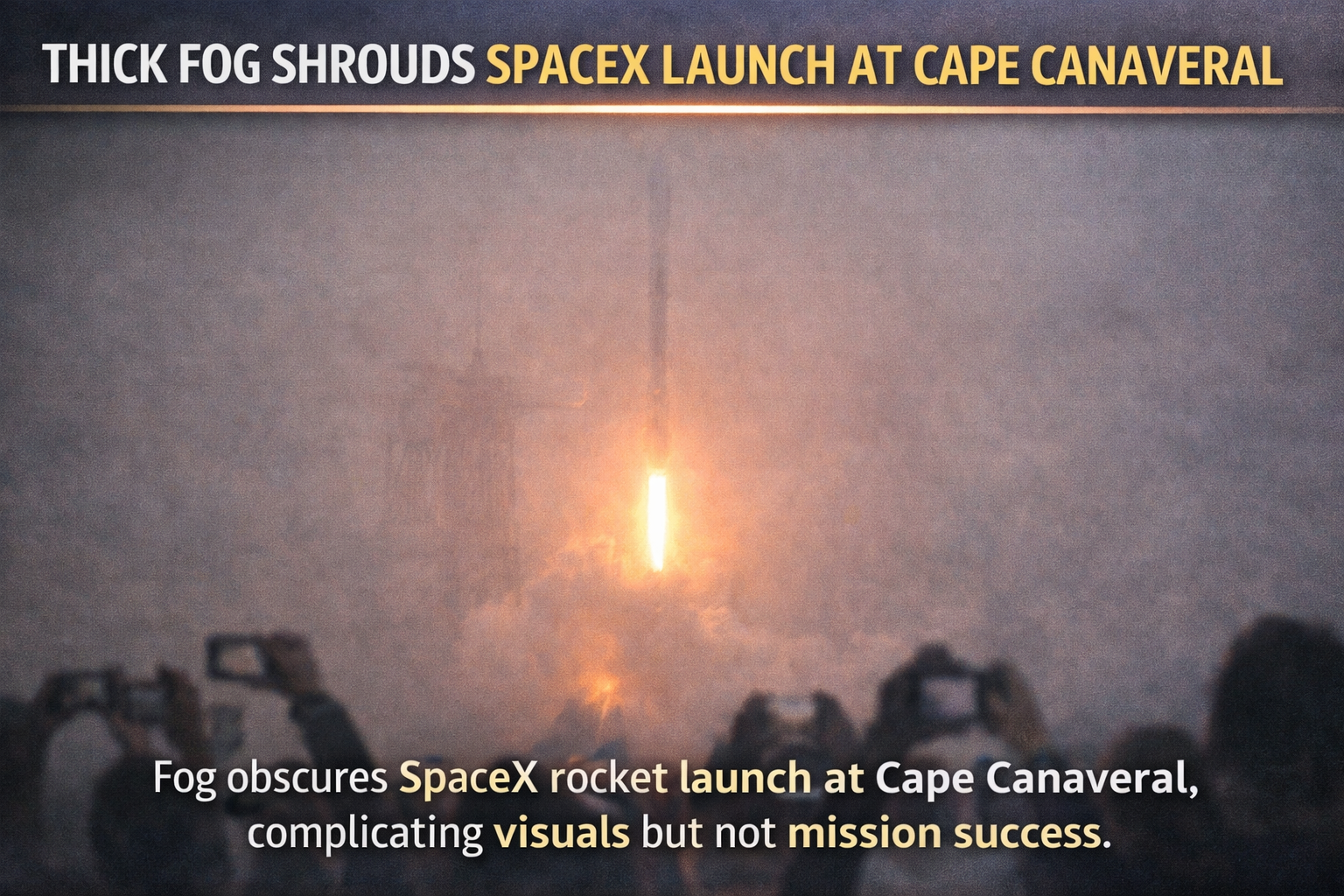
A SpaceX rocket launch from Cape Canaveral, Florida, on Thursday morning was dramatically veiled in thick fog that left spectators and photographers struggling to catch a clear view of the historic liftoff. Though the rocket’s engines ignited on schedule, the plume of exhaust and the ascending vehicle were largely hidden behind a dense, low-lying blanket of moisture that blanketed the launch pads and surrounding landscape. The unusual atmospheric conditions created an eerie, surreal backdrop for the event, producing images that were as striking for what they concealed as for what they revealed. Despite visibility challenges, SpaceX confirmed that the mission proceeded successfully, marking another achievement in the company’s expanding portfolio of space operations.
The launch took place at Cape Canaveral Space Force Station, a primary hub for U.S. space activity and a site where SpaceX has conducted numerous missions. Meteorological reports indicated that dense fog formed overnight and persisted into the early morning hours, reducing visibility to less than a quarter-mile in some locations. For spectators gathered near the shoreline and along official viewing areas, the expected spectacle of fiery ascent and plume expansion was replaced with a faint glow and rumbling sound emanating from within the fog. Photographers captured only hints of the rocket’s trail, giving the launch an almost ghostly, otherworldly feel.
The Launch and Its Objectives
SpaceX did not publicly clarify the particular mission the launch was aimed at but sources knowledgeable on the schedule of the company said that the launch was one of the series of orbital missions that the organization was undertaking to support commercial, scientific, and government customers. SpaceX has become more of a workhorse launching company of various payloads, including communications satellites, and national security capabilities, as well as science equipment. The SpaceX Falcon 9 boosters have been flying at an astonishing rate in recent years re-entry and landing to be reused in a model that has transformed rapidly expectations of the economics and reliability of launch.
Thursday, people came as early as dawn to view zones in Canaveral to observe the action. To a significant number, this was a unique and thrilling experience as a SpaceX rocket started its launch. Even though most of the visual spectacle was obscured by heavy fog, the launch attracted a lot of attention of space enthusiasts and local residents. Images and video clips of blurred forms moving on a gray background were rapidly filling social media, with snatches of ambient noise of the liftoff. At other points, the position of engines on the rocket was only betrayed by distant flashes of light, yet the ship itself was mostly hidden.
SpaceX and the U.S. Space Force frequently coordinate on launches from Cape Canaveral, maintaining tight schedules that depend on weather windows, technical readiness, and range availability. In this case, weather conditions met the technical criteria for liftoff, even though visibility was poor. Safety protocols for rocket launches prioritize atmospheric parameters such as wind speed, precipitation, and cloud cover at various altitudes. Low clouds and fog can obscure the view but do not necessarily impact the rocket’s performance or safety if other criteria are satisfied. SpaceX mission control confirmed after the launch that all flight phases performed as expected, with the first stage booster successfully completing its planned burn and, in many cases, returning for a controlled landing on a drone ship or land-based pad.
Fog’s Impact on Public Viewing and Photography
The impacts of the fog to the civilians watching the spectacle were instant and exceptional. Fans who had gone to great lengths to view the rocket did not even get a glimpse of the vehicle as it was taking off. There were no picturesque scenes of fire and smoke stretching up to the blue sky, but the audience could hear the familiar moan of engines and see only diffused light through the smoky air. Difficulties occurred reported by photographers in concentrating on the rocket, and this was referred to as trying to shoot light in a cloud.
The plume of exhaust in most of the pictures on the social media seemed to be hovering nearer to the ground just below the layer of fog. The attendees used terms such as booming and resonant to describe the sound of the launch which enhanced in the mist to make the event look personal and surreal instead of far-off and massive. Although all the fans bring along high-resolution cameras and long lenses to capture the launches in sharp detail, the conditions on Thursday tested the technical skills of many of them, compelling them to resort to abstract and artistic descriptions of the activity. The images created as a result were not traditional in terms of clarity but they were able to capture a mood and an atmosphere that can not be frequently found during rocket launches.
The images were also recorded by professional photographers who worked on official NASA and SpaceX viewing platforms and gave much attention to the density of the fog and the light impact on the gray background. Such images that get released will probably form a visual spaceflight history of the interaction of natural weather phenomena with human technological accomplishment. In such a way, the fog-covered launch in 2026 might even be recalled with the conditions of the atmosphere rather than the success of its mission.
Atmospheric Conditions and Launch Safety
Fog is formed when the damp air close to the ground is cooled up to the extent that the water vapor condenses to tiny liquid droplets suspended in the air. The coastline of Cape Canaveral renders the place highly vulnerable to mist particularly in the seasonal change as the cooler air enters the Atlantic Ocean and flows over the land which is hot. Early morning—the time around which the SpaceX launch was to take place—that brought together temperature gradients and a heavy amount of humidity in the atmosphere to produce the thick fog that ended up blocking the launch of the rocket.
Although fog and low clouds present challenges for human observers and photographers, engineers and mission controllers focus primarily on atmospheric parameters that affect rocket performance and safety. Variables such as upper-atmosphere winds, electrical storm risk, and precipitation at higher altitudes are more influential on launch decisions than surface fog alone. In this case, forecasts and real-time weather monitoring indicated that the broader atmospheric conditions were within acceptable limits for liftoff, enabling SpaceX to proceed with the mission despite the limited visibility at ground level.
Space Launch Delta 45, the U.S. Space Force unit responsible for managing the Eastern Range safety and coordinating launches from Cape Canaveral, confirmed that the launch met all required safety criteria. Lance Corporal Sarah Mitchell, a spokesperson for the range, noted that “weather conditions are evaluated holistically, and while surface fog reduces visibility for observers, it does not necessarily preclude launch if other atmospheric conditions comply with safety standards.”
Visual Documentation and Public Engagement
Despite the visual limitations, the launch provided a powerful reminder of the public’s fascination with space exploration. On social media platforms, enthusiasts shared stories of their experiences, describing the unique sensation of hearing a launch without the expected accompanying spectacle of visible flame. Some spectators recorded the echoing sound of the engines through the fog, capturing how the noise seemed to surround them rather than emanate from a distant point in the sky. These accounts, combined with the striking images, created a vivid narrative that continues to circulate online.
Space Center enthusiasts noted that the foggy launch created a sense of mystery and intimacy, transforming an already dramatic event into something more atmospheric and evocative. The images and stories from Thursday’s launch have sparked renewed conversation about how nature and technology intersect, reminding the public that space missions occur within complex environmental contexts that are beyond human control.
Conclusion: A Launch Remembered for Its Atmosphere
The SpaceX launch from Cape Canaveral on that foggy February morning will likely be remembered for the unusual atmospheric conditions that obscured its visual grandeur. Yet, beneath the veil of mist, cutting-edge technology performed precisely as designed, reinforcing confidence in the company’s launch capabilities. For spectators and photographers, the event offered a unique blend of sensory experience and poetic imagery that transcended straightforward documentation.