
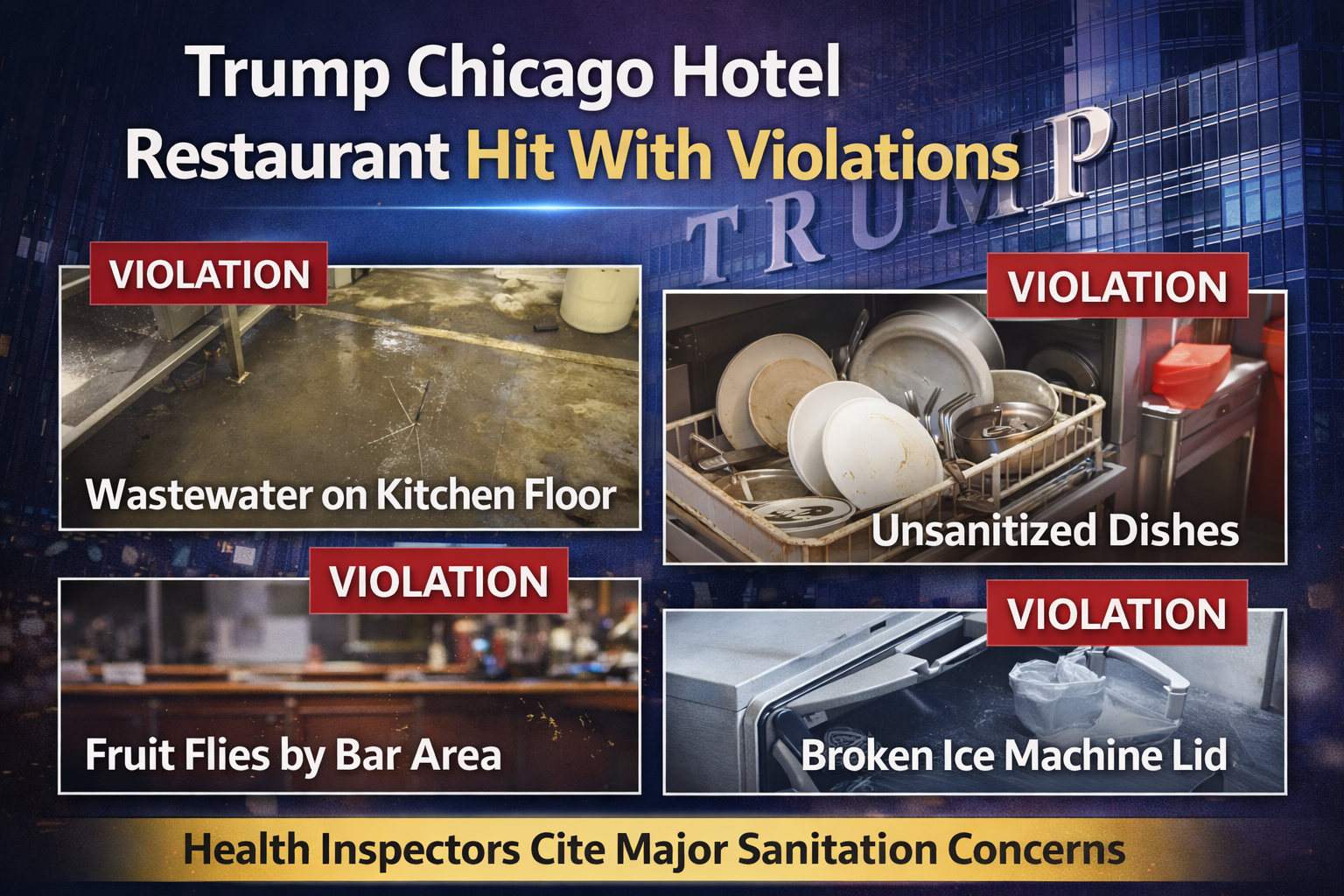
One of the restaurants in the Trump International Hotel and Tower Chicago has lately been put in the spotlight because of a series of violations that were discovered by health inspectors during an official inspection. The audit, which took place in December 2025, showed disturbing evidence in the kitchen and food preparation section of the hotel. The records of public health showed that the inspectors found that wastewater was accumulating on the kitchen floor due to the fact that a number of prep sinks emptied onto the floor instead of connecting to the correct plumbing systems.
Besides drainage problems, the inspection also discovered that the commercial dishwasher did not sanitize dishes and utensils. This brought up issues of the likelihood of contamination and food safety hazards to the customers eating in the restaurant of the hotel. The health inspectors observed debris in a food preparation cooler and a broken lid on the ice machine, which may result in the ice stored being contaminated.
Violations of this kind are not just technical concerns. Sanitation systems can be used in the food service industry to avoid foodborne illness and to ensure a sense of trust in the population. The smallest negligence in cleaning may be very disastrous when the number of visitors can be hundreds each day in a restaurant.
Kitchen Pest Presence and Sanitary Issues
Some of the most terrifying results of the inspection were associated with the pest activity and food handling habits, perhaps. More than ten small flies were found around the bar area, and the inspectors also observed a few other flies in the dishwashing section of the rooftop restaurant. Such a degree of the existence of pests is usually regarded as a grave violation since insects are able to transmit bacteria and pollute food surfaces.
The other problem was that employees were preparing food without the necessary protection. In the inspection reports, it was mentioned that a number of the food handlers had been touching sushi toppings and burger buns without gloves. Although gloves are not always mandatory in every jurisdiction, there tend to be very strict hygiene standards when it comes to ready-to-eat foods. The same inspectors indicated that there was no hand soap in an employee restroom, which is a breach of basic hygiene in any food facility.
Managers in restaurants were told to rectify the violations as soon as possible. The pest control servicing and better hygiene procedures were also needed by the officials before the restaurant was declared to be compliant.
Partial Improvements with the help of the Follow-up Inspection
A follow-up visit was made less than 1 week after the first inspection, which mentioned red flags, and the health authorities had to approach. The second inspection indicated that there were some of the most urgent problems that the management addressed. Kitchen drainage issues were partially resolved, and the level of pest activity seemed to be under control following specific cleaning and servicing.
But the inspectors have noticed that there were still certain issues with the equipment. E.g., the ice machine was broken on the top, and the lid was yet to be replaced. This might appear to be a minor problem. Still, these defects can cause contaminants to leak into the food preparation equipment, which is why health departments demand the equipment to be repaired immediately.
These ambivalent findings indicate that, although the restaurant acted in time, in relation to inspection threats, more vigilance and operational discipline might be needed to ensure the restaurant adheres to the rules in the long term.
Pattern of scrutiny of the Trump-owned properties
The recent health breaches are not the initial regulatory issue associated with the property. The building has already been a subject of legal controversy due to its environmental compliance. In 2024, a Cook County judge decided that the hotel tower was in violation of environmental law that was aimed at protecting wildlife in the Chicago River. The cooling system of the building draws millions of gallons of river water every day, which, according to critics, can entrap or even kill fish and other aquatic life.
This ecological settlement eventually resulted in the settlement of the ecological damage of the environment to provide compensation amounting to approximately 4.8 million to compensate for the ecological damage and to facilitate projects to restore the rivers. It was also agreed that the entire building water supply system, in terms of cooling water intake, would be upgraded in order to protect aquatic life.
Though the environmental and the recent restaurant inspection case are very different issues, when put together, they show how high-profile properties are more prone to the scrutiny of regulators as well as the people.
Influence on Brand Image and Hotel Quality
Hotels that have a luxury restaurant have a high level of expectations of customers. Customers who come to a luxury hotel such as the Trump International Hotel would normally think that the food safety and hygiene standards will be higher than those of average restaurants.
In cases where sanitation failures are found by inspection, the reputational damage may be greatly harmed- even when the failures are soon rectified. In the digital age, health inspection reports are also available on the Internet, and they can be easily retrieved by tourists and potential customers.
Instead of just having to pass inspections, hospitality brands have to establish a culture of regular compliance. The work on the kitchens of large-volume facilities is under stress, and the high standards of hygiene cannot be ensured without regular training, monitoring, and responsibility.
Lessons in the industry about the Inspection
The incident contains more general lessons for the hospitality industry. The aim of health inspections is not only to penalize the violations but to defend the health of the population and promote optimal practices in the food preparation facilities.
The operators of restaurants are also supposed to ensure that they have proper sanitation facilities, such as functioning dishwashers, free of pest storage facilities, and that the food preparation facilities are in good condition. Staff education on hygiene, i.e., handwashing and safe food handling, on a regular basis is also essential.
Many experts have observed that the most successful restaurants have viewed the inspections as normal quality checks and not as confrontations with the regulating bodies. The violation can be less evident in the case of formal visits to sanitation conditions, as they are being actively monitored by the management.