
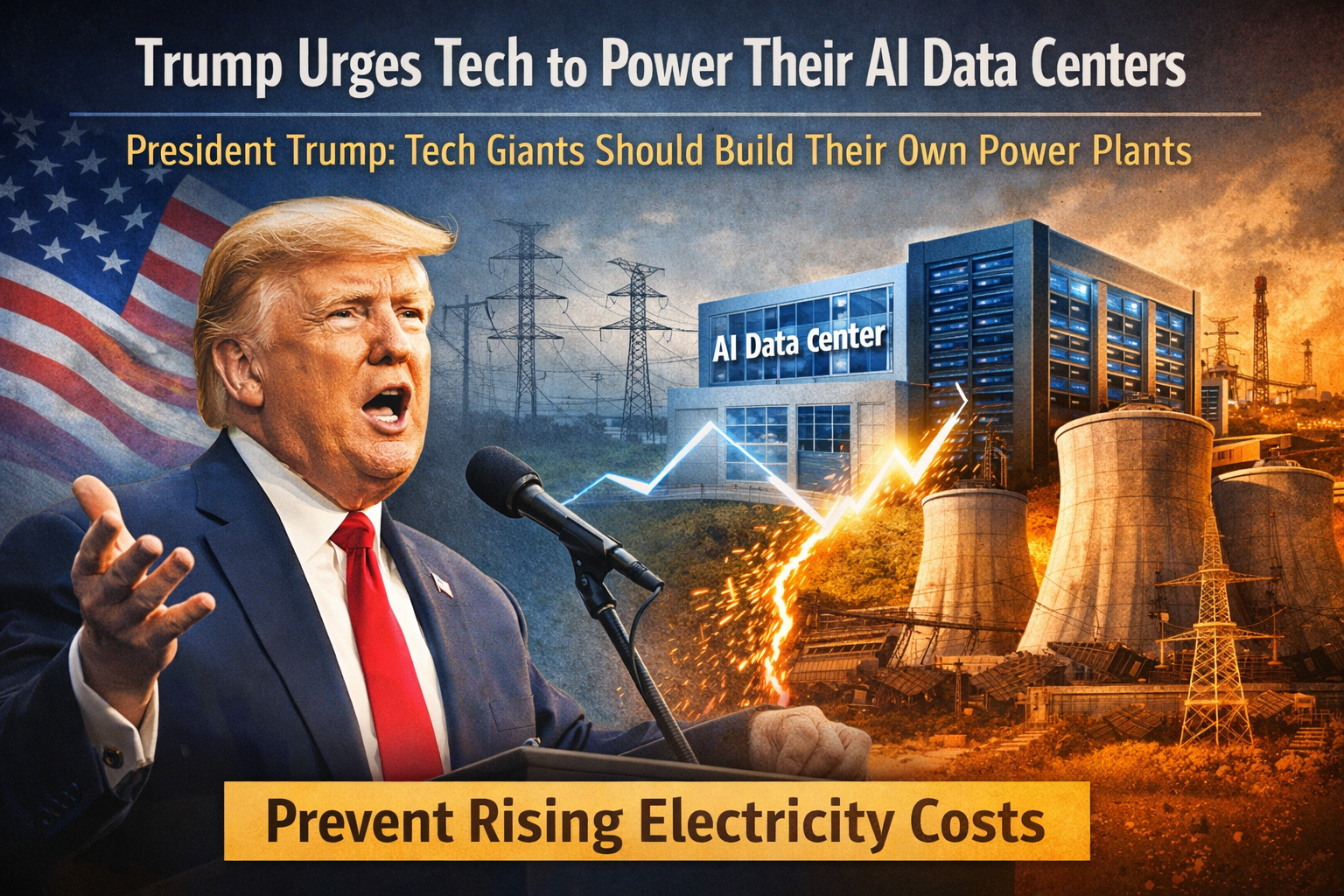
U.S. President Donald Trump announced a new project in a major policy speech on the State of the Union in 2026 to address the increasing electricity demand due to artificial intelligence (AI) infrastructure, in particular, data centers. Trump instructed large technology firms to construct their own power plants or identify dedicated energy sources for their large data centres rather than the shared power grid. His aim, he said, is to cushion the ordinary American consumers against increased electricity bills.
This concept, which the white house calls the ratepayer protection pledge, has become one of the most debatable aspects of the Trump speech. It serves as a manifestation of worries regarding increased energy prices and more extensive discussions of the ways of reconciling the fast development of AI with the demands of the national infrastructure.
Why Data Centers Are a Growing Power Problem
The powerhouse of modern technology is data centers. They archive and execute large volumes of data and operate elaborate AI systems, including cloud infrastructure, generative AI systems, and machine learning procedures. As the use of AI grows exponentially, these facilities are using enormous amounts of electricity, at times up to whole cities. This energy demand has strained the current power grid in the U.S and has contributed to the escalation of electricity prices in regions surrounding these plants.
Conventionally, companies are interconnected to local utilities, which provide electricity in residential and industrial premises. However, with the skyrocketing demands in data center electricity usage, the utilities have at times not been able to cope without having to hike the cost of power to the ordinary consumers. The increase in rates has already turned into a political problem, and that is whythe Trump administration chose to do something about it.
What Trump Announced in His Speech
In his speech to Congress on February 24, 2026, Trump stated that large tech corporations should assume responsibility to supply massive power to their AI centers. He urged them to establish their own power plants that would be directly connected to their plants to prevent congestion of the current grid in the eyes of the population.
His idea would ask the big tech firms to consider that it is their responsibility to supply their own electricity, and it would reduce the electricity costs of all other consumers, as the data centers would not be overburdened by demand-related concerns.
Understanding the “Ratepayer Protection Pledge”
This policy is centered on the Ratepayer Protection Pledge. Although there is no authoritative force of law behind the announcement, the White House intends to convene tech companies in a formalized meeting to formalize this promise in a meeting on March 4. Some of the strongest tech giants would be expected to take part under this commitment, as Microsoft, Amazon, Google and Meta, Anthropic, xAI, Oracle, and OpenAI, would either build their energy plants, purchase dedicated capacity or invest in new infrastructure such that the residential consumers in the neighborhood are not affected with hiked utility bills.
The officials claim that the pledge was aimed at safeguarding the ratepayers, the common Americans, against the burden of funding the huge AI architecture buildouts. Critics, however, add that since the pledge is voluntary and non-binding,g it can only be effective depending on the level of seriousness with which companies execute.
Tech Companies’ Response So Far
After Trump’s announcement, several companies publicly expressed support for the idea, though specifics vary. Microsoft and Anthropic, two major AI infrastructure players, have already made commitments geared toward offsetting their energy impact or investing in grid improvements.
Microsoft, for example, has announced plans to pay full utility rates and support additional power generation to help balance supply and demand. Other firms are considering or already building on-site power solutions, including natural gas or renewable sources, to ensure data centers have reliable electricity without overloading the grid. However, it remains unclear how all companies will meet these pledges, especially smaller tech firms or those with less financial capacity than the largest players.
Grid Challenges and Local Opposition
Energy experts and grid operators have also weighed in. The nation’s largest grid operator, PJM Interconnection, has warned that surging demand from data centers could strain the power grid unless large users either generate their own supply or limit usage during peak hours. This means that even without Trump’s initiative, the power system needs to adapt quickly to changing demand patterns.
Local communities have voiced objections to data center projects when they worry about higher electricity costs or environmental impacts. Some regions have already seen delays or opposition to new data center constructions because of their energy needs another reason why political leaders are looking for solutions today.
Environmental and Energy Debate
While the focus of Trump’s plan is primarily on consumer electricity bills rather than carbon emissions, many energy experts point out that data centers have environmental implications. Many off-grid or on-site power plants currently being developed use natural gas, which produces more greenhouse gases than cleaner energy sources.
Critics argue that without a strong push toward renewable energy or clean power solutions like solar, wind, or advanced nuclear, the increased reliance on fossil fuel-based on-site plants could worsen carbon emissions over time. However, integrating cleaner technologies at scale raises its own challenges, including higher costs and longer development timelines. These debates are likely to shape future discussions about how to balance economic, environmental, and consumer interests.
Political Context and Timing
This announcement comes at a politically sensitive moment. With midterm elections approaching later this year, rising electricity bills have become a major concern for voters in many parts of the United States. Political analysts note that the Trump administration’s emphasis on consumer protection through this tech pledge is also a political strategy to address public dissatisfaction with rising costs of living.
In addition, the global AI race, particularly competition with China, remains a strategic priority for the U.S. government, and ensuring data centers can scale without collapsing local energy infrastructure is part of that effort.
Editorial Insight: Why This Matters
As an experienced news editor, it’s clear this initiative is more than just a technical energy solution; it’s a policy response to multiple pressures. Rapid growth in AI and data services is transforming economies, but also stretching existing infrastructure. Data centers powering AI workloads require electricity on a scale few industries have seen before, and waiting for outdated grid systems to catch up could slow innovation or burden consumers.
The Trump plan attempts to shift responsibility for infrastructure costs to large technology corporations. In theory, this could protect ratepayers, encourage private energy investment, and reduce political friction. But the details matter, and without binding requirements or clear enforcement, the success of this approach will depend largely on corporate follow-through.
At a minimum, this policy signals that energy, technology, and politics are increasingly interconnected. In a world where AI influences everything from commerce to national security, governments and tech companies must work together to ensure the foundations powering these technologies, like electricity and infrastructure, are sustainable and fair.