
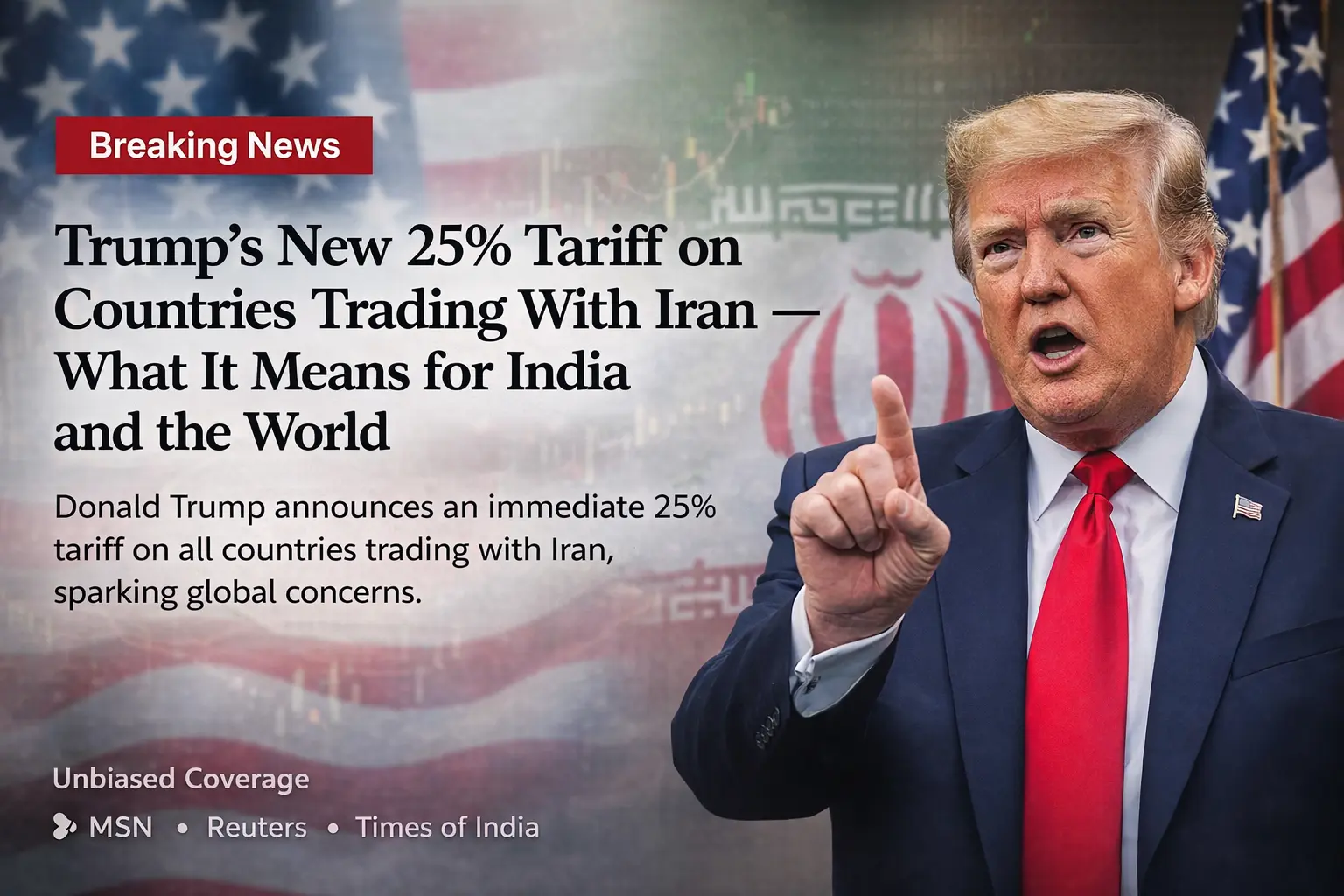
In an announcement that has caused ripples around the world markets and diplomatic communities, U.S. President Donald Trump declared on January 12 that any nation that conducts business with the Islamic Republic of Iran will be subject to a 25% tariff on all trade with the United States, immediately. The announcement, made through the social media platform Truth Social by Trump, had no specific legal paperwork or enforcement strategy, but it is a significant development in U.S. trade and foreign policy.
What the Tariff Announcement Says.
The post by Trump was short, yet general:
Any Country transacting business with the Islamic Republic of Iran will be subject to a Tariff of 25 percent of any and all business carried on with the United States of America, effective immediately… This order is conclusive and final.
The general wording leaves much to be desired, especially the definition of what is meant by doing business with Iran, how the U.S. will monitor such dealings, and whether services are included as well as goods. Critics observe that the tariff has the potential of disrupting the current agreements and would rekindle trade relations with key economies.
Impact on India
Direct Trade Exposure Limited, But Risks Loom
The official exposure of India to Iranian trade has been on the decline in recent years, and according to the government sources, the new U.S. tariff may have little direct effect on the total volume of Indian trade with Iran. Indian trade with Tehran was already reducing because of sanctions and economic turmoil, with key exports like basmati rice being cancelled and delayed in delivery to Iran because of political unrest in the country.
Nonetheless, this announcement has rocked Indian markets. The Sensex and Nifty indices were down as investors took into consideration the geopolitical risk and its potential implications on trade between Iran and the U.S.
Chabahar and Under Pressure Strategic Projects
Strategic projects of India, like the development of the Chabahar port in Iran, which was considered a key linking point to Afghanistan and Central Asia, became uncertain once again. Although previous U.S. governments issued waivers for this project because of its developmental importance, Trump’s overall tariff announcement casts doubt on that perception.
Diplomatic Tightrope
New Delhi now faces a foreign policy dilemma: maintain strategic independence and alliances in other regions while responding to an apparent American ultimatum. The government of India has not given a detailed reply, but the analysts have stressed the necessity of maintaining bilateral relations with the U.S. as a major economic and strategic partner, despite its historic relations with Iran.
Economic and Strategic Implications for the World Economy
Targeted China and Other Partners
China is the largest trading partner of Iran, followed by countries such as Turkey, the UAE, and India. The tariff imposed by Trump may have a significant impact on the exports of these countries to the U.S., as there is an extra charge on the existing duty. China has already condemned the U.S. strategy, saying that nobody wins in a tariff war and that it would protect its interests.
Analysts observe that this action may threaten a weak trade truce between Washington and Beijing and may once again unleash tariff wars that have already rocked markets and supply chains.
Mechanics, Legal Problems, and Market Sentiment
The White House has yet to provide a lot of clarity on the legal authority on which the tariff is based. The history of Trump using the International Emergency Economic Powers Act (IEEPA) to issue general trade policy is currently being reviewed by the U.S. Supreme Court, which may help establish whether such executive action is constitutional without congressional authorization.
These uncertainties have elicited volatility in financial markets. In other markets around the world, equity and commodity markets reacted to rising trade tensions and geopolitical unrest in the Middle East.
Geopolitical Conditions: The Internal Strife in Iran
Trump’s tariff announcement coincides with some of the largest protests in Iran since 1979. The Iranian economy is on the verge of collapse, the inflation rates are high, the currency is depreciating, and the civil unrest is so elevated that it has resulted in fatal crackdowns at some point. Trump and some of his advisors have associated economic isolation with more comprehensive pressure measures against Tehran.
The foreign minister of Iran has retaliated in different media houses, saying that he is ready to protect national interests, even at the cost of war.
Expert Perspectives
Foreign policy specialists and economists disagree:
Others claim that the tariff is more of a symbol, and it is not likely to discourage large trading partners such as China or India from furthering their economic relationships when there is a wide definition of the term “doing business.”
Some caution that it might trigger a re-escalation of ancient trade wars, supply chain distortions, and incentives for countries to diversify out of U.S. markets in the long run.
The critics of the U.S. government at home argue that attacking major allies can eventually be disastrous to American consumers and businesses by increasing the price of imported products and weakening diplomatic alliances.
My Editorial Perspective
As a veteran news editor who has witnessed this turn of events, the abrupt tariff announcement is indicative of a change of strategy, which confuses the customary boundaries between trade policy and geopolitical coercion. The tariff is so general but so imprecise in its application that it threatens to destroy the international standards of predictable and rule-based trade. Nation after nation now has to reconsider long-term policies not only in terms of economy but also of diplomatic orientation, energy security, and supply-chain resiliency.
For India, it’s not just bilateral trade volumes with Iran. The bigger challenge is to sail through great-power politics and still have independent foreign policy decisions. The historical policy of strategic independence by New Delhi can be questioned because it aims to enhance its relationship with the U.S., counterbalance China, and ensure stability within its extended neighborhood, all under the shadow of unilateral trade sanctions.
Global markets and policymakers must brace for heightened uncertainty. The clarity of this tariff threat to change trade alliances or merely increase the noise in existing geopolitical disputes will be determined by how well this threat is enforced and how determined the involved nations are.