
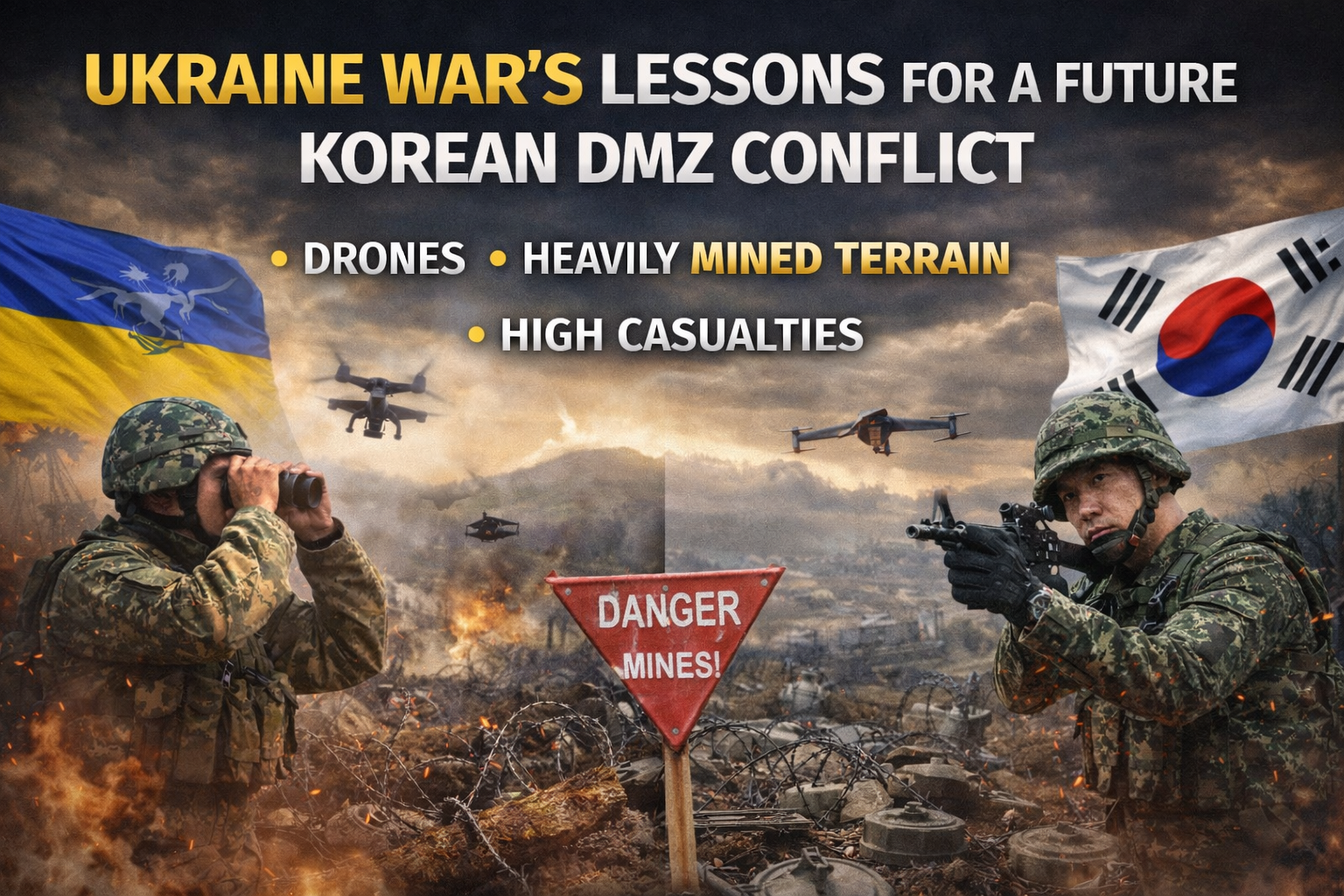
With the Russian invasion of Ukraine entering the fourth year, military observers are increasingly looking to the conflict as a lesson of how future ground wars may be fought in other regional flashpoints, most notably the Korean Demilitarized Zone (DMZ). In original reporting by UPI Korea Regional Review, analysts discuss the changing nature of warfare in Ukraine and its potential impact on the strategic planning and operational concept of a potential full-scale war in the Korean Peninsula, an event that has long been feared but never materialized since the armistice was signed in 1953 to the two nations, ending the active hostility. The discussion highlights that the dissimilarity between Eastern Europe and Northeast Asia in terms of geographical and political setting is, nonetheless, not the only lesson to be approached harshly by the incursion of brutal lessons of the modern mechanized and technology-intensive warfare in Ukraine, which can teach and guide policy-makers and military planners on the right and left sides of the DMZ alike.
The major idea of the UPI analysis is straightforward yet unglamorous: in the event of any future ground war along the Korean DMZ it would be incomparably brutal, densely saturated with unmanned systems, and highly contested on both electronic and information planes, as well as as destructively attrition-intensive as the battlefields of Ukraine. These conclusions represent ground-truth experience based on years of battle experience in which combined arms operations, drone saturation, and deep defensive positions have determined the brutal nature of the war not the rapid armored break out that was envisioned in the Cold War-era doctrine but a grinder, expensive affair that has shaken both tactics and strategy.
The Changing Face of Ground Combat in Ukraine
The conflict in Ukraine has challenged numerous established ideas of the conventional ground warfare. Instead of the lightning armored strike that was expected by Western armaments theorists at the very beginning of the war, both Russian and Ukrainian sides have been in trench battles of World War I and terror-tech of the twenty-first century surveillance and precision strike capabilities. Large combat units and small off-the-shelf drones of various types swarm the battlefield, making hiding hard and turning the ground battle into a sensor-saturated battlefield. The infantry movement and vehicle maneuver have to change radically under constant aerial surveillance and threat of strikes as aerial drones act within a saturated zone at least 15 km ahead of front lines, as recent military analysis observes. This congestion has prefigured movement being predictable, and susceptible, on what would otherwise be moving lines.
Simultaneously, Ukraine and Russia have altered some fundamental doctrines on combined arms coordination. Close concert between small infantry units and mechanized aspects and unmanned systems is achieved. Occasionally, the nature of reconnaissance never really ceases; continuous monitoring of the battlefield by drones, satellites, and electronic surveillance keeps commanders of the battlefield informed as to the enemy location. This real time visibility has lowered the veil of secrecy around maneuver by a great margin and exposed traditional massed formations. The outcome in Ukraine has been an expensive yet unambiguous illustration of the fact that current ground fighting is not only technologically sophisticated but also attritional.
Lessons for the Korean Peninsula
The implication of the combat patterns of Ukraine is important to planners who consider how a future conflict will develop along the Korean DMZ. The geography of the peninsula, that plain plains are on the west, and rugged hills on the east, with highly populated urban areas around the most important population centers would make any offensive or defensive operation, on a large scale, difficult. Combined with the development of unmanned aerial and ground capabilities, the DMZ surrounding territory might turn into a hot spot where high-intensity warfare is raged by real-time visibility, quick acquisition of targets, and automation.
Analysts warn that a serious drone environment, such as Ukraine, would also occur in Korea. A war between North Korea and South Korea would be characterized by a eruption of swarms of drones by both parties as they strive to detect and kill the opposition. This would force every combatant to spend a lot of money on counter-UAV systems, electric warfare and safeguards of the key communications infrastructure. Practice in Ukraine demonstrates that without proper counter-measures, even small unmanned systems are capable of decreasing the effectiveness of traditional ground forces and shift in the direction of doctrinal forces.
The other important lesson is the high level of integration of logistics and sustainment during long-term conflict. The front lines in Ukraine revealed that the supply chains, resupply bases, and maintenance facilities are the major targets of the war of attrition. The ability of the forces to defend themselves at the first line of fire and remain there was the cornerstone of any breakthrough or retaliation along the DMZ. The situation in Ukraine, where logistics was disjointed, and infantry movement was slow and on many axes, serves to illustrate the importance of supply chains when the conflict extends past days and into months.
The Human Dimension and Escalation Risks
The most chilling experience about the ground combat in the Ukraine is perhaps the horrific price it pays both the personnel and the civilians. The number of casualties is still controversial and incomplete, yet researchers estimate that tens of thousands of combatants were killed or injured in fighting- and the civilian ones are increasing as cities and towns are involved into combat. The volume of such attrition highlights the human toll of a high-intensity ground war and the constraints of even strong professional forces to take casualties without an ensuing strategic impact.
In the Korean Peninsula, a number of millions of civilians within artillery reach of the DMZ would tend to increase humanitarian stakes. It is possible that with use of drone surveillance and modern precision-guided munitions, urban areas will become deadly within hours. Ukraine has presented us on multiple occasions with how cities turn into spaces of extended conflict and pain, with defensive strategies, fortifications, and rebel posts mixing with the infrastructure of civil society, civilian infrastructure. A major ground war in Korea would most likely engage several population centres, and would make the devastating effects in Eastern Europe even more widespread.
Dynamics of escalation are also an issue. A confrontation across the DMZ would place the big power squarely in the arena unlike the case in Ukraine, where NATO intervention has been highly balanced to prevent the escalation of war. The United States has formal defense obligations to South Korea. Such a strategic background would render the risks of escalation urgent, possibly attracting China and other neighbors, compared to the more limited European arena.
Technological Shifts and Modern Doctrine
The war in Ukraine has also illustrated how emerging technologies reshape warfare. From the proliferation of low-cost consumer drones used for reconnaissance to advanced electronic warfare suites and AI-enhanced targeting systems, the modern battlefield has become exponentially more sensor driven than ever before. Ukrainian and Russian forces alike have had to adapt to an environment where information moves as fast as firepower and can be just as lethal if misused or compromised.
This emphasis on information dominance and networked operations presents a dual challenge for future ground wars. On the Korean Peninsula, where terrain masking, electromagnetic interference, and underground facilities could affect communications, robust and secure battlefield networks would be critical. A conflict marked by contested spectrum and cyber vulnerabilities would need heavy defense planning to prevent paralysis of command and control systems—issues that have repeatedly surfaced in Ukraine amidst electronic attacks, jamming, and network disruptions.
Moreover, the increasing use of autonomous and semi-autonomous systems in ground combat may introduce ethical and operational dilemmas that traditional military doctrine has not fully addressed. In Ukraine, both sides have experimented with robotic platforms and unmanned ground vehicles that can carry munitions or serve logistic functions. The integration of these systems will almost certainly feature in any future Korean contingency, raising questions about decision-making, accountability, and the pace of engagement in fast-moving conflicts.