
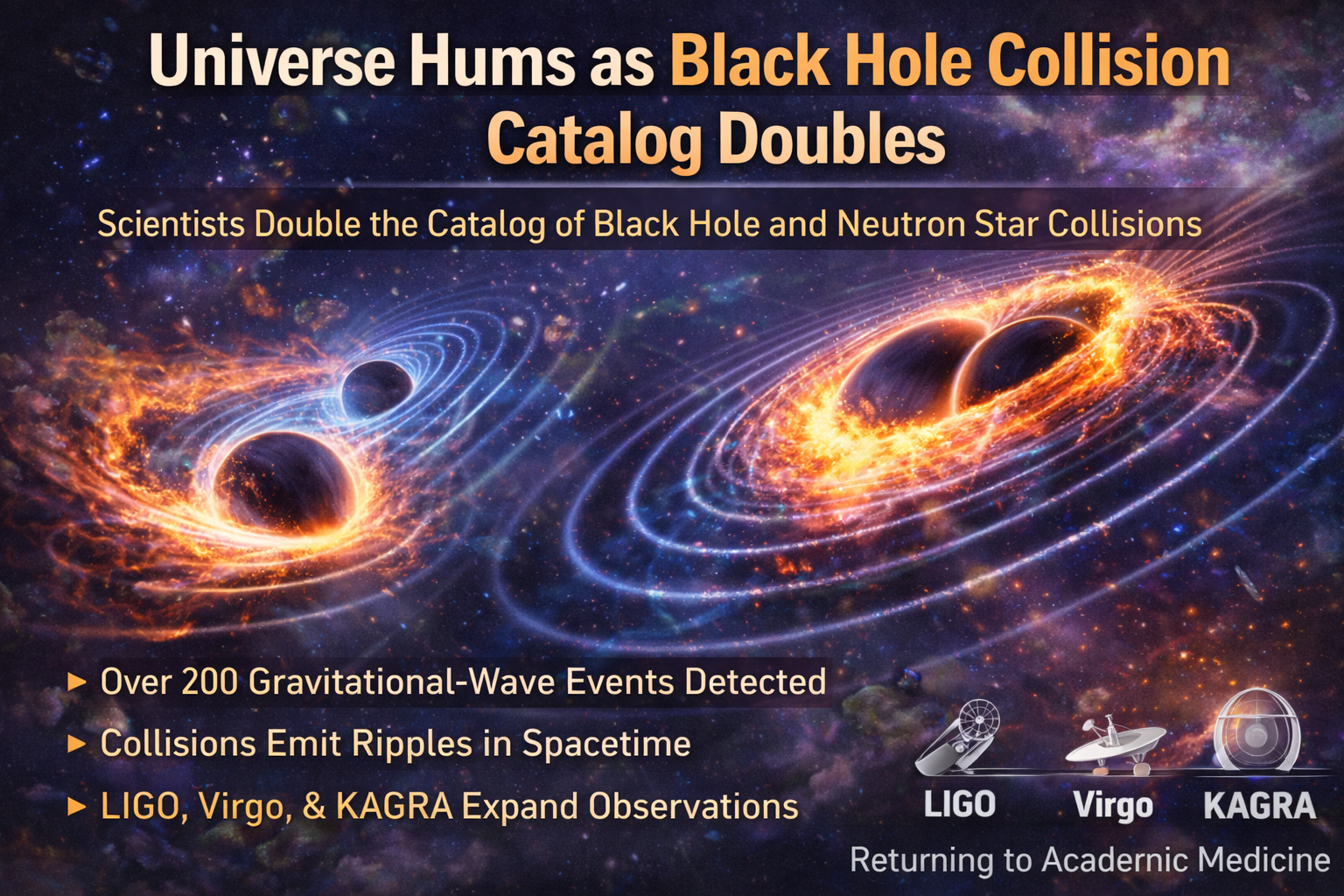
Astronomers have taken a major step forward in understanding the violent events that shape the cosmos. A new release of gravitational-wave data has more than doubled the number of known collisions between black holes and neutron stars, revealing that the universe is constantly vibrating with ripples in spacetime. These faint signals, known as gravitational waves, originate from some of the most extreme cosmic events ever observed. The discoveries come from the international collaboration between the Laser Interferometer Gravitational-Wave Observatory (LIGO) in the United States, Virgo in Italy, and the KAGRA detector in Japan. Their combined observations are offering scientists an unprecedented view of the hidden dynamics of the universe.
The latest catalog of gravitational-wave signals shows that cosmic collisions are far more common than scientists once believed. Instead of being rare phenomena, mergers between massive objects appear to occur regularly across the universe. Each event sends out waves through the fabric of spacetime, allowing astronomers to detect them from billions of light-years away.
Understanding Gravitational Waves
Gravitational waves are distortions in spacetime predicted by Albert Einstein’s theory of general relativity more than a century ago. They occur when extremely massive objects accelerate, particularly during events such as black hole mergers or neutron star collisions. These waves travel outward from the source at the speed of light, stretching and compressing space as they move through the universe.
However, by the time these waves reach Earth, they become incredibly faint. Detecting them requires highly sensitive instruments capable of measuring changes thousands of times smaller than the diameter of a proton. The LIGO observatories in Washington and Louisiana, along with Virgo and KAGRA, use laser interferometers to measure these tiny disturbances. Together, they form a global network capable of identifying gravitational waves from deep space.
Since the first confirmed detection in 2015, gravitational-wave astronomy has transformed our understanding of the universe. What was once theoretical physics has now become an observational science.
A Catalog That Doubled in Size
The newly released gravitational-wave catalog represents one of the most significant expansions in astrophysical data in recent years. The catalog now contains more than 200 candidate signals originating from compact binary mergers involving black holes and neutron stars. This new dataset includes 128 additional gravitational-wave events discovered during the fourth observing run of the international detector network.
Before this update, scientists had confirmed around 90 gravitational-wave signals from earlier observing runs. With the addition of the newly identified events, the catalog has more than doubled in size. The expanded dataset allows astronomers to analyze patterns in these cosmic collisions and better understand how black holes form, evolve, and interact with other extreme objects in the universe.
Researchers say the findings show that the universe is effectively “humming” with gravitational waves produced by countless distant mergers. These signals are not isolated events but part of a continuous background of cosmic activity occurring across billions of galaxies.
Black Holes and Neutron Stars: Cosmic Heavyweights
Most of the newly detected signals originate from mergers between pairs of black holes. When two black holes orbit each other, they gradually spiral inward as they lose energy through gravitational radiation. Eventually, they collide and combine into a single, larger black hole, releasing enormous amounts of energy in the form of gravitational waves.
Some events involve neutron stars, which are the incredibly dense remnants of exploded stars. A neutron star packs more mass than the Sun into a sphere only about 20 kilometers wide. When neutron stars collide with each other or with black holes, the resulting gravitational waves provide scientists with valuable insights into extreme physics.
These events also help astronomers investigate questions about the nature of matter under extreme pressure, the formation of heavy elements, and the behavior of gravity itself.
The Most Powerful Cosmic Collisions
Among the discoveries included in the new catalog are several remarkable events. One particularly notable detection involved the merger of extremely massive black holes that ultimately formed a final black hole roughly 225 times the mass of our Sun.
Events like these provide valuable information about how massive black holes form and grow. Scientists believe that some of these objects may originate from earlier mergers, gradually building larger black holes over time. Observing these events also allows researchers to test fundamental predictions of Einstein’s theory of general relativity under conditions that cannot be recreated on Earth.
Some of the gravitational-wave signals also come from unusual systems where the two merging objects have very different masses or unusual spin patterns. These rare systems offer clues about the environments in which such objects form, such as dense star clusters or regions of intense stellar evolution.
A New Era of Gravitational-Wave Astronomy
The dramatic increase in detections is largely due to improvements in detector sensitivity and the expansion of the global observatory network. As instruments become more precise, scientists are able to detect weaker and more distant signals than ever before.
Today, LIGO and its partner observatories detect black hole mergers at a surprisingly regular rate. In fact, modern gravitational-wave observatories can observe such events roughly once every few days.
This steady stream of detections marks the beginning of what scientists call gravitational-wave astronomy. Unlike traditional telescopes that observe light, gravitational-wave detectors allow researchers to study the universe through the motion of spacetime itself. This opens an entirely new window into cosmic phenomena that may not emit visible light.
For example, many black hole mergers occur in regions of space that are completely dark to traditional telescopes. Gravitational waves allow scientists to detect these invisible events and study them in detail.
What These Discoveries Mean for Cosmology
The expanded catalog of gravitational-wave detections has important implications for astrophysics and cosmology. By studying the frequency and distribution of these events, researchers can better estimate how often black holes and neutron stars form and merge throughout the universe.
These observations may also help solve longstanding mysteries in cosmology. For example, gravitational waves could contribute to understanding the rate of cosmic expansion, a topic known as the “Hubble tension,” which refers to discrepancies between different measurements of the universe’s expansion rate.
In addition, the data allows scientists to examine whether Einstein’s theory of gravity still holds true under the most extreme conditions imaginable. So far, every gravitational-wave observation has supported the predictions of general relativity, strengthening confidence in the theory.